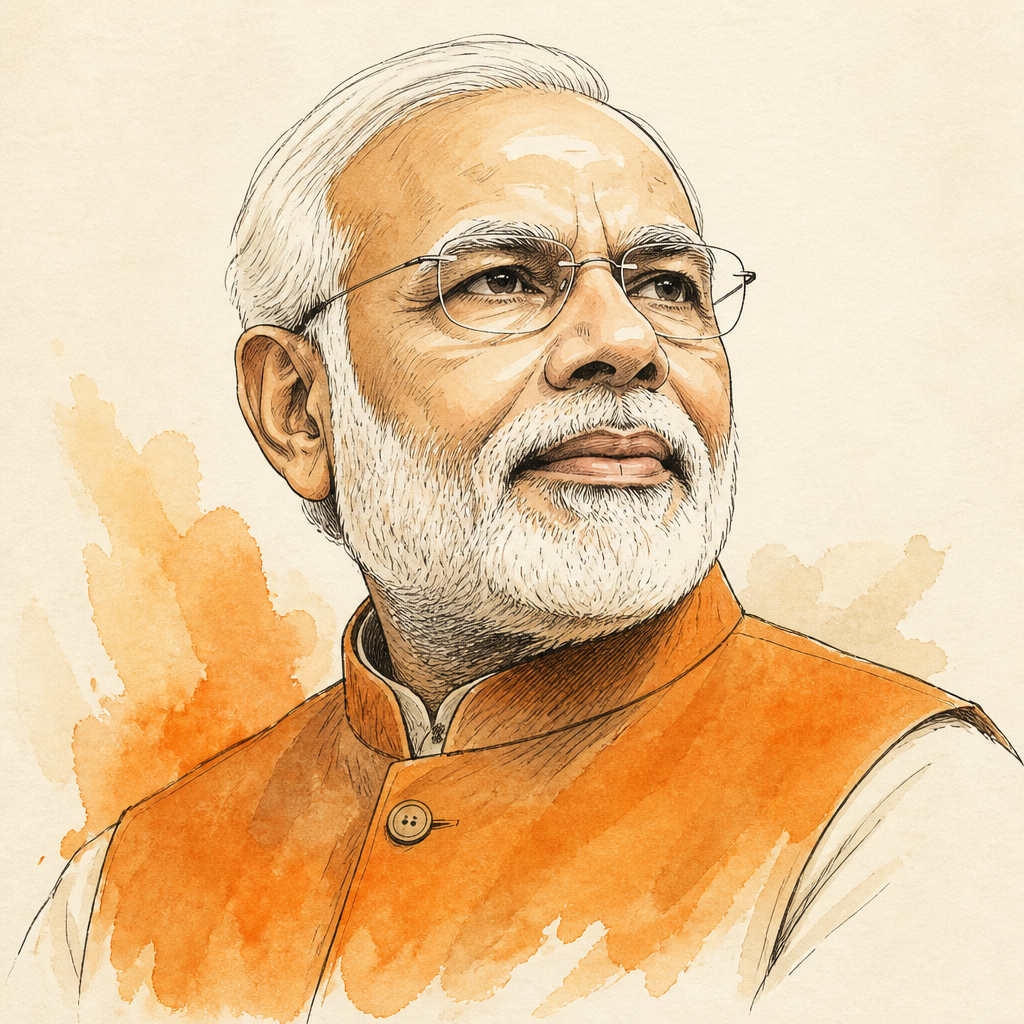
The Photograph That Wasn't Taken
Somewhere in Shenzhen this week, two men who answer to no electorate worth the name stood close enough for the cameras to call it a bear hug. Xi Jinping and Donald Trump, arms near shoulders, smiles doing the diplomatic work that neither man's institutions are built to do on their own.
It made for a good photograph. It is worth asking what, exactly, it produced besides the photograph.
Narendra Modi was not in that picture. Nor should he need to be. India does not run its foreign policy through bear hugs, because India's prime minister, however large his majorities, still has to answer — eventually, imperfectly, but actually — to Parliament, to courts, to a press that argues with him, and to voters who can and do throw governments out. That is a duller kind of power than a staged embrace. It is also the only kind that survives contact with an election.
Tables, Not Hugs
Look at where the real arguments of the day are actually happening. A draft deal is circulating to keep the climate summit from collapsing. Diplomats in another room are failing, again, to agree on legally binding rules for autonomous weapons — the so-called killer robots that no single leader, however charismatic, gets to approve alone. These are not photo-op venues. They are grinding, multilateral, committee-bound rooms where a country's weight is measured in coalitions built, not embraces performed.
India belongs at those tables not as a favor granted by Washington or Beijing, but because it is the one democracy on earth large enough to matter in climate math, in arms-control math, in almost any math that involves a sixth of humanity. The question worth asking is not whether India gets invited. It is whether India uses the seat to build rules, or merely to collect photographs of its own.
The Ledger at Home
And here the essay has to be honest rather than flattering. The same week carries a UN finding that one in four women worldwide cannot refuse sex within their own marriage. That is not a headline about a far-off dictatorship. It is a mirror held up to every democracy that likes to export its values before it has finished installing them at home — India included, alongside plenty of others who should not feel smug reading this from a comfortable distance.
The golden rule does not pause at the border of a household. A government that wants a voice on the world stage earns credibility for that voice the same way it earns a vote: by the consent it actually protects inside its own kitchens, not only the speeches it gives in someone else's conference hall.
What Size Buys You
Here is the standpoint, plainly stated. Size without institutions is just Russia or China with better weather. Institutions without size are Denmark — admirable, but not decisive at a table of eight billion people. India has both, unevenly, imperfectly, but genuinely: courts that still rule against governments, a press that still prints uncomfortable numbers, elections that still change outcomes. That combination is rarer than it looks from outside, and rarer still than the bear-hug diplomacy currently fashionable among men who no longer need to count votes.
The temptation, as any large democracy grows confident, is to start envying the simplicity of the strongman's method — one handshake, one headline, no committee. Watching for that drift, in New Delhi as much as anywhere, is not hostility. It is the ordinary vigilance a free people owes itself.
The world does not need India to out-hug anyone. It needs India to keep showing up at the rooms where killer robots get regulated and carbon gets counted, and to keep making sure the rules it argues for abroad are the rules it is willing to live under at home. That is a less cinematic kind of leadership. It is also the only kind that outlasts the term of office, the photograph, and the man.