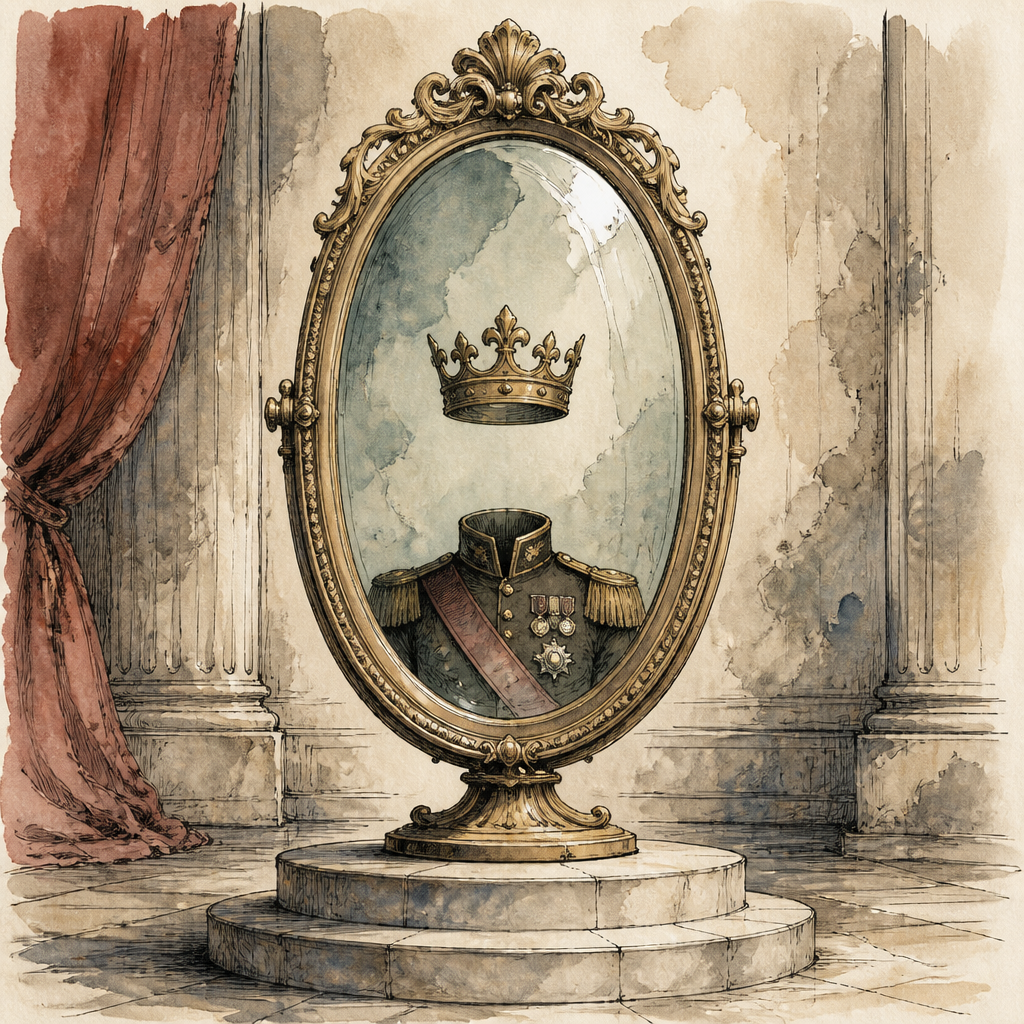
The Vanity of Not Looking
Every strongman owns a mirror. He simply never uses it.
Why would he? He already knows what he would see: a wise father of the nation, chosen by history, perhaps by God, certainly by himself. Checking would only waste time he could spend being right.
This week's global conversation offers a tidy comparison between two kinds of leadership: the kind that must keep checking the mirror, and the kind that has smashed it.
The Ugly Mirror of Democratic Mess
In Taiwan, Taipei's mayoralty just went to the opposition, fending off a candidate aligned with Beijing's preferences. Beijing, famously, prefers elections that confirm what it already believes about itself. Taipei's voters, less famously but more usefully, preferred to check.
In Israel, rival leaders are sitting down to break an election deadlock — not a cinematic breakthrough, just the grinding, undignified business of coalition arithmetic. It looks like failure. It is actually the system working: nobody gets to skip the mirror by simply declaring the election over.
Spain heads toward a vote that the world, oddly, is watching closely — another reminder that healthy democracies produce suspense, not certainty. Deadlock, recount, coalition talk: these are not the symptoms of a broken political body. They are its pulse.
The Mirror, Removed
Contrast this with Myanmar, where the ruling junta's strikes this week reportedly hit a wedding and a school. No negotiation, no rival candidate to concede to, no opposition mayor to annoy the capital. Just the clean, terrible efficiency of power that answers to no reflection at all.
This is the strongman's actual mirror problem: it is not that he avoids looking and secretly doubts himself. It is that, eventually, there is no mirror left in the room — no free press, no rival party, no independent court — to show him anything but his own intentions reflected back as fact. Certainty, taken far enough, stops being a character flaw and becomes a weapons system.
Institutions Need Mirrors Too
Even international institutions aren't exempt. As the race to replace the outgoing UN Secretary-General continues, one candidate associated with the UAE's prior role in Sudan is reportedly trying to separate her candidacy from that record, insisting she no longer speaks in that capacity. Fair enough — people change jobs. But the question worth asking isn't whether she can say she's no longer that official. It's whether the institution she wants to lead is willing to hold up its own mirror and look, rather than accept the candidate's preferred angle of reflection.
That, too, is a small authoritarian temptation: to let the subject write the caption under their own portrait.
A Reasoned Preference
Here is the standpoint, plainly: prefer the ugly mirror to the flattering portrait, every time.
A coalition negotiation that drags on for weeks is not a failure of leadership; it is leadership agreeing to be examined. A mayoral race that could have gone the other way is not instability; it is a nation refusing a scripted outcome. A candidate forced to account for a prior record is not persecution; it is the ordinary tax that public life owes to public memory.
The strongman's offer is tempting precisely because it is cheap: no deadlock, no debate, no recount, no inconvenient Sudan record following you into a new job. Just certainty, delivered on schedule.
But certainty without a mirror is not strength. It is a portrait painted in a dark room — confident brushstrokes of a face nobody actually checked.
The healthier habit, however undignified it looks on a given Sunday, is to keep the lights on and the mirror hung where everyone, including the leader, has to pass it on the way out the door.