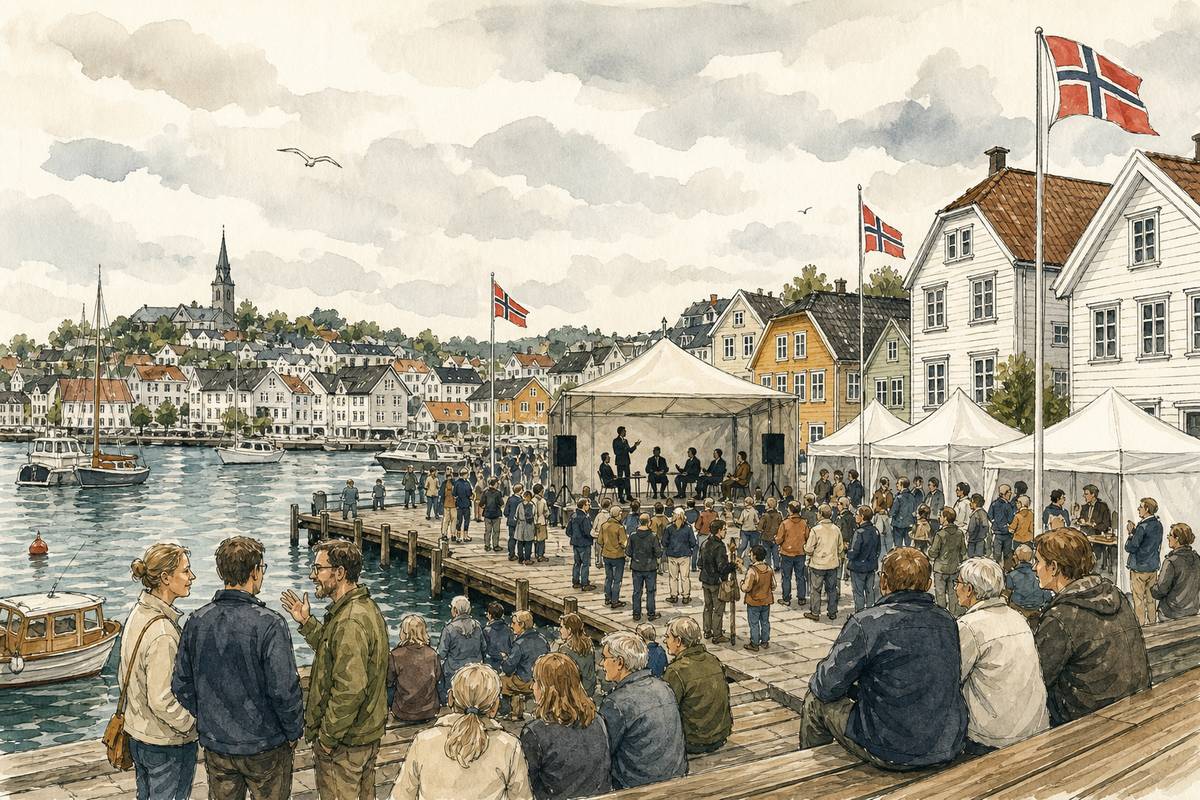
A Fjord Full of Questions
Every August, in a small Norwegian town called Arendal, something faintly absurd happens. Ministers, party leaders, union bosses and teenagers with strong opinions crowd into white tents along the harbor and simply talk to each other. No moat, no motorcade wall, no palace guard. A citizen can walk up to a sitting minister and ask an inconvenient question, and the minister is expected to answer it, in public, without a script written by a strongman's press office.
It sounds unremarkable. That is precisely the point worth noticing.
What the World Brought to the Tents
This week's headlines read like an agenda no festival organizer would dare invent, and yet they are the very material such tents exist to digest.
In Zambia, vote counting resumed after a pause caused by attacks on polling staff, with the ghost of an old rival still haunting the incumbent's camp. Ask yourself: what separates a democracy from a managed spectacle, if not the boring, nerve-wracking discipline of counting every ballot and accepting the count, even the count you dislike?
On the other side of the world, a U.S. senator publicly demanded answers about conditions aboard the USS Lincoln, calling the leadership failing what it was. Compare that to a system where no senator, no journalist, and no citizen may ask such a question of a fleet without risking a cell. The complaint itself, aired loudly, is evidence of health, not decay.
Meanwhile, on Instagram, accounts are reportedly selling paid "advice" to desperate people trying to cross into Ceuta — a private, borderless little authoritarianism of its own, profiting from hope it cannot deliver. And in Afghanistan, NPR reminds us what happens when the tents disappear entirely: girls, and increasingly boys too, losing years of schooling to men who answer to no ballot, no free press, no rival tent down the street.
The Test of Sunlight
Arendalsuka's whole premise is that sunlight is a decent disinfectant — that power exposed to a crowd of ordinary, occasionally rude questioners behaves better than power hidden behind ceremony. This week's news is a rough field test of that idea, run simultaneously in several countries.
Where the tents exist — a Senate hearing room, a contested vote count that still gets finished, a free press asking why a carrier's conditions deteriorated — the failures get named, argued over, sometimes fixed. Where the tents do not exist, the failures simply happen to people, quietly, for years, until the world notices almost by accident.
Two Cheers, Not Three
But let us not applaud too fast. A tent by a fjord is cheap theatre if the sunlight ends when the cameras pack up. Norway can host the world's most civil debate on migration, climate, and military accountability, and still, come autumn, quietly outsource the hard decisions to committees no one watches. Talking shops earn their keep only if talk leads somewhere — a vote, a law, a resignation, a changed budget line. Otherwise the tent is just a nicer building than the palace, and just as good at absorbing anger without changing anything.
The Stance
So here is the measure worth taking home from Arendal, and from this week's news: not whether a country holds a festival of open questions, but whether the answers given there survive contact with power afterward. Zambia's count must be honored once finished. The senator's question about the Lincoln must produce a report, not a shrug. The Instagram predators selling false crossings deserve clear, proportionate law enforcement — not moral panic, not new mountains of paperwork, just consequences that fit the crime.
A tent on a Norwegian harbor cannot fix a Sahel kidnapping, an Ebola outbreak's sixth province, or a Taliban curriculum. But it can keep reminding free peoples of a simple household rule: power that must answer questions in public tends to behave better than power that need not. That is not a Norwegian eccentricity. It is a habit worth exporting, tent by tent, wherever citizens still have the nerve to ask.