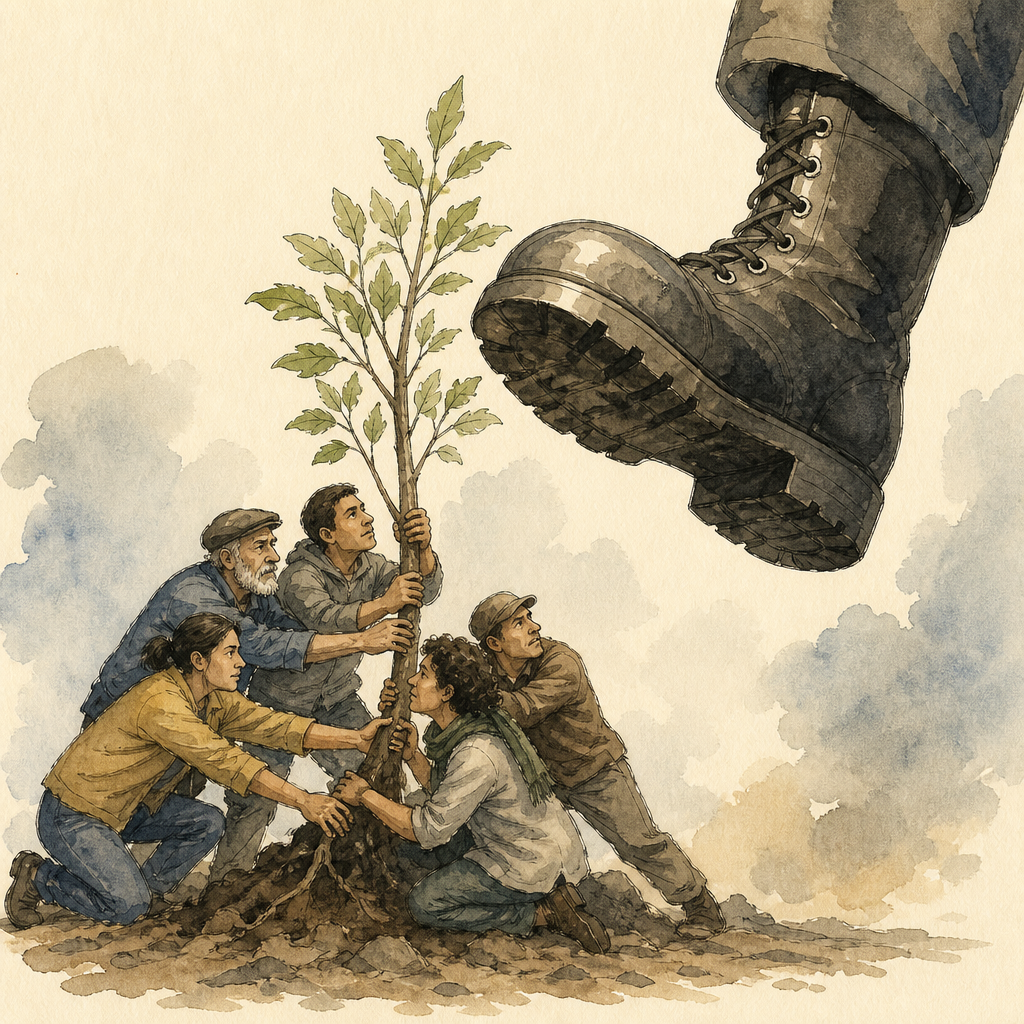
The Easy Backlash
This week a head of state claimed he had personally "convinced" a chip company to reinstate its chief executive. Within hours, the backlash arrived — swift, loud, slightly embarrassed on his behalf. Commentators asked the obvious question: since when does a president hire and fire corporate officers by phone call?
It is worth noticing how easy that backlash was. Nobody had to storm anything. Nobody risked prison. A norm was poked, and the poke was answered in public, in daylight, by people who still believed the norm was theirs to defend. That is what protest looks like when it is still ordinary — cheap, fast, almost boring. Democracies should want more boring protests like this one, not fewer.
The Habit That Grew Teeth
Compare that with a slower story unfolding the same week. Ukrainian naval drones struck Russian ships docked in Benghazi, a harbor a thousand miles from the Donbas. NATO's chief is now promising to defend against threats in orbit, after reports of a Russian nuclear-capable satellite. And NATO states are counting incursions into their own airspace with a frequency that used to be unthinkable and is now, apparently, a line item.
None of this arrived overnight. Each step was once a "first," and each first was answered, at the time, with statements of concern rather than consequence. A habit is a strange animal: small enough to ignore on day one, large enough to require an alliance's defence budget by year ten. The war that now touches a Libyan harbor and NATO's own skies did not begin there. It began with earlier firsts that were, at the time, easier to stop than they looked.
The Arithmetic of Early Courage
Here is the uncomfortable arithmetic: the cost of objecting rises every single time the objectionable thing is allowed to repeat. Objecting to a president's loose talk about firing a CEO costs almost nothing — a headline, an op-ed, a shrug from the markets. Objecting to a tenth border incursion after nine were tolerated costs tanks, treaties, and the attention of a continent.
This is not a call for alarmism about every headline. Most political noise is just noise, and a press that cries wolf at every provocation trains its readers to stop listening. The skill — and it is a skill, not a mood — is distinguishing the habit from the headline. Ask not "is this outrageous" but "is this the second time." The second time is the one worth a letter, a vote, a protest sign, before there is a twentieth.
A Ballot Box Still Works
The same week carried a quieter, more hopeful data point: in the United States, one party won control of the House of Representatives by its largest margin in fifty years. Whatever one thinks of the platforms involved, the mechanism worked exactly as designed — a grievance, expressed through ballots, producing a change of power without a single shot fired or a single border crossed.
That is the comparison worth sitting with. One government's overreach met an electorate's correction, peacefully, on schedule. Meanwhile a war begun with earlier, smaller overreaches now needs naval drones and orbital defence plans to answer it. Both are forms of protest. One was affordable because it happened early and through institutions built for exactly that purpose. The other is enormously expensive because the early version of it was allowed to become routine.
The lesson is not complicated, which is precisely its value. Protest the first incursion, not the tenth. Object to the small overreach while objecting is still ordinary, because by the time it isn't ordinary anymore, objecting looks like war.