A Word Repeated Enough Times
Someone in Washington keeps saying that Canada wants the "benefits" of being an American state. It is said the way a rumour is said — lightly, often, as if repetition were the same thing as truth. Trade talks between the two countries have now collapsed, and the remark surfaces again, like a stone thrown into the same pond until the ripples start to look like the shape of the pond itself.
Here is a modest question, the kind a newspaper that prefers clarity should ask: at what point does a line, repeated often enough, stop being a joke and start being a plan? Nobody can say exactly. That is precisely why the line is dangerous. Habits of power rarely announce themselves. They rehearse.
The Small Machinery of Habit
Authoritarian habits are built the way any habit is built — through repetition and through the absence of consequence. Say a thing once, and it is an opinion. Say it fifty times while nobody objects, and it becomes ambient, then plausible, then, eventually, a premise nobody remembers agreeing to. This is not a claim that any particular leader is plotting annexation over breakfast. It is a claim that democracies which wait for the plot before they object have already given the habit a decade's head start.
Canada's Reply, and Why It Is the Right Size
Mark Carney's government is not storming anything. It is readying retaliatory tariffs and calling the moment, bluntly, a trade war. That is the correct scale of response — ordinary, procedural, entirely within the grammar of two democracies disagreeing. Protest, to be useful, does not need to be dramatic. It needs to be early and it needs to be proportionate. A tariff schedule and a plain sentence — "we are at war, economically, and we will answer in kind" — cost far less than the alternative, which is silence now and grievance later. Reciprocity, after all, is not only a private virtue. Neighbours who will not be spoken of as property should say so before the sentence hardens into policy.
The Same Habit, Different Rooms
Washington's language toward Tehran has also shifted from diplomacy to something its own officials call economic warfare — a phrase Iran's government has been quick, perhaps too quick, to read as an admission of military failure. Meanwhile in the matter of North Korea, the courting of Kim Jong Un continues while Pyongyang raises its price and Seoul quietly wonders whether it is still in the room. Different continents, same instinct: negotiate over the heads of the people who will live with the outcome, and see whether anyone minds. Early courage, in each case, looks unglamorous. It looks like Seoul insisting on its seat. It looks like a finance minister publishing a tariff list instead of a grievance.
A Ballroom, of All Things
Even the small furniture of power deserves a glance. America's Supreme Court is set to rule on a dispute over a White House ballroom — a question, at bottom, about how much a president may reshape the building that belongs to everyone, without asking. It is a minor case. Minor cases are exactly where the habit of asking permission, or not, gets its first quiet workout.
What Showing Up Still Means
Against all this, place a smaller, warmer fact: Britain's prime minister has chosen Kyiv for his first foreign trip, to say plainly that support for Ukraine continues. NPR calls this a "post-American world," and the phrase need not be mourned. If the old assumption — that one country will always lead — is loosening, the useful response is not despair but rehearsal: other democracies practising the muscle of showing up, of objecting, of paying the tariff and making the visit, before the muscle is needed for something larger.
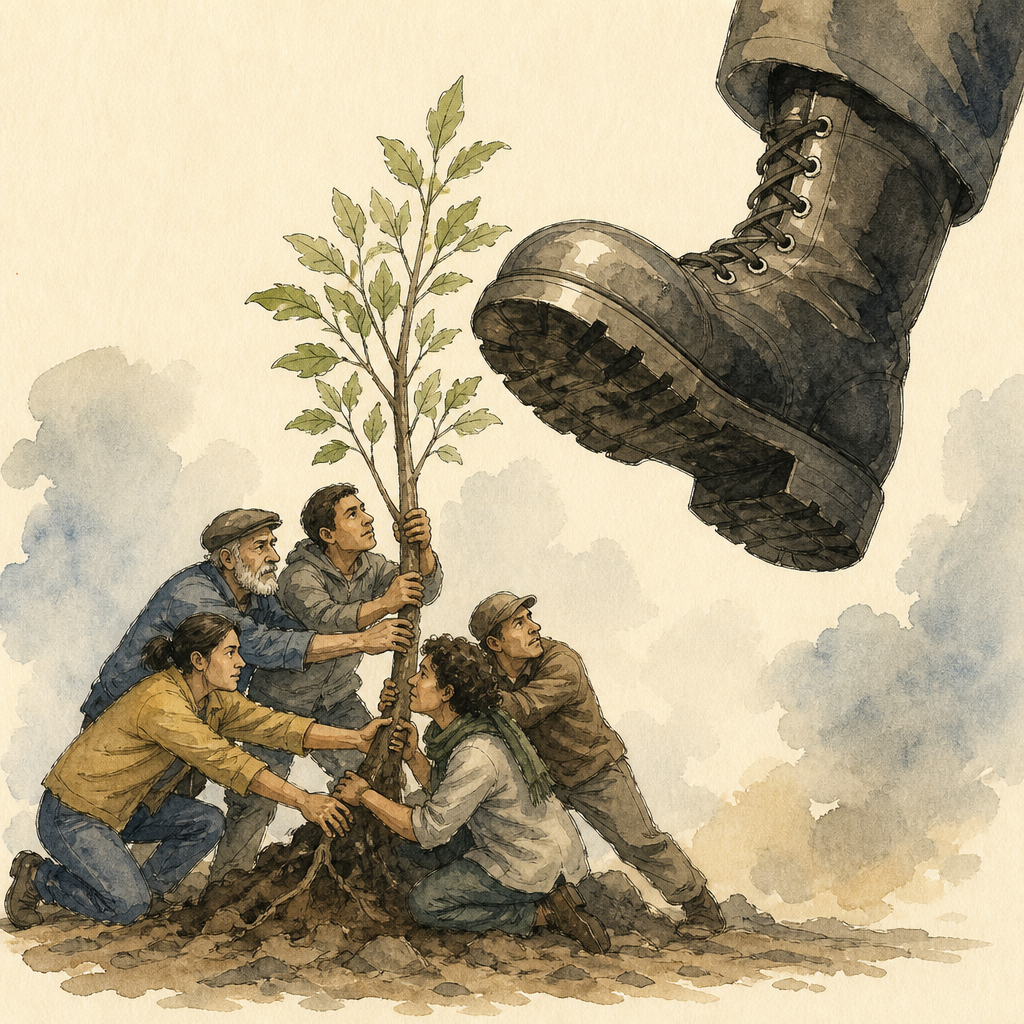
That is the whole argument, and it is not a complicated one. Protest is cheap while the offence is still just a habit — a remark, a tariff dispute, a ballroom. It becomes expensive once the habit has calcified into a claim. Canada's tariffs, Seoul's insistence, Britain's visit to Kyiv: none of these are heroics. They are the ordinary, unglamorous, exactly-on-time courage that keeps jokes from ever needing to become borders.