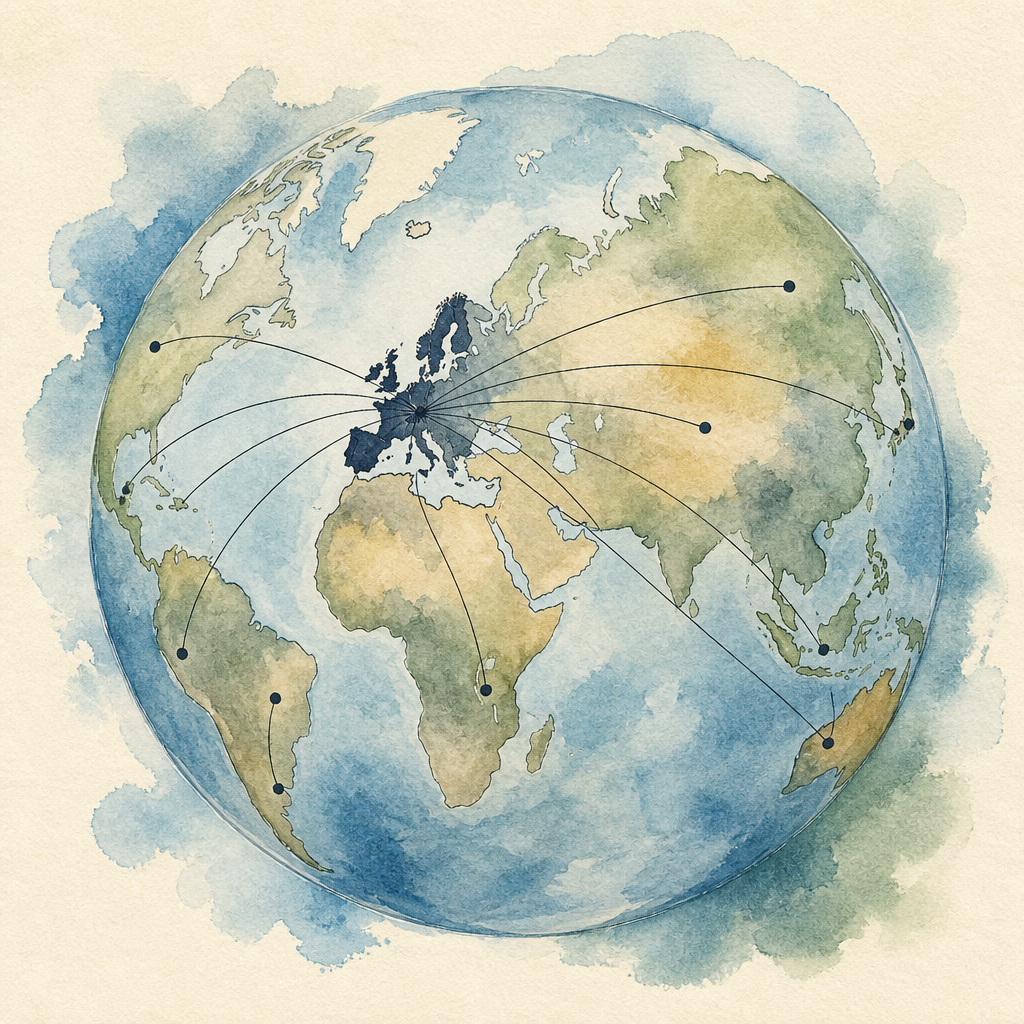
A continent, several sirens
On the same stretch of days, a Russian warship reportedly fired flares at a Danish military helicopter. NATO jets shot down a drone that had wandered into Lithuanian airspace. Dutch railway operators are investigating what looks like sabotage that snarled train traffic across the Netherlands. None of these, taken alone, is a war. Taken together, they are a pattern — and patterns are exactly the thing a mature democracy is supposed to notice before someone louder notices it for them.
Meanwhile, across the Atlantic, the man who leads the alliance's largest member has declared that fears about artificial intelligence safety are a "hoax," and that Ukraine and Russia have agreed to stop striking each other's energy sites — an announcement Europeans will read about, hope for, and then have to verify with their own eyes, because it is their pipelines, their winters, and their refugees at stake if the announcement turns out to be more mood than treaty.
Whose sky is it, exactly?
Here is a modest question, asked in the spirit of common sense rather than alarm: if flares are fired at a Danish helicopter over the Baltic, and a drone crosses into Lithuanian airspace, and a Dutch rail network goes dark for reasons still under investigation — does Europe need someone else's press conference to tell it what happened in its own neighbourhood?
The honest answer is uncomfortable. For decades, the continent that invented the modern idea of shared sovereignty has also outsourced a good deal of its situational awareness, and its defence spending, to a partner whose attention now visibly wanders — toward hoaxes it wishes to declare, toward deals it wishes to announce, toward whatever keeps the cameras pointed at itself. That partnership was never worthless; NATO's jets still fly, and they still did their job over Lithuania. But usefulness is not the same as reliability, and reliability is what a continent needs when its warships get flared at on a Tuesday.
The dividend of taking yourself seriously
This is not an argument for Europe to go it alone in some romantic, flag-waving sense — the kind of strongman theatre the EU was built precisely to avoid. It is an argument for the EU and its neighbours to do the unglamorous work of being a serious actor: shared attribution of hybrid attacks instead of national shrugs, resilient infrastructure that doesn't collapse the first time a rail line is tampered with, and defence budgets sized for a decade in which flares and drones and sabotage are simply part of the weather, not exceptions to it.
The moral case is simple, almost embarrassingly so: a union of liberal democracies that asks its own citizens to obey shared rules — on elections, on courts, on who gets to build a parallel legal order inside a neighbourhood — should be equally willing to build shared rules for defending itself. Reciprocity does not stop at the border. What Europe expects of its own citizens — participation, responsibility, showing up — it may reasonably expect of itself as a union.
Not louder. Steadier.
None of this requires Europe to match anyone's swagger. It does not need to call safety concerns a hoax to seem strong, and it does not need to announce peace before peace exists to seem statesmanlike. It needs, instead, the less cinematic virtue of steadiness: verifying the ceasefire claims instead of merely applauding them, investigating the sabotage instead of merely tweeting about it, and treating a flare fired at a helicopter as information rather than an inconvenience.
The wise position, then, is neither panic nor deference. It is for Europe to answer its own alarms in its own language — calmly, together, and on the record — so that when the next flare goes up, the first serious voice heard is not a hoax declared from afar, but a continent that has already done its homework.