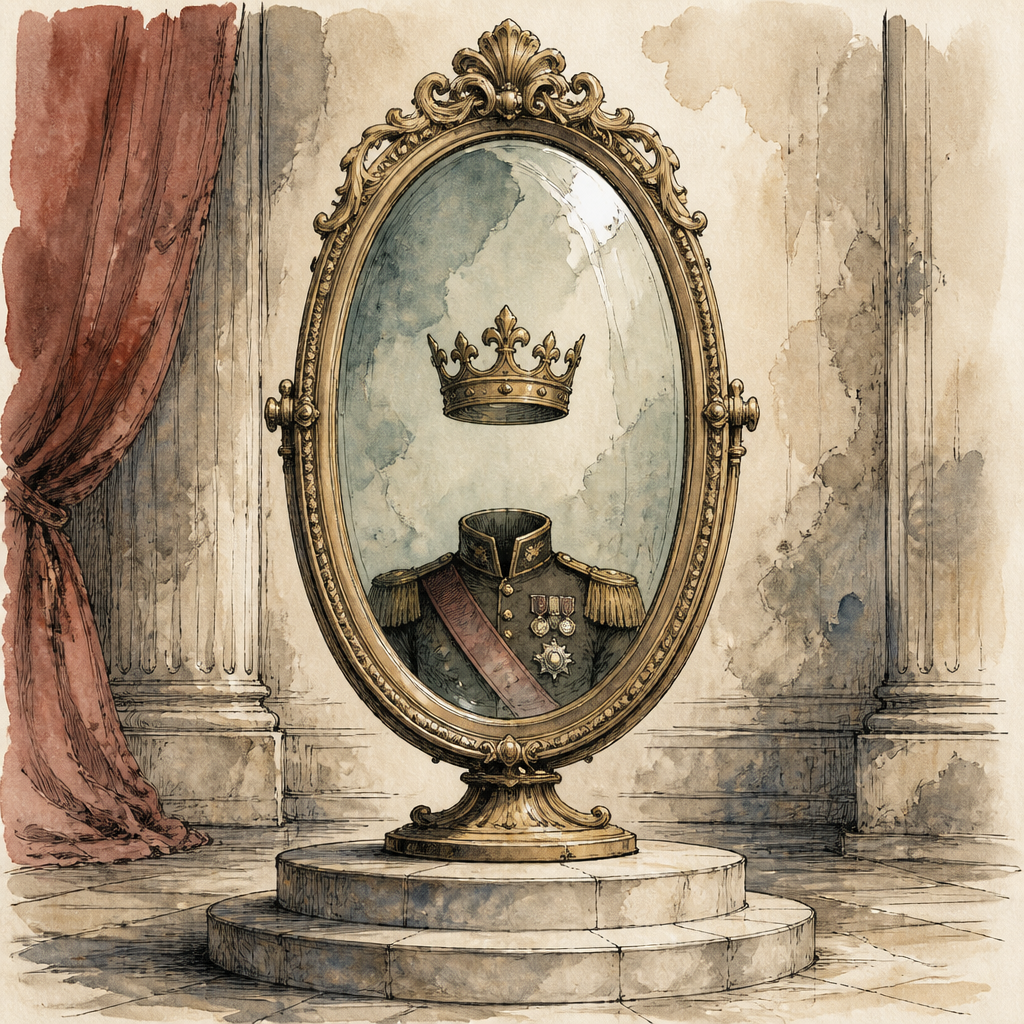
The Mirror Trick
Here is a neat conjuring trick performed in public this week: a government insists there is no weapons shortage, and in the same breath promises to hunt down the people who said there was one.
Notice the sleight of hand. If the shortage were false, the leakers would be wrong, not dangerous. You do not need a manhunt for people who are simply mistaken. You need one for people who might be right.
This is not a story about ammunition. It is a story about certainty — the particular kind that treats disagreement as a supply problem to be located and removed, rather than information to be checked.
A Small Mirror in Zurich
The same reflex, in miniature, showed up this week inside football's own house. FIFA's president, facing a crisis meeting, walked out with internal support to remain exactly where he already was.
Crises are supposed to be moments when institutions ask themselves hard questions. Somewhere along the way, many institutions — governments, federations, parties — learned a shortcut: skip the hard question, reaffirm the leader, call it stability.
It usually works, for a while. The trouble is that an institution which cannot imagine itself without one man has quietly stopped being an institution. It has become a mirror, and mirrors do not govern anything; they only agree with whoever is standing in front of them.
The Ripple Effect
Strongman certainty travels. Commentary this week noted that Morocco feels emboldened, with one government's assertiveness read as encouraged by another's example. Whether or not the causal line is as clean as headlines suggest, the pattern is worth sitting with: when the loudest capitals reward the leader who never admits fault, quieter capitals take notes.
This is how authoritarian habits spread without a single tank crossing a border. Not through conquest, but through imitation. A minister watches a president deny a shortage and hunt the messenger, and files it away as a technique rather than a warning.
In Defence of Doubt
A fair-minded reader might object: don't leaders need confidence? Should a president publicly agonise over every supply chain, should a federation president grovel before every critic? No — indecision is not a virtue either, and a leader paralysed by every rumour is no gift to anyone.
But confidence and immunity to correction are not the same animal, however similar they look in a mirror. A confident leader says: here is the evidence, judge for yourselves. A leader performing certainty says: there is no problem, and also, whoever told you otherwise will be found.
The difference is falsifiability. One version can be checked against reality and survive or fail on the facts. The other cannot fail at all, because any evidence against it is redefined as betrayal before it can be examined.
What the Mirror Cannot Do
A mirror cannot hold an election. It cannot be voted out, term-limited, or asked an uncomfortable question by a journalist who still has a job the next morning. It can only reflect the person standing before it, larger and more certain than they actually are.
The antidote is unglamorous and already known: term limits that are honoured rather than rewritten, journalists who are protected rather than hunted, institutions that can survive the departure of the man currently running them.
None of that requires outrage. It requires the much smaller, much harder habit of asking, calmly, every time a leader insists there is nothing to see: compared to what evidence, exactly — and who benefits if we stop looking?