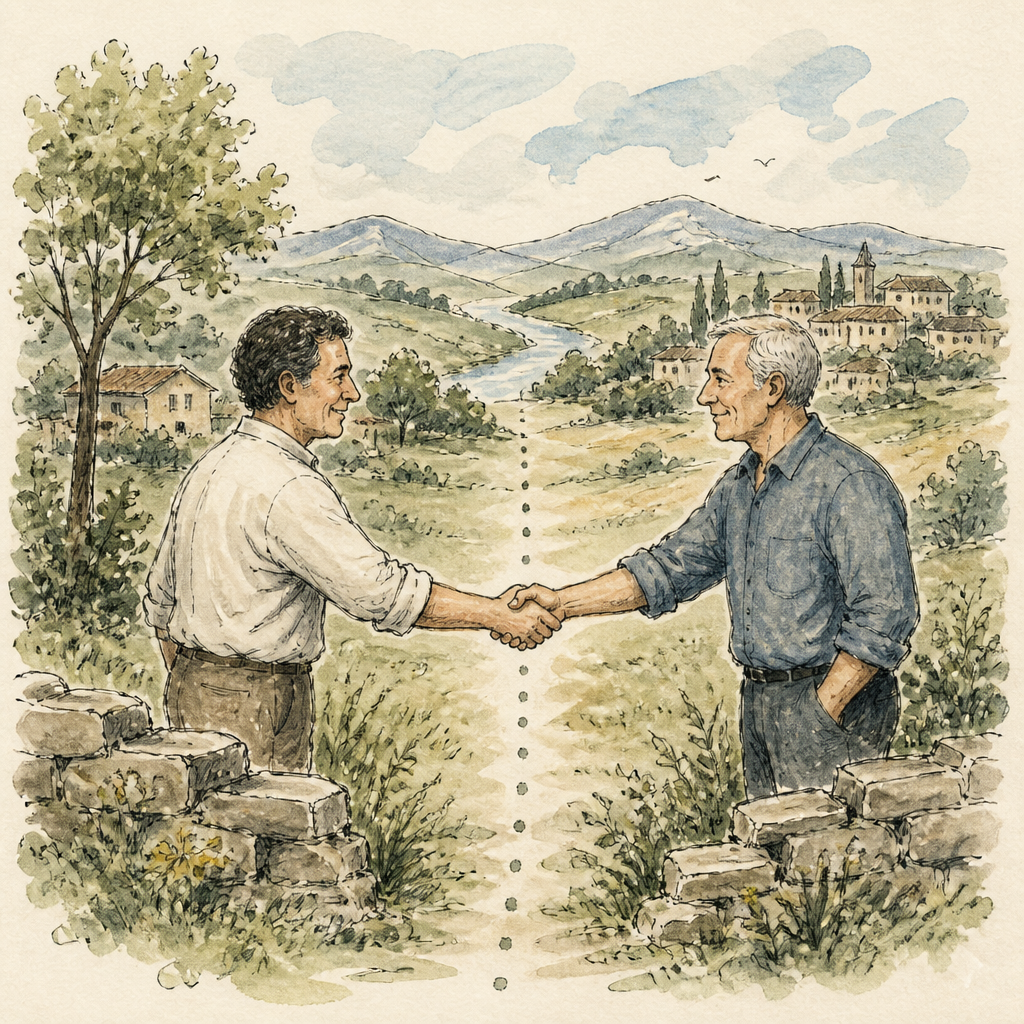
What a fence is for
Good fences, the saying goes, make good neighbours. But only if both sides know where the fence is, and agreed on it together. A fence one neighbour moves at night, or hides behind a hedge of secrecy, does not make peace. It makes a grievance with a delay timer.
That distinction is worth holding onto today, because the world's neighbours are behaving in both ways at once.
The truce that asks nothing clever
Volodymyr Zelenskyy has proposed something almost embarrassingly simple to Vladimir Putin, via a meeting with Donald Trump: an energy truce. Stop bombing the pipes and the grid. Let people on both sides of a war keep their lights and their heat through another winter.
There is no grand doctrine in that proposal. It does not require anyone to admit who started the war or who will win it. It only asks that two neighbours, mid-quarrel, agree not to freeze each other's grandmothers. That is reciprocity in its most stripped-down form — the golden rule with the theology removed. You do not want your power plants hit; do not hit mine. Whether Moscow accepts it will say a great deal about which kind of neighbour it intends to be.
Annihilation, then talks: the weather-vane approach
Compare that with the on-again, off-again choreography between Washington and Tehran — a threat of "annihilation" from Mr Trump in the summer, and now, this week, the first talks since. Perhaps this is diplomacy finding its footing. Perhaps it is simply what happens when foreign policy runs on one man's mood rather than on institutions built to outlast him.
A neighbourhood run on moods is exhausting to live in. You never know, from one season to the next, whether the man next door wants to borrow your ladder or burn your fence down. Institutions — treaties, alliances, courts, a European Union that keeps functioning whether or not any single leader is having a good week — exist precisely to spare neighbours that exhaustion. They are unglamorous. They are also why Western Europe has not fought itself in eighty years, which is either the dullest headline in history or the greatest one, depending on how much you enjoy war.
Deportation deals in an undisclosed location
Then there is the darker version of border-management: reports of secret deportation arrangements that send people to countries far from home, with little public accounting of where or why. A nation that quietly ships its unwanted problems to "alien lands" is not practising neighbourliness at all. It is practising avoidance — the diplomatic equivalent of dumping your rubbish over the hedge after dark and hoping no one asks.
Contrast that with Denmark's approach to its own internal borders — the unglamorous, argued-over, multi-party effort to fold parallel enclaves back into one shared civic law, in the open, with elections attached to the decision. You may like it or dislike it. But you can find it, read it, and vote against the people who wrote it. That is the whole difference between a border and a burial.
Why the boring version wins
So here is the standpoint, plainly: written rules, applied in daylight, beat clever deals struck in private, even when the private deal looks faster. An energy truce proposed openly, an alliance built on treaties rather than a leader's temperament, a housing or migration policy debated in parliament rather than signed behind a curtain — these are slower, and they are also the only versions durable enough to survive the neighbour who has a bad week, or the leader who does not win the next election.
A guide in Edinburgh, according to today's lighter dispatches, has apparently found a way to make centuries-old art history funny enough that tourists actually listen. That is worth noticing too: understanding between neighbours across time, culture, or border rarely arrives through decree. It arrives through people willing to explain the fence, laugh a little at how odd it looks, and agree, in writing, to keep it where both sides can see it.