A Neighbour's Offer
Imagine a large man leaning over the fence and telling you that if you simply moved into his house, you'd finally enjoy the benefits of his kitchen. He isn't threatening you, he insists. He's doing you a favour.
This week's exchange between Washington and Ottawa reads almost like that. Trade talks collapsed, and the suggestion followed that Canada wants the 'benefits' of being a US state. Canada's prime minister, for his part, says his country is 'at war' with its closest neighbour — not with tanks, but with tariffs, which these days can do a great deal of the same work.
Notice the vocabulary. One side offers benefits. The other reaches for the language of war. Between those two words sits a question every democracy near a larger power eventually has to answer: is closeness with a giant a gift, or is it a slow rehearsal for disappearance?
Europe Already Answered This, Slowly
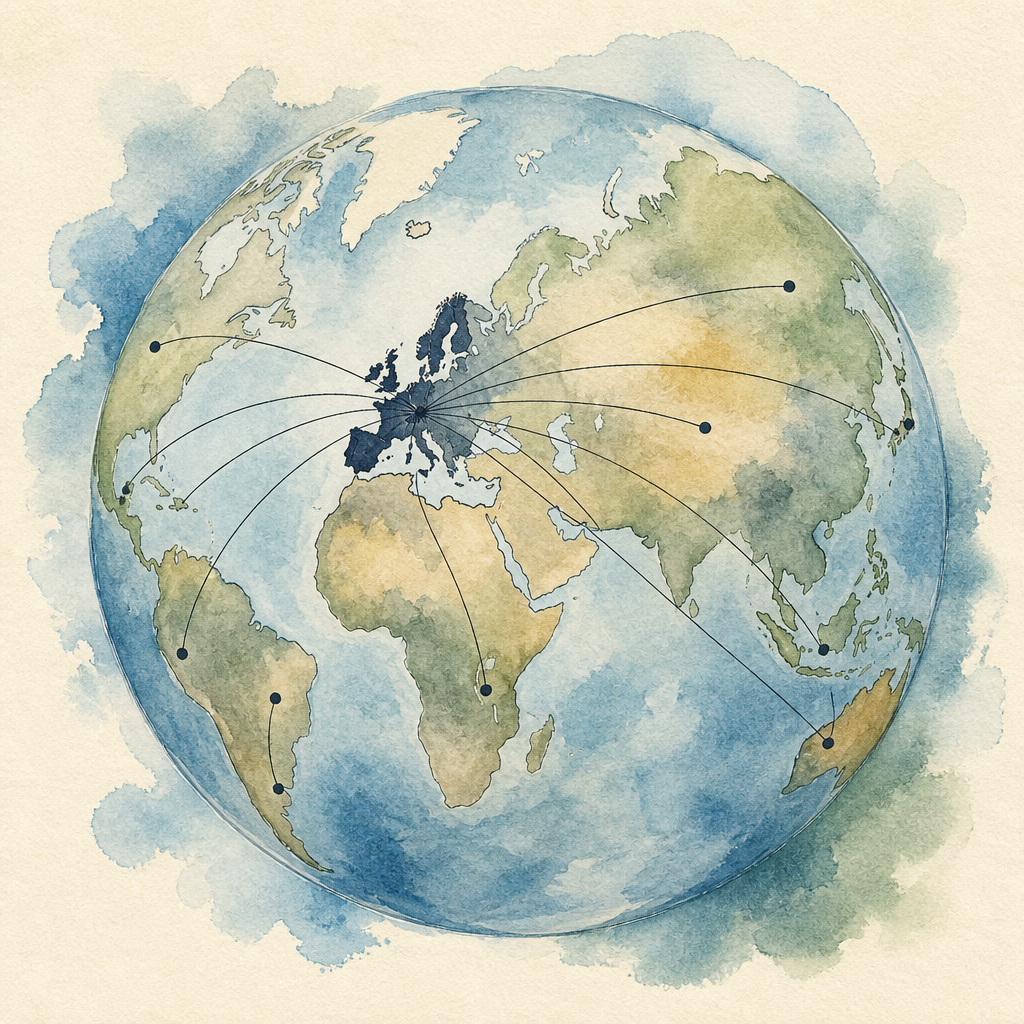
Seventy-odd years ago, a continent that had just finished destroying itself faced a version of the same choice. It could let the strongest state set the terms for everyone else, or it could build a table with no head — a union where France does not outvote Luxembourg simply by being larger, where a small country's veto still counts.
The European Union is often mocked for its committees and its patience. Fair enough — bureaucracy for its own sake deserves mockery, and Brussels has not always resisted the temptation to regulate for the sake of regulating. But the underlying idea, pooled sovereignty among equals rather than absorption by the strong, remains one of the more useful inventions of the last century. It is the opposite of being told you'll enjoy the benefits of someone else's kitchen. It is being handed your own chair at the table, with your own vote attached.
That is worth remembering when watching Ottawa's trade war unfold, or Tehran's officials arguing that economic warfare is simply what a great power resorts to once its military options have failed. Both stories describe the same temptation: using leverage instead of law, pressure instead of partnership. Europe does not get to feel smug about this — it has its own history of empire and its own present arguments about migration and rules. But it does have, in its own construction, a working counter-example. That counter-example is worth exporting more loudly than it currently is.
Small Corrections, Large Signals
Spain's decision to let five hundred migrant children in Ceuta move to the mainland is a modest story next to tariffs and gold mines. But modesty is often where democratic health actually lives. A government looked at a policy, noticed it was failing children, and reversed course in public. No revolution, no slogan — just a system correcting itself, which is precisely what authoritarian systems find hardest to do.
Australia's law requiring big tech to pay for the news it feeds on is a smaller cousin of the EU's own digital rules, and worth cheering for the same reason: middle-sized democracies borrowing from one another to keep concentrated power, whether a state or a platform, inside the fence of accountable law. This is what solidarity among free peoples can look like when it isn't a treaty summit — one democracy noticing another's homework and doing its own version.
The Standpoint
So here is a plain answer to a plain question. Should Europe watch Canada's trade war, Iran's sanctions fight, and Australia's tech law as someone else's business? No. Each is a data point in the same argument: whether the twenty-first century belongs to leverage or to law.
Europe's honest contribution is not to lecture, and certainly not to gloat. It is to keep proving, table by table, chair by chair, that cooperation among equals can outlast coercion by the strong — and to say so clearly enough that neighbours of large powers everywhere can hear it as an option, not a fantasy.