The instruments that warn us
Sailors die on a tanker in the Gulf. Two flags meet in a Spanish enclave. A businessman in Malta walks free from the courtroom where the murder of a journalist who investigated him was supposed to be answered for. On the same news day, Guinea-Bissau drafts a new constitution that its own opposition says will hollow out the republic, and a prime minister in the world's largest democracy courts the young online while tightening the leash around them.
These stories look unrelated. They are not. Each one is a reading on the same instrument panel: the panel democracies use to tell whether power still answers to anyone.
The case of the missing verdict
Daphne Caruana Galizia was killed in 2017 for reporting on corruption. This week a Maltese jury acquitted the businessman accused of orchestrating her murder. A jury's decision deserves respect; juries are not rubber stamps, and acquittal is not proof of a conspiracy. But notice the question a healthy democracy should still be free to ask out loud, without being accused of contempt: did the institutions built to protect the people who protect us from corruption actually do their job here, from investigation to courtroom? If citizens cannot ask that question without flinching, the court has won a verdict and the republic has lost something quieter.
This is the pattern worth naming early, before it hardens: not the single verdict, which may be entirely lawful, but the chilling effect of watching a killed journalist's case end without anyone made to answer for the killing. Reporters elsewhere are taking notes. So are the people who fund contract killings.
Constitutions as camouflage
Guinea-Bissau's new constitution arrives dressed as reform, as most do. Strongmen rarely announce themselves; they announce "stability," "efficiency," "modernisation." The opposition's complaint is the oldest one in the authoritarian playbook: rules rewritten by the people they are meant to restrain. A constitution captured this way is not a coup. It is slower and, for that reason, harder to protest against — there is no tank in the square, only a new paragraph in a legal text most citizens will never read closely.
This is exactly why early noticing matters more than late outrage. By the time a captured constitution is fully in force, the courts that might strike it down have often been reshaped to agree with it.
Courting the young while jailing their voice
India's government wooing its Gen Z on the platforms where they live, while cracking down on the same generation's dissent, is not a contradiction to be embarrassed by — it is a strategy. Attention and control are not opposites in this playbook; they are two hands doing one job. A government that flatters the young in public and disciplines them in private is testing how much of that generation's civic imagination can be rented rather than earned.
Why vigilance is the sane position, not the paranoid one
None of this means every acquittal is a cover-up, every new constitution a coup, every online charm offensive a trap. Democracies need juries who can say "not proven," nations that can rewrite outdated founding texts, and leaders who can speak to the young without it being sinister. The wise citizen is not the one who assumes the worst by reflex. The wise citizen is the one who keeps checking the instruments anyway — a free press still able to ask uncomfortable questions about a verdict, courts still independent enough to test a new constitution, young people still free to organise without a knock on the door.
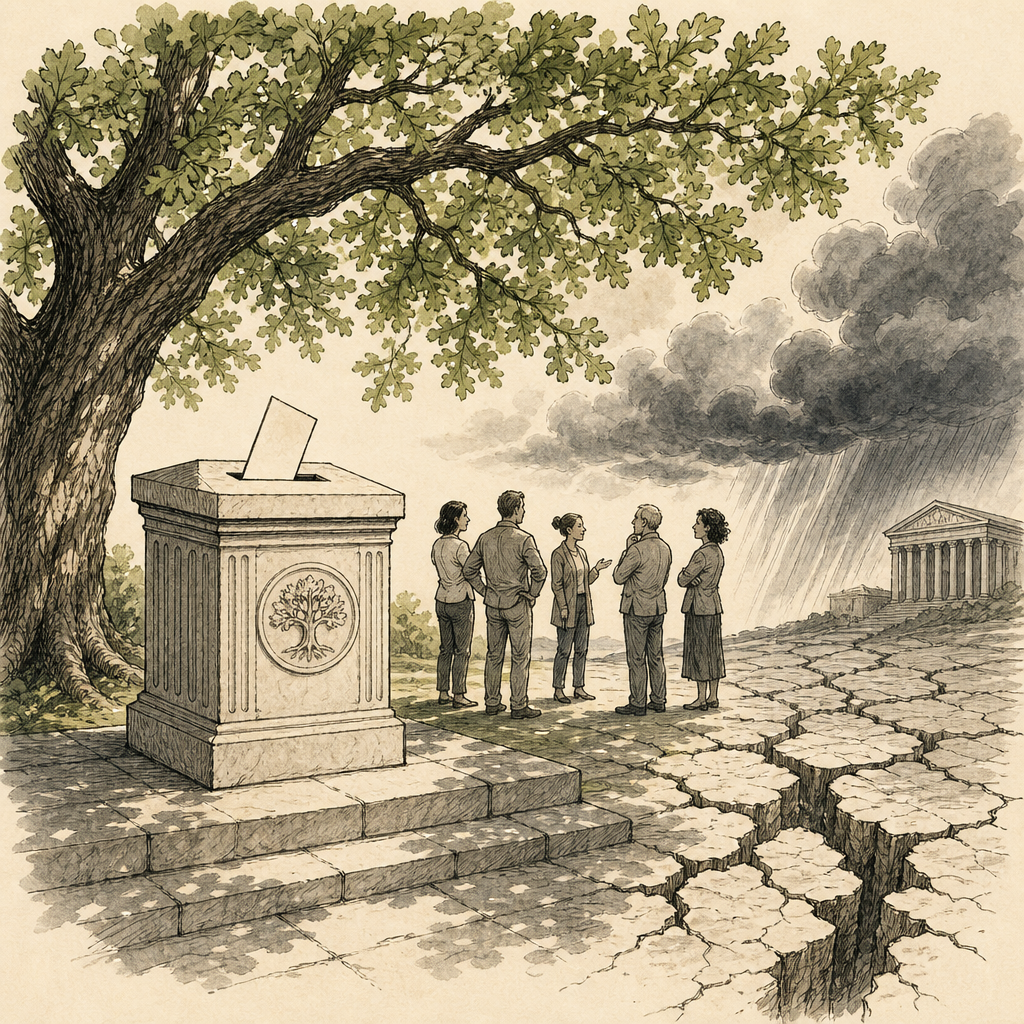
Democracy is not a trophy won once. It is a weather system, checked daily, adjusted often, and never assumed to be fair just because it was fair yesterday. Malta's jury, Guinea-Bissau's drafters and India's algorithm-savvy government are not proof that democracy is dying somewhere today. They are reminders to keep reading the instrument panel — because the storm that arrives unannounced is always the one nobody thought to watch for.