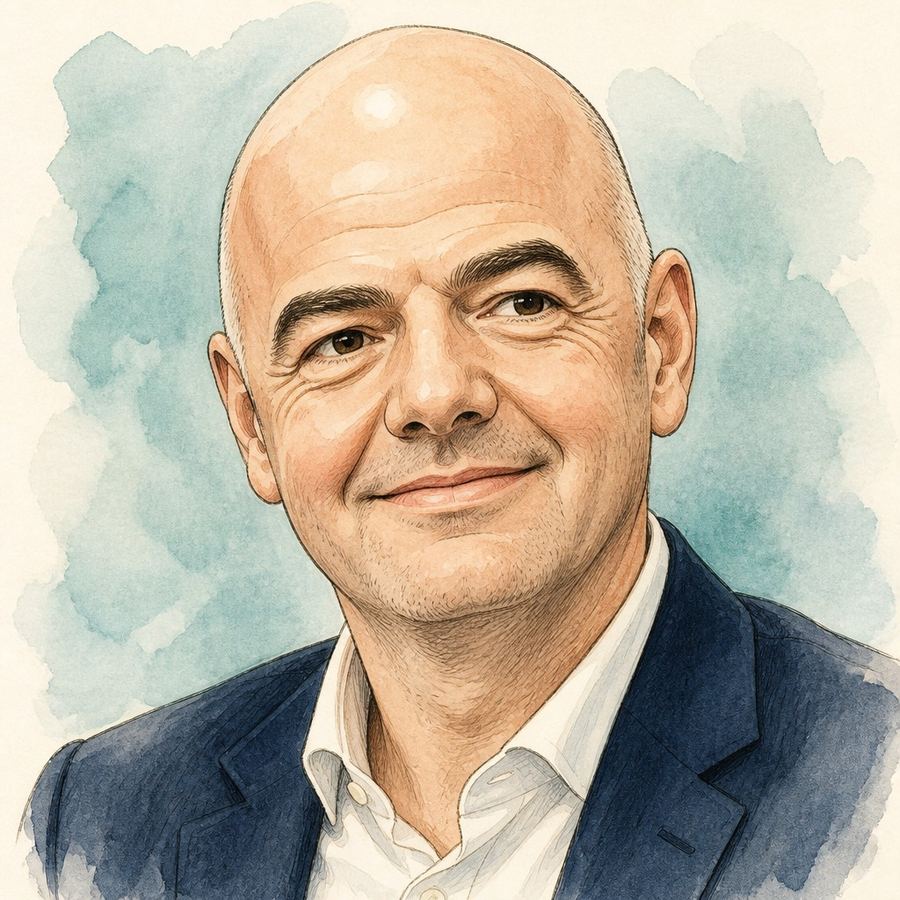
A parliament of 211, and no opposition bench
Here is a trivia question for a quiet Sunday. Which global body gives Tuvalu the same formal vote as France? Not the United Nations Security Council, where five permanent members hold a veto the rest can only watch. It is FIFA, football's governing house, where each of its 211 member associations casts one vote at congress, full stop.
On paper this is more democratic than most democracies. In practice, congress after congress has returned Gianni Infantino with margins that would make a one-party state blush. Not because 211 federations independently reasoned their way to the same conclusion, but because development funds, World Cup hosting favors, and administrative goodwill tend to flow toward federations that vote the expected way. One vote each, yes. One real choice, rarely.
What real friction looks like
It is worth noticing, on a day when French streets are again full of protest and police, and Serbian students are marching over a disputed election, what actual democratic friction costs. Nearly a thousand arrests in France this weekend. Students in Belgrade risking their studies and more to question how votes were counted. These are not pleasant images. But they are evidence of something FIFA's congress has never produced: citizens, or delegates, willing to publicly contest the people who hold power over them.
No football federation has ever been tear-gassed for booing Zurich. No delegation has staged a sit-in outside FIFA headquarters demanding an independent audit of World Cup hosting decisions. The absence of visible dissent inside FIFA is sometimes read as contentment. It is more honestly read as structure: when your federation's budget depends on staying in the chairman's good graces, dissent is a luxury few can afford.
The costume of democracy
Formal equality — one country, one vote — is a fine starting point. It is not the whole of democracy. A vote needs a free press covering the candidates, competing slates with real chances, term limits that prevent any one figure from becoming indispensable, and consequences when money changes hands near a hosting decision. Strip those away and one-country-one-vote becomes theater: everyone performs equality, nobody risks the outcome.
This matters beyond football trivia, because FIFA governs something genuinely valuable. International team sport, done honestly, is a quiet rehearsal for living together — mixed squads, shared rules, rivalries that stay rivalries and never curdle into hatred. Lewis Hamilton's hope to race long enough to see a Grand Prix on African soil points at the same instinct: global sport should widen the circle, not just the sponsorship deck. That promise is worth protecting, which is exactly why its governance deserves the same scrutiny citizens apply to their own governments.
A fair weighing
In FIFA's defense: one-country-one-vote did once break the old grip of a handful of European federations over the sport's direction, and gave smaller nations a formal seat they had lacked. That reform was not nothing. The failure is not the structure itself but what has been built on top of it — a patronage system strong enough that formal equality never has to be tested by real competition.
The sensible demand
Member federations do not need to storm anything. They need to do, inside their own congress, what French and Serbian citizens are doing in their streets and squares: ask who counts the votes, who controls the money that follows them, and why no credible rival has mounted a serious challenge in years. Term limits, independent integrity oversight, and a press corps with real access to delegates would cost FIFA nothing it claims to value and would test, finally, whether one country, one vote means what it says.
Democracy is not proven by the shape of the ballot. It is proven by whether anyone could plausibly lose.