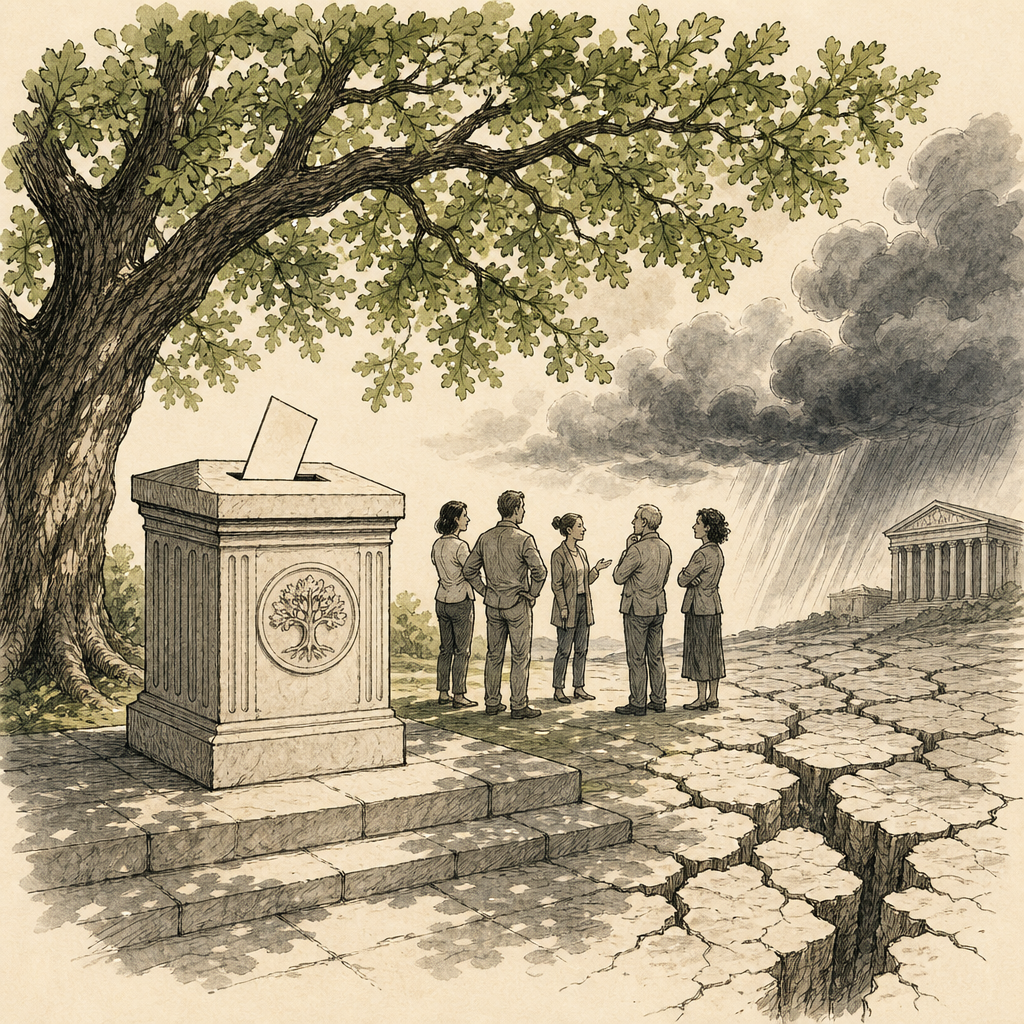
When "Order" Becomes a Password
Every government, sooner or later, asks its citizens to be calm. This week it was President Macron, after a weekend of riots and student protests spreading across France. Calm is, on its face, a reasonable request. Nobody builds a hospital or a school during a riot.
But calm is also the oldest password in politics. Said by a mayor, it usually means: let the normal machinery work. Said by a strongman, it can mean: stop asking questions while I rearrange the machinery. The word is identical in both mouths. The difference is what happens the week after — whether courts, press and parliament keep their teeth, or whether "restoring order" quietly becomes a reason to file them down.
France, for now, is arguing in public, loudly, messily, the way democracies are supposed to. That noise is not the disease. It is the immune system working.
The Law That Only Bites One Side
Compare that noise to the silence building elsewhere. In Pakistan, political rivals are now being swept up under anti-terrorism law — legislation written, presumably, for people who plant bombs, now stretched to fit people who merely win elections or criticise them. A reader might ask: is the law broad because terrorism is broad, or because opposition is inconvenient?
That question is worth sitting with, because this is precisely how courts get captured — not with a dramatic purge, but with a vocabulary creep. The statute stays the same size on paper. Its appetite grows. One day it is eating terrorists. Months later it is eating opposition leaders. The public is told nothing has changed, only the enforcement has "strengthened." Strengthened against whom, exactly, is the only question that matters.
Borrowed Courage, Borrowed Patience
In Senegal, hundreds have been arrested as LGBTQ+ people go into hiding — a reminder that the instrument used against rivals in one country can just as easily be aimed at identity in another. The tool is interchangeable: a law, applied unevenly, against whichever group is least able to defend itself in court that year. Freedom of belief, freedom of being, survive only where the law is blind to who stands in front of it. The moment law learns to recognise faces, it has stopped being law and started being a leash.
And on the world stage, a different kind of patience is being rationed. Washington's decision to suspend sanctions on Russia, explained as necessary to "keep peace negotiations going," is the sort of sentence that sounds statesmanlike until you ask who benefits from an exhausted sanction regime: the country being pressured, or the country doing the pressuring? Anti-Putin sabotage continues quietly inside Russia itself — ordinary people risking everything for exactly the kind of accountability that outside pressure is meant to reinforce, not relax. Democracies that grow tired of enforcing consequences for dictatorship are not choosing peace. They are choosing fatigue, and calling it diplomacy.
Why Noticing Early Is Not Paranoia, It's Maintenance
None of this is a prediction of collapse. France has unions, courts and an opposition press that still functions loudly. Pakistan has lawyers who still object, publicly, when the law is misused. Senegal has a diaspora and international observers watching. None of these are hopeless cases. They are simply cases in progress — which is the condition every democracy is permanently in.
The wise habit is not outrage at each individual headline, but attention to the pattern underneath several of them at once: a law stretched past its intended target, a word like "order" used to shrink rather than restore, a sanction eased not because the behaviour changed but because the pressure got tiring. Each on its own looks survivable. Together, repeated in enough countries, they describe the slow weather in which authoritarian habits grow best.
Defending institutions early costs little — a question asked in parliament, a journalist who keeps publishing, a court that refuses to stretch a statute past its plain meaning. Defending them late costs everything, and rarely succeeds. That arithmetic, more than any ideology, is the actual argument for democracy: not that it is prettier, but that it is cheaper to maintain than to rebuild.