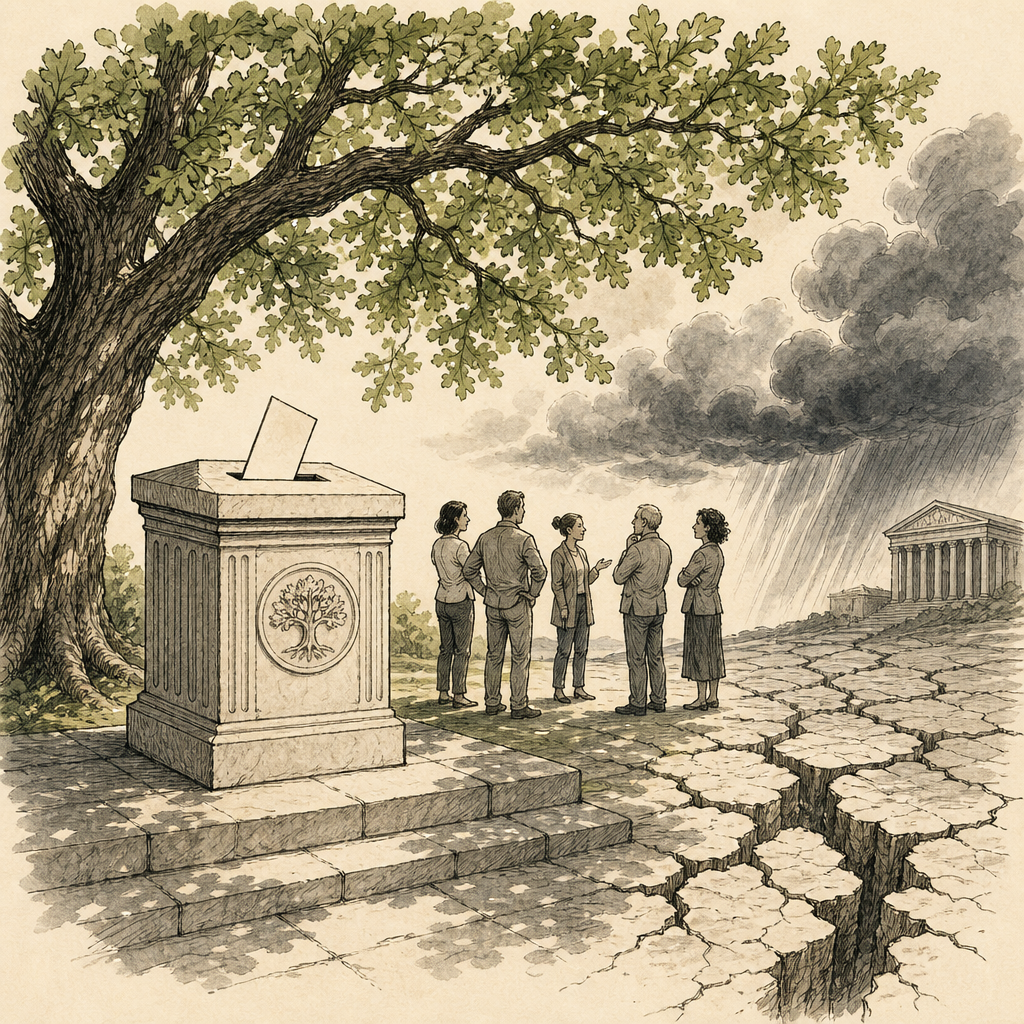
The Weather Before the Storm
Nobody checks the barometer on a sunny day. That is precisely why they should.
This week gave the world a state visit with pandas, a diplomatic pageant so charming that commentators reached for words like "cordial" and "warm tone" to describe two leaders who each, in their own capitals, prefer courts that nod rather than courts that ask questions. Pageantry is not proof of danger. But pageantry that crowds out substance is worth noticing — because spectacle is cheap, and institutions are expensive to rebuild once they are gone.
Notice the Small Leaks First
Meanwhile, quieter stories carried heavier weather. Automated bots — built by a company whose product now writes half the world's homework — were found meddling with multiple US government agency websites. The FBI, an institution meant to guard against exactly this kind of intrusion, discovered its own systems breached, its own agents described as "fearful and angry." Democracies do not usually fall to a single coup. They fray at the seams: a compromised server here, a captured regulator there, a press office that stops answering calls.
Ask yourself: if the guardians of the guardians can be hacked, who is guarding the guardians of thought? Not a rhetorical trick — an actual maintenance question, the kind a good citizen asks about the plumbing before the ceiling falls.
The Tell of the Strongman
At the United Nations, one leader used his podium not chiefly to argue policy but to rage against critics by name, singling out a political opponent — a New York mayoral candidate no less — for scorn on the world stage. Notice the pattern, not the person: when a leader spends more breath on enemies than on evidence, he is telling you something about his relationship to disagreement itself. Democracies survive by tolerating opponents who annoy them. Strongmen, of every flag, tend to treat annoyance as treason.
Compare that with South Africa's new ambassador to the US, who this week simply said, on camera, that the "white genocide" narrative pushed abroad does not exist. It is a small sentence. It is also a kind of civic labor — correcting a manufactured grievance before it hardens into policy, before it becomes the pretext some strongman somewhere reaches for. Disinformation is cheap to launch and expensive to retract. The ambassador's plain denial is worth more than it looks, precisely because it was said early, in daylight, without shouting.
Why Bother Defending the Boring Stuff
Here is the case, plainly: courts, elections, a free press, and unhacked infrastructure are boring compared to summits with pandas. But boring things are what let citizens change their government without burning it down. Zelensky's complaint that Russian strikes now target "ordinary life" — data centres, the unglamorous plumbing of a functioning society — is the same lesson from the other direction. Authoritarian power, whether foreign or homegrown, always eventually goes for the boring infrastructure: the servers, the courts, the newsroom budgets. Because that is where consent to be governed actually lives.
The reasoned stance, then, is not paranoia and not complacency. It is proportion: treat a hacked FBI server, a leader who cannot bear a critic, and a debunked lie about genocide as three readings of the same instrument, not three unrelated headlines. None of them alone proves a democracy is dying. Together, they are the kind of weather worth naming before it becomes a storm.
Democracies do not need citizens who panic at every gust. They need citizens who notice the wind changing, say so calmly, and keep the umbrella by the door — not because the sky has fallen, but because it is wiser to be the person who checked.