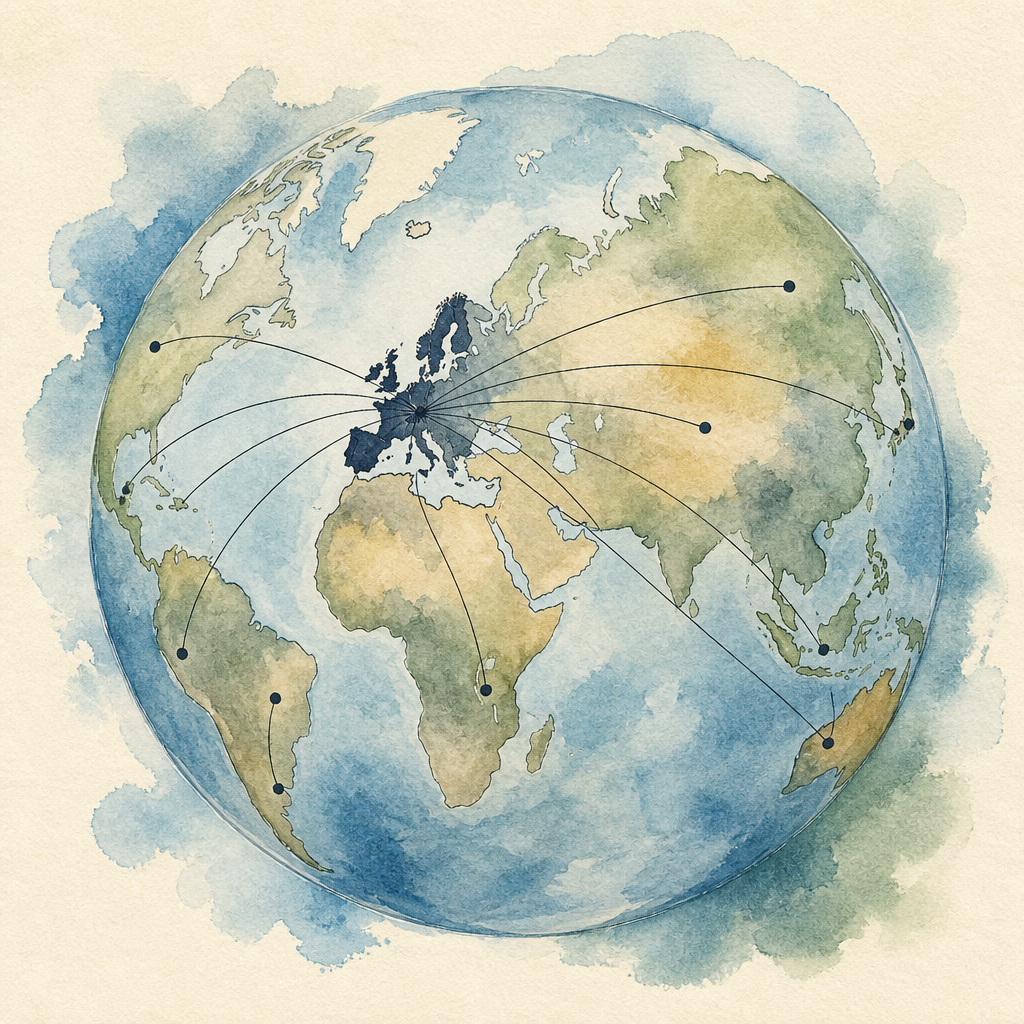
A Union That Checks Itself
Spain has announced temporary border checks on travellers arriving from Italy. Two founding-generation partners of the European project, both inside Schengen, both signatories to the idea that the point of the union is that borders between friends should matter less over time, not more.
The reason given is security, and security reasons are rarely without merit. But it is worth asking, gently, what a checkpoint between Madrid and Rome actually measures. Not the danger from outside Europe — that conversation happens elsewhere, in ministries and summits. This checkpoint measures something quieter: whether the union still believes its own architecture can hold without reinforcement.
A temporary check, clearly bounded, transparently justified, reviewed and lifted on schedule, is a mature institution doing ordinary maintenance. A checkpoint that quietly becomes permanent is something else — a confession that the promise was decorative. The difference is not rhetorical. It is the difference between Schengen as living trust and Schengen as a brochure.
While Europe Debates Its Own Borders, Others Retreat From the World's
Elsewhere this week, the United States announced it will shut five consulates abroad, and commentators immediately asked who moves into the vacated space — with China's name mentioned more than once. Whatever one thinks of that particular calculation, the pattern deserves attention: a great democracy quietly withdrawing its everyday, unglamorous presence from parts of the world, at the very moment the world needs steady addresses more than dramatic gestures.
Compare this to the week's other American theatre — a president switching planes after a summit, citing a possible threat, in a story that reads more like a thriller trailer than statecraft. Plane swaps generate headlines. Closed consulates generate silence. Guess which one shapes more lives over the next decade.
This is precisely the gap Europe should notice, and fill — not with its own theatrics, but with its unglamorous strength: the visa officer who shows up on Tuesday, the trade desk that answers the phone, the embassy that stays open when the news cycle moves on. Liberal democracies compete with authoritarian rivals less through summits than through reliability. Presence is a form of argument.
Accountability, at Least Somewhere
This was also the week a court sentenced Bashar al-Assad to death in absentia — a verdict he will likely never face, delivered by a justice system still trying, however imperfectly, to say that mass violence has a name and a ledger. It is a modest thing next to the scale of what happened in Syria. But modest accountability is still accountability, and it stands in useful contrast to the world's other current arrangement, where powerful men are answerable mainly to their own travel plans.
Europe did not deliver that verdict, but Europe's institutions — courts, tribunals, the slow patient machinery of law across borders — are built on the same premise: that power should answer to something outside itself. That premise is worth defending at home before it is preached abroad.
The Case for Steadiness Over Spectacle
Weigh it honestly. The case for Spain's checkpoints: legitimate, if bounded, security management is not a betrayal of Europe — it is Europe governing itself like an adult. The case against: any checkpoint that outlives its stated reason quietly teaches citizens that borders are the default and openness the exception, exactly backwards from what the union promised.
The wise position sits between the poles: allow the check, insist on the clock. Watch it as closely as any citizen should watch any temporary power.
And abroad, while a quake buries families in Colombia and rescuers dig by hand, while Ebola mutates quietly in a region few consulates now cover, the real test of European maturity is not whether it can match anyone's theatre. It is whether it keeps showing up — steadily, unglamorously, on schedule — long after the headline has moved to the next plane.