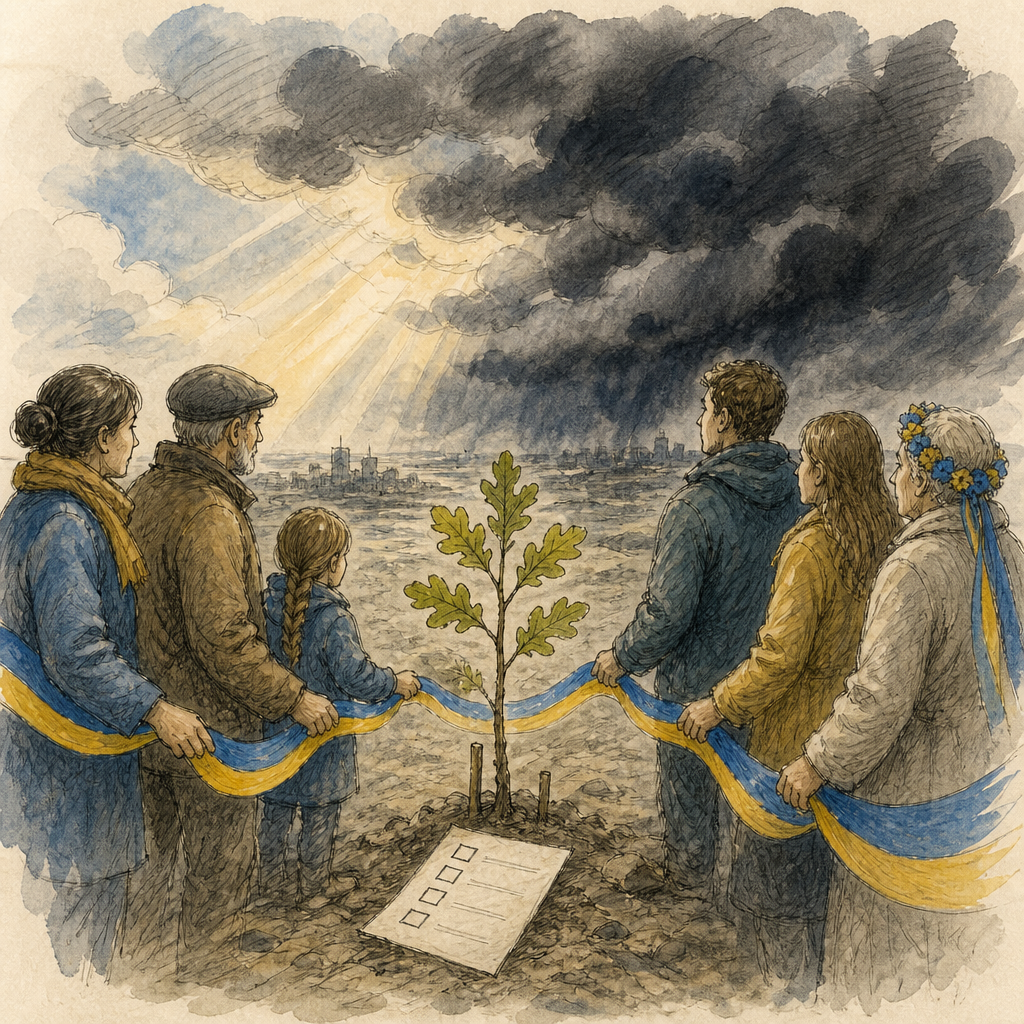
A Ceasefire Long Enough to Count the Living
This week brought something rare enough to be newsworthy on its own: a ceasefire in the Russian-occupied town of Oleshky, long enough for hundreds of people to be evacuated. Not a peace. Not even a pause in the war, really. Just a window of a few hours where ambulances could move and nobody had to decide between staying and dying.
It is worth sitting with that for a moment before talking about anything more abstract. Whatever word gets used in diplomatic briefings — frontline, ceasefire, negotiation — the actual unit being discussed is a person who gets to leave a basement. Ukraine's fight for democracy is not, in the end, an argument about flags. It is an argument about who gets to decide whether they live under occupation or under their own government.
Five Hundred Patriots and a Plain Question
The United States has approved the sale of 500 Patriot missiles to Ukraine. Readers who are tired of war news may feel the familiar flinch: more weapons, more escalation, more money that could go elsewhere. It is a fair instinct, and worth taking seriously rather than waving away.
But ask the plain question: who crossed whose border? Ukraine is not asking for the tools of conquest. It is asking for the tools of refusal — refusal to be absorbed, refused to be governed by someone it never elected. A democracy with no army is a democracy that exists only until its neighbour changes its mind. Supporting Ukraine's defence is not a love of weapons; it is the unglamorous arithmetic of what self-determination costs when a larger power doesn't believe in it.
The Quieter Front, in Warsaw
Meanwhile, police were deployed this week over a standoff about control of Poland's top court. No missiles involved. No occupied towns. Just the much duller, much more decisive question of who gets to say what the law means.
It would be tempting to file this under domestic politics and move on. Resist that temptation. A court that can be bent by whoever currently holds power is a court that has already stopped being a check on power — the tanks simply haven't needed to show up yet. Poland is a member of the EU, a functioning democracy by any normal measure, and still the argument over its judiciary is not settled. That is not a scandal; it is the ordinary, permanent maintenance work of democracy. The danger is not that the argument exists — it's if citizens stop noticing when it does.
What the Alternative Looks Like
For contrast, look to Egypt, where this week an independent outlet, Mada Masr, was shut down and its editor fined. That is not a standoff. That is the standoff already lost. One government decided a court shouldn't be independent and no one with enough leverage pushed back hard enough, and eventually there is no free outlet left to report on the next decision either.
That is the quiet logic worth remembering: institutions do not fall in one dramatic move. They fall in instalments, each one defensible on its own, each one making the next instalment easier. Ukrainians are resisting the dramatic version of that fall — an army at the gate. Poles are being asked, more tediously, to resist the instalment version — a court quietly recomposed. Both are the same fight.
A Standpoint, Not Just a Shrug
So: arm Ukraine, yes — not as enthusiasm for war but as respect for the only right that makes any other right possible, the right to self-rule. And treat the Warsaw courtroom story with the same seriousness as the Oleshky evacuation, even though one has sirens and the other has paperwork.
Democracy is rarely lost to a single invasion. It is lost to the years nobody insisted on keeping it. The missiles are the loud defence. The courtroom is the quiet one. Ukraine is teaching, at terrible cost, that both must be fought for — and that citizens who wait for tanks before they notice trouble have already waited too long.