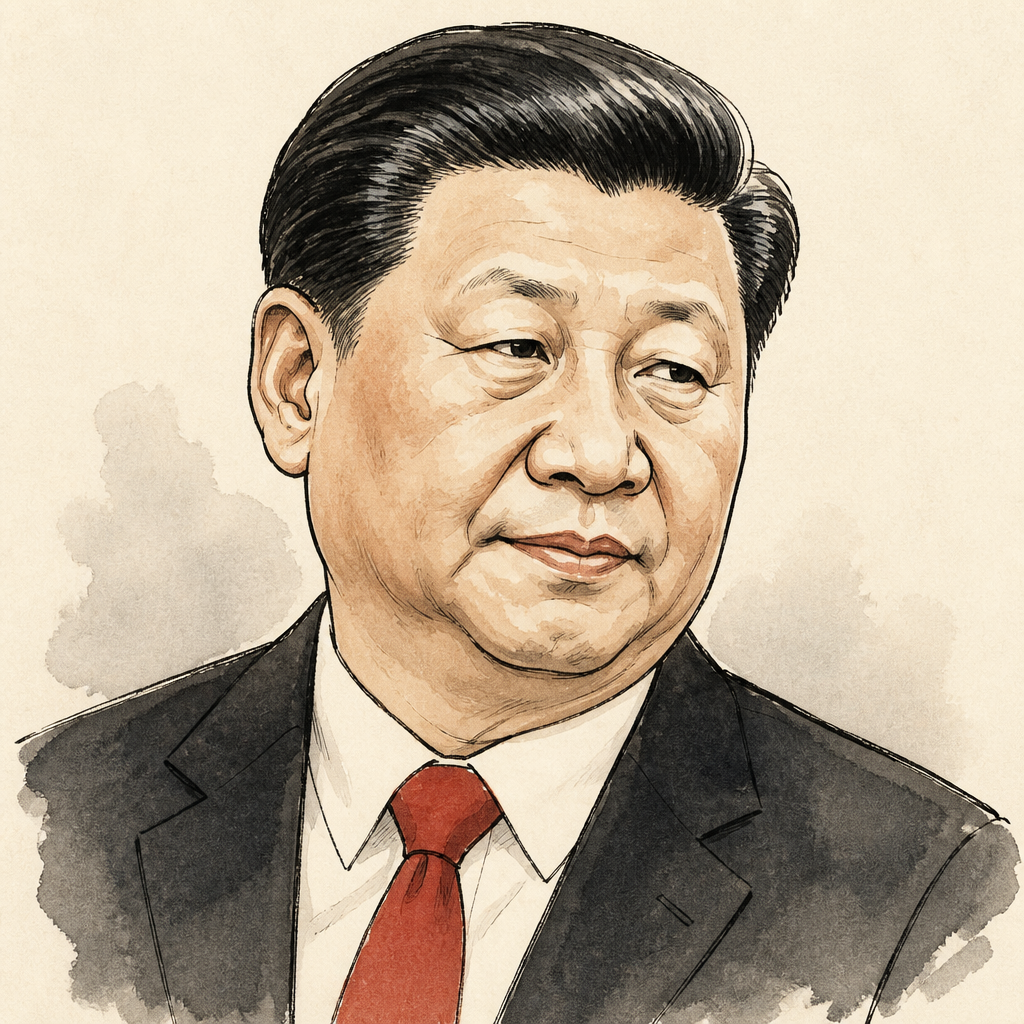
A Week the World Argued With Itself
Paris has buildings ablaze and more than a thousand people arrested. Tirana has protesters and police trading blows in the street. Washington is untangling a State Department scandal while its president waives sanctions on Russia mid-argument with Kyiv. None of this is really about Xi Jinping. He is mentioned in none of it. That, perhaps, is the point worth sitting with.
Somewhere in Beijing, none of these fires need to be lit by anyone's hand but our own.
The Watcher's Patience
Here is the uncomfortable question: is Xi simply a cautious statesman managing a rising power responsibly, biding his time the way any serious leader should — or is the caution itself the strategy, a long game played precisely until the moment patience is no longer required?
It is tempting to answer with certainty either way. Certainty is cheap and comforting. The honest answer is that we do not know, and that not knowing is exactly the condition a patient strategist would want his rivals to live in.
Consider what patience costs him. Nothing, so far. While democracies hold elections, argue in parliaments, let students march and courts rule and journalists needle their own governments, that noise is routinely described — by autocrats and their admirers — as weakness. But is it weakness, or is it simply the sound a system makes when it is still alive enough to argue with itself? A country that can riot over its own grievances and still hold elections next year is not the same as a country where riot is the only vote available.
What the Burning Streets Actually Prove
France in protest, Albania in protest, a scandal eating at an American ministry, a president trading sanctions like poker chips — these are not signs of democracy's decay. They are its ordinary, undignified weather. Democracies are loud because they are allowed to be loud. The danger is not the noise; it is mistaking the noise for fatal weakness, and therefore handing rivals a prize they have not actually earned.
South Africans, three decades after apartheid, are still pursuing justice for crimes committed under a different kind of patient, confident power — one that also assumed time was on its side. It was not, in the end. That is worth remembering on days when today's patient men look unstoppable.
Why the Fear Is Reasonable, Not Paranoid
To fear that Xi is simply waiting is not conspiracy thinking. It is the ordinary caution one should apply to any leader who has spent years consolidating personal authority, removing term limits, and building military capacity while describing himself, patiently, as a partner in global stability. A chess player does not announce the endgame in move six. He waits for the board to look different.
So what would wisdom look like, for democracies watching this unfold? Not panic — panic flatters the strategy by confirming the weakness it hopes to exploit. And not blind trust either, mistaking thirty years of careful words for thirty years of settled intention.
Wisdom looks like boring things: keeping alliances in good repair even when they are inconvenient, keeping militaries capable even when peace feels permanent, keeping institutions strong enough to survive a bad news week without declaring the whole experiment finished. Democracies that use their current arguments as an excuse to abandon each other are doing exactly what a patient watcher would hope for. Democracies that use the same arguments to fix what is actually broken — and still show up for each other at the table — are doing the one thing patience cannot plan around.
The question is not whether Xi is playing a long game. Assume he might be; it costs nothing to assume it and everything to assume otherwise. The real question is whether the rest of us are still capable of a long game too — one built on institutions rather than a single leader's calendar, which is, after all, the only kind of patience democracies have ever been good at.