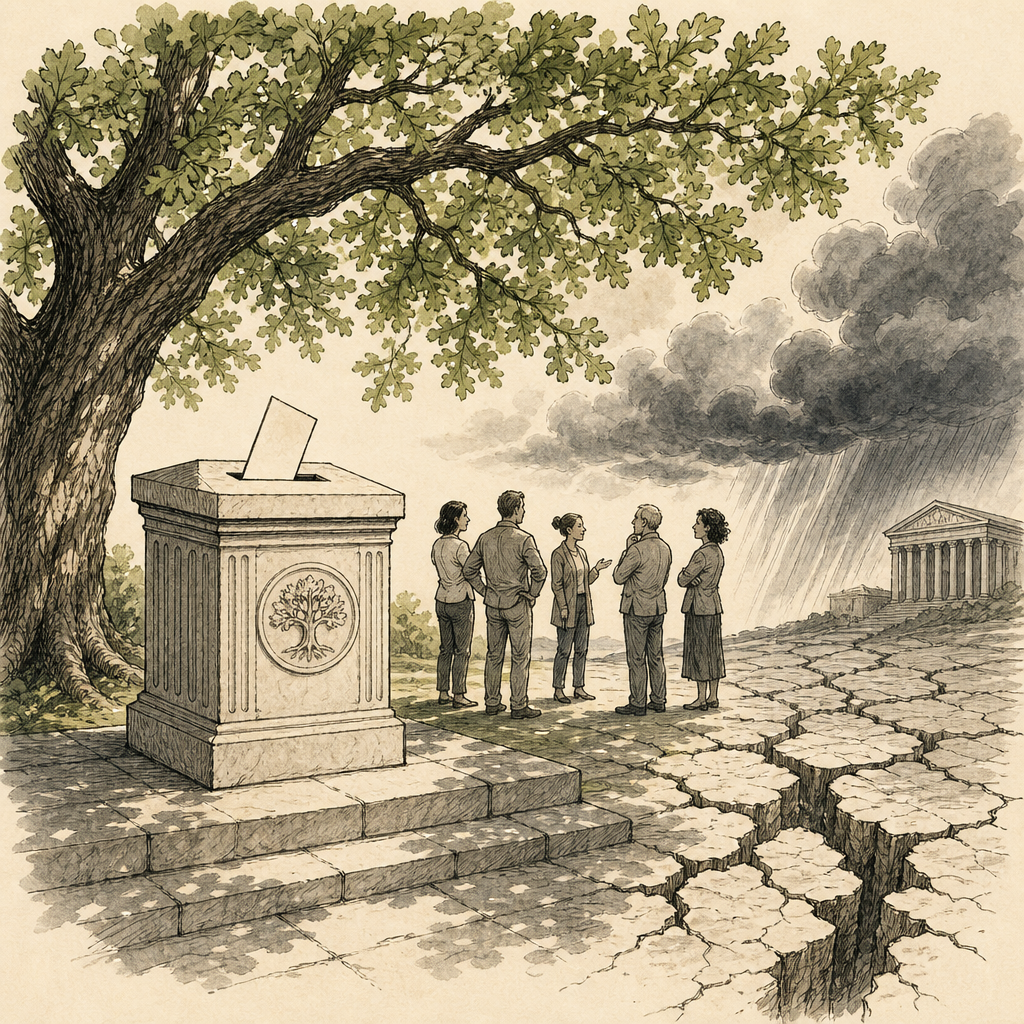
A Court, a Ballroom, and a Question Worth Asking
This week the United States Supreme Court is expected to rule on a dispute about a White House ballroom. Whatever the legal merits, notice the shape of the story before you judge its content: a president wanted something built, and a court had to decide whether he was allowed to want it that way. That a court must adjudicate the vanity projects of power is not scandal. It is democracy doing its unglamorous job — the seatbelt, not the crash.
But seatbelts only work if people keep wearing them. The question worth asking is not "did the court rule correctly" but "did anyone notice the ruling was necessary at all"? Authoritarian habits rarely arrive announcing themselves. They arrive as a preference for personal monuments over public accounting, tested quietly, one contract at a time.
Courting Strongmen, Sidelining Friends
Elsewhere this week, Washington is reported to be courting Pyongyang while Seoul, an actual democratic ally with actual elections and an actual free press, worries about being sidelined. There is a certain seduction in strongman diplomacy: two men, a photograph, a headline. It photographs better than a coalition of finance ministers arguing over a communiqué for six hours. But photogenic is not the same as wise.
Democracies are slow, argumentative, and full of institutions that insist on being consulted. That is the feature, not the bug. A foreign policy built on personal chemistry between leaders is a foreign policy that dies the day one of them loses an election — or stops needing an election at all. Allies who are patient with process should not be treated as an afterthought to a summit photo.
Canada's Answer: Firm, Not Furious
Contrast this with Ottawa's response to the collapse of trade talks with Washington: Canada says it will match tariffs dollar for dollar. Not more. Not less. Dollar for dollar. There is something almost old-fashioned about that phrase — proportionate, measurable, answerable to a parliament and a public that can vote the government out if it overreaches.
This is what democratic muscle memory looks like. Not capitulation, not escalation for its own sake, but a reply sized exactly to the provocation, made by a government that still has to explain itself at home. Compare that instinct with the alternative on offer elsewhere in the world this week: a government reinstating a previously closed settlement in the West Bank in defiance of growing international protest, testing not a trading partner's patience but its own courts and the patience of the wider world. Both are elected governments. Only one of them is currently choosing restraint as a form of strength.
Why Noticing Early Is the Whole Job
None of this is a coup. Nobody is cancelling an election. That is precisely the point, and precisely the danger of complacency. The erosion of democratic habits rarely announces itself with tanks. It announces itself with a ballroom that needed a court's permission, a summit that forgot to invite an ally, a settlement reopened over the objections of half the world, a tariff war treated as personal rather than procedural.
The wise citizen of a democracy — Canadian, Korean, American, Israeli, anyone with a ballot in a drawer — learns to read these small tests the way a sailor reads a change in wind before the storm arrives. You do not need a storm to check the rigging. You check it because the wind has shifted, even slightly, and shifting wind is the only warning a democracy ever reliably gets.
The answer is not outrage. Outrage is cheap and burns fast. The answer is attention, proportion, and the stubborn insistence that courts rule, allies are consulted, and tariffs are matched rather than multiplied. Democracies do not fall in a single afternoon. They are, however, occasionally handed a very good afternoon to notice.