A bridge as a selfie
Some bridges connect two shores. The Kerch bridge, linking Russia to annexed Crimea, was built mostly to connect one man to his own reflection. Vladimir Putin opened it himself in 2018, driving a truck across it for the cameras. It was never only concrete and steel. It was a message: this is permanent, because I say so.
This week part of it fell into the sea, after what Ukraine's president called an unprecedented attack. Whatever one thinks of the tactics, the symbolism writes itself without help from any editorial page. Monuments to personal infallibility have a bad habit of discovering gravity.
Three men, one frame
Meanwhile, elsewhere in the world, cameras are arranging a different kind of bridge: Donald Trump touring Asia, set to stand in the same frame as Xi Jinping and, reportedly, the very man whose bridge just lost an argument with physics. Three leaders, three different systems, one shared appetite for being photographed as History Itself.
It is worth asking, gently, what such a summit is actually for. Trade routes, chip export rules, the yuan quietly creeping into African ledgers — these are real matters, and real diplomacy should discuss them. But watch how often the cameras linger not on the agreements but on the handshake, the walk down the red carpet, the practiced half-smile that says: look how comfortable I am holding the world's attention.
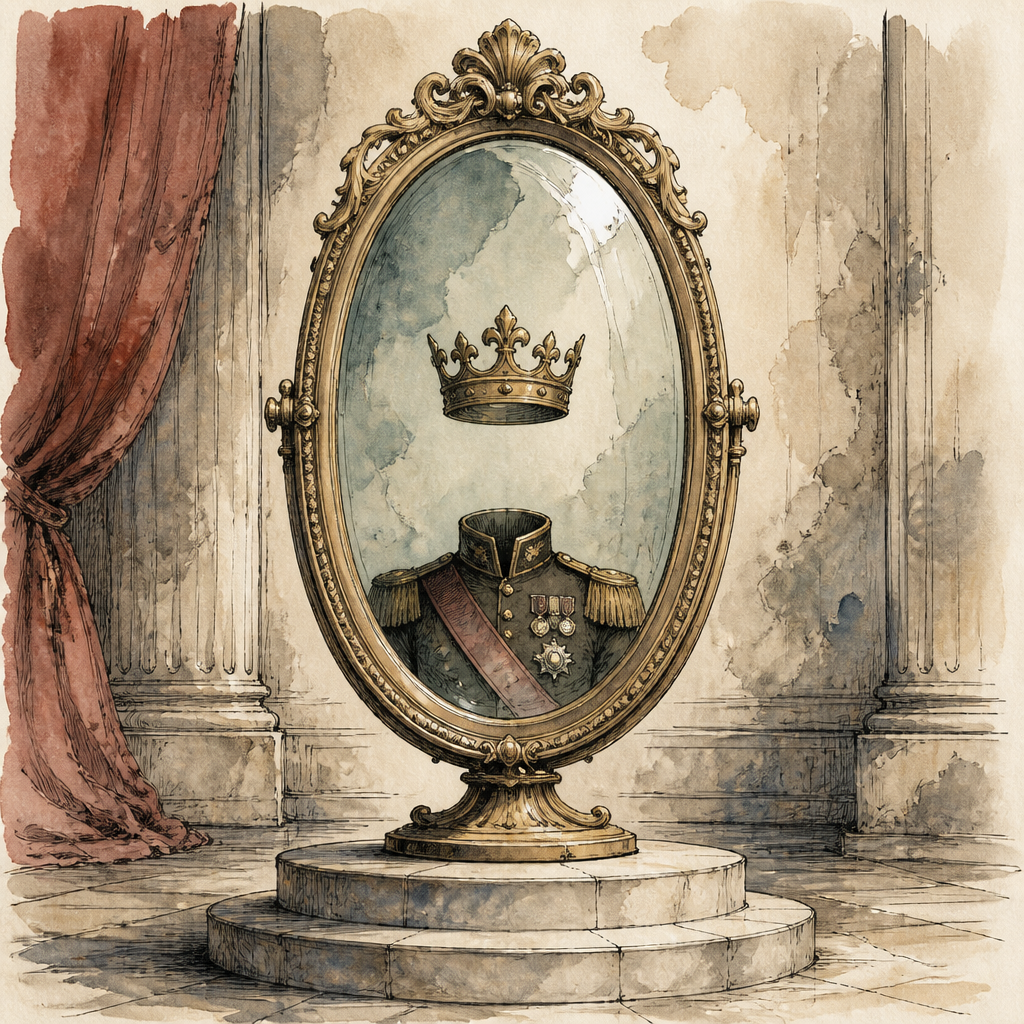
A mirror does not ask whether the face in it is wise. It only flatters. That is precisely its danger for a man who already distrusts contradiction.
The tell: who gets to be wrong
Here is a useful test for any leader, strongman or otherwise: can his own country safely tell him he is wrong? In Moscow, a bridge collapsing under enemy fire will not be reported as an engineering question but managed as a morale question — because admitting the bridge was vulnerable is close to admitting the man was too. In a functioning democracy, by contrast, an embarrassing failure gets an inquest, a parliamentary question, a free press asking annoying follow-ups. That tedious, unglamorous friction is not weakness. It is the immune system.
Personality cults are expensive precisely because they remove that friction. Decisions get made to please a mirror rather than to survive contact with reality. Ask Crimea's bridge planners how that worked out.
Small machines, same old question
Fittingly, this same week diplomats are meeting at the UN to argue about autonomous weapons — so-called killer robots, machines meant to decide, without a human in the loop, who lives. The debate sounds futuristic, but the underlying question is ancient and familiar: what happens when accountability is designed out of a system, whether the system is a drone swarm or a presidency that brooks no correction? A machine that cannot be questioned is dangerous. So is a man who has arranged his country so that no one dares question him either.
What is wise here
It would be too easy — and too lazy — to simply mock the men in the photographs. Trump, Putin, Xi are not identical, and flattening them into one caricature would be its own kind of dishonesty. But there is a shared habit worth naming without shouting: certainty performed for cameras, dressed up as strength, while the actual test of strength — can you survive being told you are wrong? — goes conveniently untaken.
Democracies are not immune to vanity. But they are supposed to be structurally allergic to permanent certainty, because elections, courts, and a free press exist precisely to put cracks in anyone's bridge before the enemy has to. That friction is annoying. It is also, so far, the best defence against building your entire country around one man's reflection.
The next time a leader insists a thing is permanent because he says so, it might be worth remembering a stretch of road over the Kerch Strait, recently relearning what every bridge eventually learns: nothing stands on reputation alone.