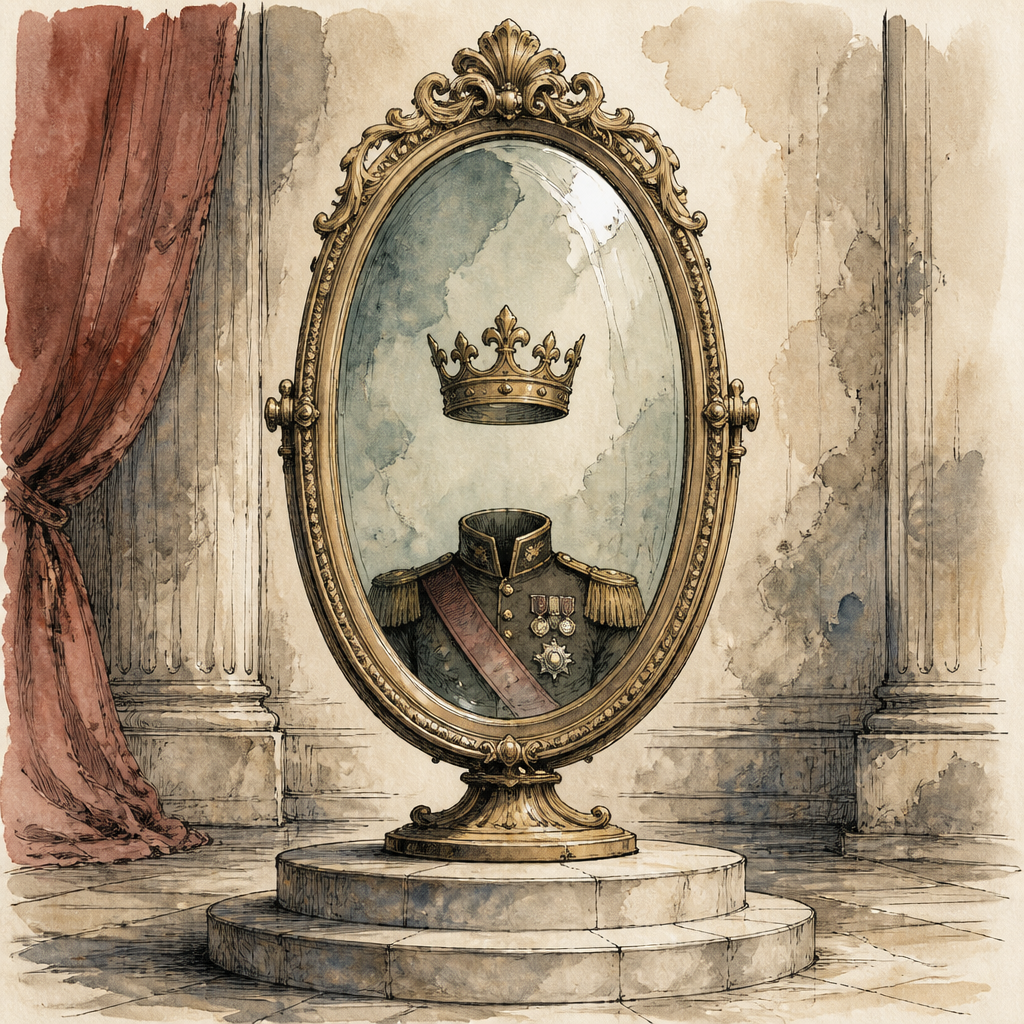
A Mirror Has No Opinion
Mirrors are honest by accident. They show whatever stands in front of them, without flattery, without spin. The strongman's trouble is that he never quite trusts one. He prefers a different kind of mirror — a crowd, a loyal ministry, a flag draped just so — something that reflects back exactly the face he wants to see.
This week gives us three small mirrors, each cracked in its own way.
Berlin's Storm Is the Point, Not the Problem
In Germany, Chancellor Friedrich Merz went after the AfD in a debate loud enough to make headlines, after the far-right party's recent election gains. Commentators call it stormy, as if storms were a design flaw in democracy rather than its weather system.
Here is a modest question worth sitting with: what would it mean if the debate had been calm instead? A parliament that argues, interrupts, and loses its temper in public is a parliament still doing its job — testing claims out loud, in front of citizens who get to judge the performance. The strongman's parliament, by contrast, is usually very calm. Calm because dissent has already been arranged out of the room beforehand.
Noise is not proof of health. But total silence is fairly reliable proof of something else.
Renaming the Furniture
Across the Atlantic, the intelligence community is being "overhauled," reportedly in the name of rooting out a "Deep State." It is worth asking, gently: which state, exactly, is this? Analysts who assess troop movements. Officers who track enrichment facilities in North Korea. People whose job is to tell power things it may not want to hear.
Every government has a bureaucracy that occasionally embarrasses its leader by being right about something inconvenient. Calling that bureaucracy a hidden enemy is an old move, and a clever one, because it lets a leader replace expertise with loyalty and call it reform. The furniture hasn't changed. Only the label on the door has — and the people now expected to agree with the label before they're allowed to sit at the table.
A democracy can absolutely reorganize its institutions. That is normal housekeeping. The tell is not the reorganizing. The tell is whether the new arrangement produces people who tell the leader the truth, or people who tell the leader what he already believes.
The Flag on the Map
And then, almost too small to matter, Iceland summoned the American ambassador over a map the U.S. president posted online — countries draped, apparently, in American flags. Reykjavik took it as a symbol worth objecting to formally.
It is tempting to laugh this off as internet ephemera. But symbols are exactly how certainty likes to travel — cheaper than policy, faster than treaties, and legible to millions in a single glance. A flag draped over someone else's country says, without needing footnotes: this is mine to imagine as mine. Iceland's ambassador-summoning is a small, proportionate, entirely democratic answer: we noticed, and we are saying so, on the record, through the normal channels that exist for exactly this purpose.
That is the whole difference in miniature. The strongman communicates through gesture and expects awe. The democracy answers through protocol and expects an explanation.
The Argument, Plainly
So here is the standpoint, not just the irony: prefer the noisy debate to the polite one, the embarrassing intelligence report to the flattering one, and the stiff diplomatic note to the shrug. None of these are comfortable. All of them are what self-correction actually looks like from the inside — untidy, occasionally undignified, and still functioning.
Certainty that never has to check itself in an honest mirror is not strength. It is a man alone in a room, admiring a reflection he arranged himself. Citizens elsewhere still get to ask their leaders inconvenient questions in public and watch how they answer. That habit, however loud, is worth keeping — and worth noticing the day it goes quiet.