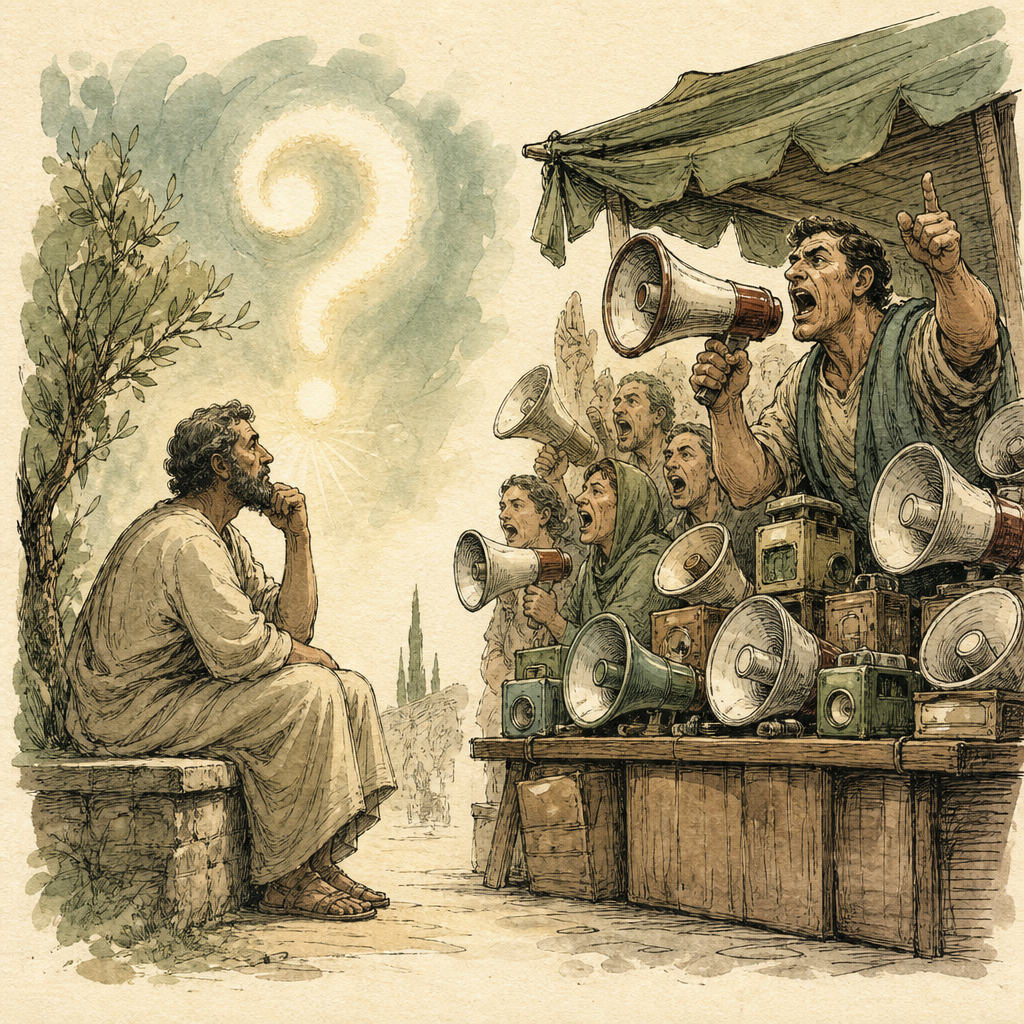
A busy market, two kinds of stalls
Imagine a market square. Most stalls sell ordinary things — bread, questions, doubts, second opinions. But a few stalls sell something else: certainty. No ingredients listed. No return policy. Just a confident vendor and a line of customers who are tired of thinking.
This week's global square has several such stalls open at once. In Germany, pollsters describe a political center squeezed from both sides, as far-right and far-left parties gain ground by offering the public something the center rarely promises: a final, simple diagnosis of what has gone wrong with the country, and a final, simple cure. In Brazil, the two leading presidential candidates are reportedly competing over who sounds more certain about crime — tougher, faster, more absolute — while Brasília and Washington trade accusations about whose democracy needs correcting from outside. Different countries, same stall design.
Why certainty sells so well
Certainty is a good product precisely because it removes the one thing democracy asks citizens to keep doing: deliberating. A ballot box is an invitation to keep asking questions, election after election, forever. A certainty stall promises you can stop. That is its appeal, and also its danger — because a political movement that has stopped asking questions about itself has usually also stopped listening to anyone who disagrees with it.
Notice the shape of the argument on both of Germany's flanks: the far ends agree on almost nothing except that the center is naive, exhausted, and no longer worth defending. That agreement between opposites should itself raise an eyebrow. Two people shouting from different directions that doubt is weakness are, in effect, promoting the same product.
The crime question, asked twice
In Brazil, the contest over who sounds tougher on crime is familiar to any democracy that has watched a security debate get reduced to volume. Toughness is not the same as effectiveness, and certainty is not the same as a plan. The honest question a voter can ask a candidate is not "how hard do you sound?" but "what, specifically, changes the day after you win?" A candidate who answers with a number, a timeline, and an institution responsible for delivering it has offered something closer to policy. A candidate who answers with resolve alone has offered something closer to theatre.
One more question, not zero and not a hundred
Common sense does not mean refusing all conviction — a newspaper that only shrugs is as useless as one that only shouts. The skill is narrower than that: before accepting the loudest answer, ask one more question. Who benefits if I stop asking? What would change my mind? Has this diagnosis been tested anywhere, or only promised? That single extra question rarely overturns a good argument. It reliably exposes a bad one.
This is also why institutions — courts, independent election commissions, a free press, a boring but functioning center — matter more than their critics admit. Their job is structural scepticism: to keep asking the question after the crowd has decided the answer is obvious. Weaken them, and you don't get more clarity. You get a market with only certainty stalls left, and customers who have forgotten bread was ever an option.
The stance
So here is the standpoint, plainly: prefer the party, the candidate, and the country that can tolerate one more uncomfortable question over the one that offers the most confident final answer. Not because doubt is noble for its own sake, but because a democracy that forgets how to ask has already decided, quietly, to stop being one. The stall selling certainty will still be there next market day. The wiser shopper walks past it slowly, and asks the vendor one question before buying anything at all.