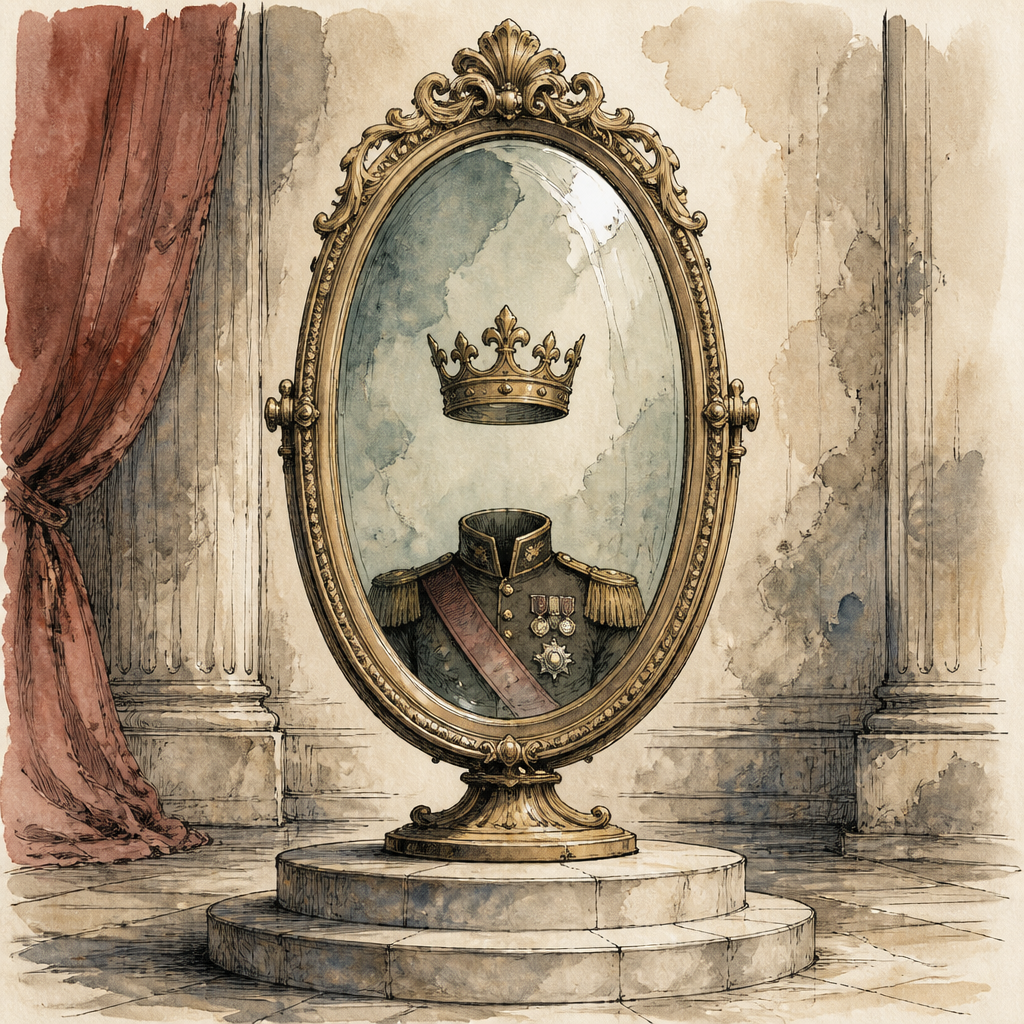
Two Ways to Read Your Own Reflection
On the same weekend, two leaders looked into very different mirrors.
In Germany, Chancellor Friedrich Merz called his party's state election result a "disaster." Not a triumph reframed. Not an enemy's plot. A disaster, in his own word, on the record, and then a promise to stay and keep pushing reforms anyway. It is a strange kind of political courage: admitting the mirror is cracked, and standing in front of it regardless.
Meanwhile, from Washington came a different plan for a different kind of monument. The president described a triumphal arch that would double as a military complex — drones overhead, snipers on watch. A triumphal arch, historically, is built to celebrate a nation's victory and let citizens walk beneath it in peace. This version comes pre-fortified, as though the arch itself expected to be attacked, or as though the man beneath it did.
What does a leader defend when he defends his own celebration?
The Mirror That Only Shows Glory
Here is a useful test for any government, democratic or otherwise: does it have a mirror, and does it let the public see what's in it?
Merz's mirror showed him something ugly, and he described it accurately before an audience that will vote again. That is unglamorous. It will not trend as inspiring. But it is what self-correction looks like in practice — a leader naming a failure without immediately pivoting to blame the mirror-maker.
Compare this to a mirror surrounded by its own security detail. A monument that anticipates attack the way it anticipates applause is not really a triumphal arch anymore; it is a fortress wearing a triumphal arch's clothes. It suggests a certainty so total that even celebration must be guarded — not celebration of a shared victory, but of a person who cannot risk being seen without protection, even at his own party.
One might object: leaders get threatened. Security is not vanity. Fair. But there is a difference between protecting a person and re-engineering a national symbol into a personal perimeter. The first is prudence. The second is a monument to certainty that brooks no accident, no crowd, no unscripted moment — the architecture of a man convinced the story is entirely about him.
Real Drones, Real Stakes
It is worth setting this theatrical fortification against an actual, ongoing use of drones this week: Ukraine's largest strike yet on Moscow, hundreds of drones sent toward a capital in an actual war, in actual defense of an actual invasion. There, drones are not decoration. They are the blunt vocabulary of a country fighting for the right to hold its own elections at all, disasters and all.
It would be a strange century that mistook a costume of fortification for the real thing while a real war used the real thing to survive. Strongman aesthetics — the arch bristling with defenses nobody asked for — borrow the imagery of siege without paying its price. That is precisely what should make citizens in stable democracies uneasy: not the drone itself, but the appetite for looking permanently under siege, at home, by choice.
The Wiser Bet
So which mirror is wiser to build a country around — the one that shows disaster and stays standing, or the one that arms itself against ever being questioned?
The answer is not close. A democracy's whole design is to survive bad election nights without shattering; a strongman's whole design is to ensure there are no bad nights left to survive, because no result is ever allowed to be called a disaster in the first place. Between a chancellor pressing reforms after admitting failure, and an arch fortified against its own crowd, choose the one still capable of embarrassment. Embarrassment, oddly enough, is a sign the mirror still works.