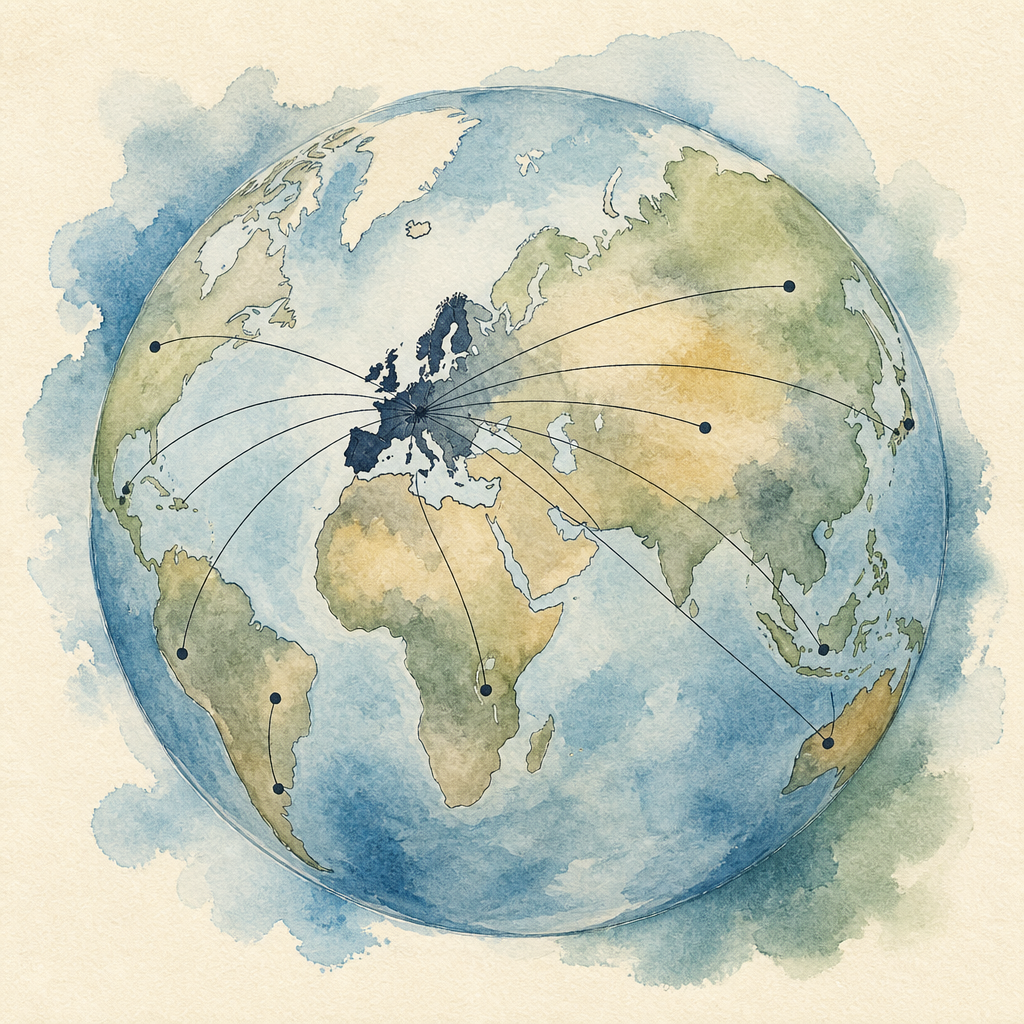
A failed group project
The longest UN climate talks on record just ended with no deal. Divisions exposed, as the wire services put it — a tidy phrase for a messier truth: the world's governments, including some of its oldest democracies, sat in a room for weeks and could not agree on fossil fuels.
This is not a story about villains. It is a story about coordination, which is the less glamorous half of democracy and the half most often skipped. Twenty-seven European states, plus assorted partners, each arrived with a sensible national position. None of them, apparently, arrived with the same one.
A war that no longer respects the map
Meanwhile the war in Ukraine keeps demonstrating something uncomfortable: it is not staying where it started. Reports describe the conflict spilling into NATO territory. A Ukrainian drone strike reportedly sank a Russian warship in Libya — a detail that would have sounded like fiction three years ago and now reads as Tuesday.
Geography used to do some of Europe's thinking for it. Borders implied distance, and distance implied safety. That assumption is retiring. A continent whose security depends on separate national reflexes, each watching the news and deciding independently what to do next, is not a continent with a defence policy. It is a continent with twenty-seven opinions and one shared vulnerability.
The cracks at home
And then, almost as a footnote beside the drone strikes and the broken climate talks, a smaller headline: flights cancelled in Belgium over a cost-of-living strike. It is tempting to file this separately, under domestic affairs, far from the grand questions of war and climate. That temptation should be resisted.
A union that asks its citizens to absorb inflation quietly while it debates grand strategy abroad is asking for exactly the backlash it will eventually get. People do not object to solidarity. They object to solidarity that seems to flow outward while nothing flows back. If Europe wants its citizens to support a common voice on Ukraine or climate, that voice has to sound like it also hears them.
The case for more Europe, not more paperwork
Here is the argument, stated plainly rather than hinted at: Europe needs deeper cooperation now, precisely because these three stories — the climate deadlock, the spilling war, the grounded flights — are symptoms of the same disease. Fragmentation. Twenty-seven governments negotiating climate policy as twenty-seven delegations. Twenty-seven defence ministries watching the same drone footage and reaching for twenty-seven different phones. One continent, many solo acts, badly out of tune.
But say this carefully, because the easy mistake is to answer fragmentation with its opposite excess: more forms, more committees, more Brussels memoranda that nobody outside Brussels reads. That cure has its own symptoms, and European voters have shown, repeatedly, that they can smell bureaucracy for its own sake and will vote against it, sometimes by voting against democracy itself. The goal is not a thicker rulebook. It is a clearer one — a shared position at the climate table, a shared signal on defence, a shared sense that economic strain is a European problem and not merely a Belgian one, achieved with the fewest possible forms rather than the most impressive ones.
What a chorus requires
A chorus does not need every voice to sing the same note. It needs every voice to know which song is being sung. Europe's liberal democracies do not need to erase their differences — on energy mix, on fiscal caution, on how fast to move — to act, for once, like participants in the same performance rather than competitors in adjacent ones.
The climate talks will reconvene. The war will not wait politely for Europe to find its voice. The citizens grounded by a Belgian strike will remember whether anyone in Brussels seemed to notice. None of these are separate tests. They are the same test, asked three different ways: can a union of free, disagreeing peoples act together when it actually matters, or only when it is easy?
The honest answer, this November, is: not yet. The useful question is whether that answer will still be true in a year.