A Boring Vote, and Why That Was the Point
Alberta held a referendum on independence this week. Voters said no. Canada stays Canada. Nobody stormed a parliament, nobody needed a hero, nobody will write songs about it.
That is the quiet trick of a healthy democracy: its most important moments are allowed to be boring. A province argued, counted, and accepted the count. Compare that to the places where a vote against the centre becomes a crisis requiring tanks, or a vote for the centre becomes a crisis requiring exile. Alberta reminds us what ordinary courage looks like — showing up to object, or to reaffirm, before the stakes have been raised to the point where objecting requires bravery rather than a ballot.
The Oslo Room Where Nobody Is Shouting
Meanwhile in Oslo, American envoys and Ukrainian officials have been talking, while Washington's own secretary of state denies that intelligence is being withheld from Kyiv. Nobody is shouting. That is worth noticing, not reassuring.
Habits of accommodation rarely announce themselves. They arrive as a softened phrase in a briefing, a meeting moved, a question left unasked at a podium. If a democracy is quietly adjusting its posture toward the country that invaded a neighbour — becoming, in small procedural ways, friendlier to the aggressor than to the invaded — the moment to ask "why" is now, while the shift is still a set of meetings and not yet a settlement written on someone else's land. Allies of Ukraine do not need to wait for a dramatic betrayal to say, politely and early, that they are watching the pattern.
A Car, a Lawmaker, and the Word "Accident"
In Australia, a lawmaker lies critically injured after being hit by a car, and the prime minister has already said plainly: this was no accident. A man has been charged. The suspect's own father calls the victim a family friend — the ordinary tragedy of political violence landing inside an ordinary life.
It would be easy to file this as one unstable individual and move on. But every society that has slid toward normalized political violence can point to a first case that looked, at the time, like an isolated madness rather than a habit forming. The useful question is not "was this political?" — officials have answered that — but "what do we do differently the week after, so that this remains rare rather than becoming a genre?"
Early Courage, Defined
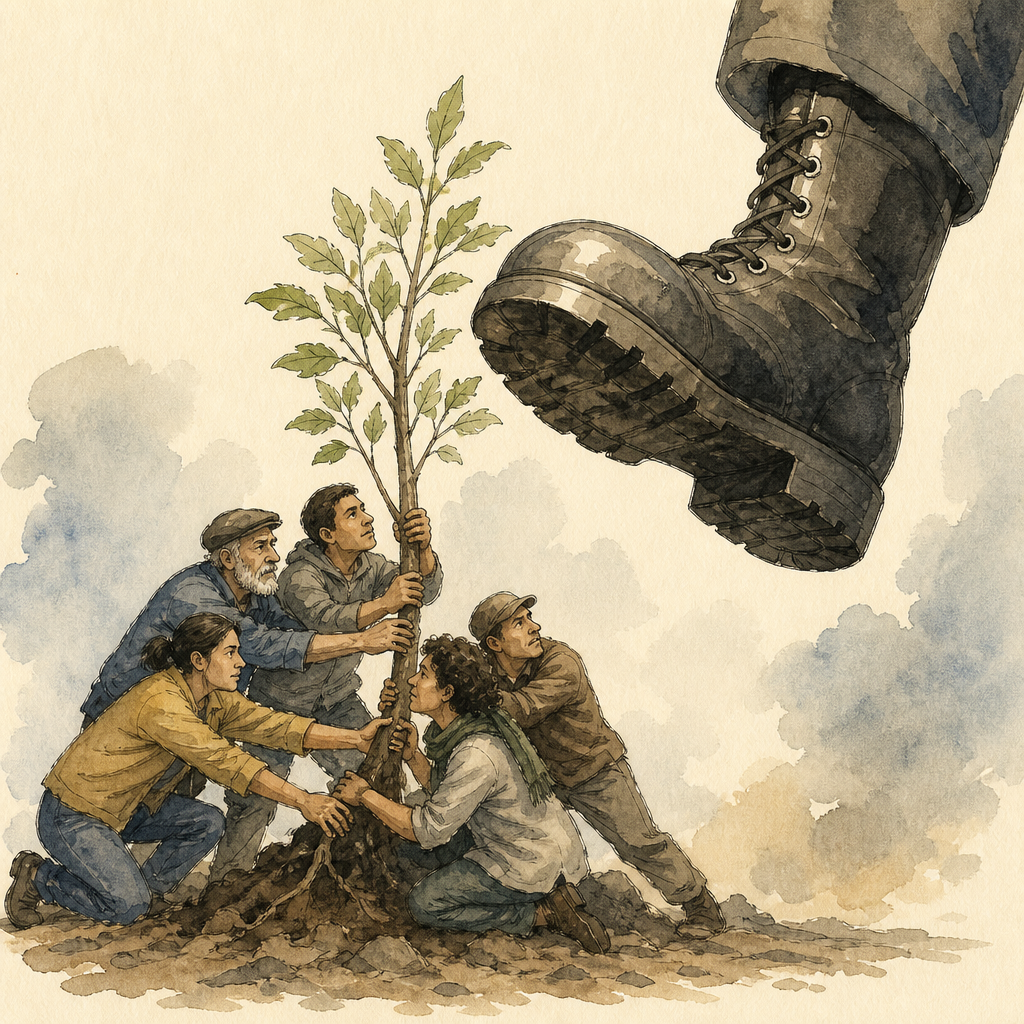
None of this requires panic. It requires a specific, almost unglamorous kind of attention: noticing the drift while it is still cheap to object to it. Alberta's voters practiced this by treating a referendum as routine business rather than a referendum on their own belonging. Oslo's diplomats, and the publics who elected them, could practice it by asking hard questions about an ally's posture while the posture is still just a meeting and not yet a map redrawn. Citizens anywhere can practice it by refusing to let one attack on one politician become background noise.
The discouraging truth about authoritarian habits is that they are never dramatic until suddenly they are. The encouraging truth is the opposite: resisting them is never dramatic either, right up until it works. Writing a letter, voting no on a Tuesday, asking a minister an uncomfortable question in a quiet room in Oslo — none of it will make the news the way a crisis does. That is not a flaw in early courage. It is the entire point of it.
Wait for the dramatic moment to object, and you will likely be objecting to something already finished. Object while it is still ordinary, and you may never need the drama at all.