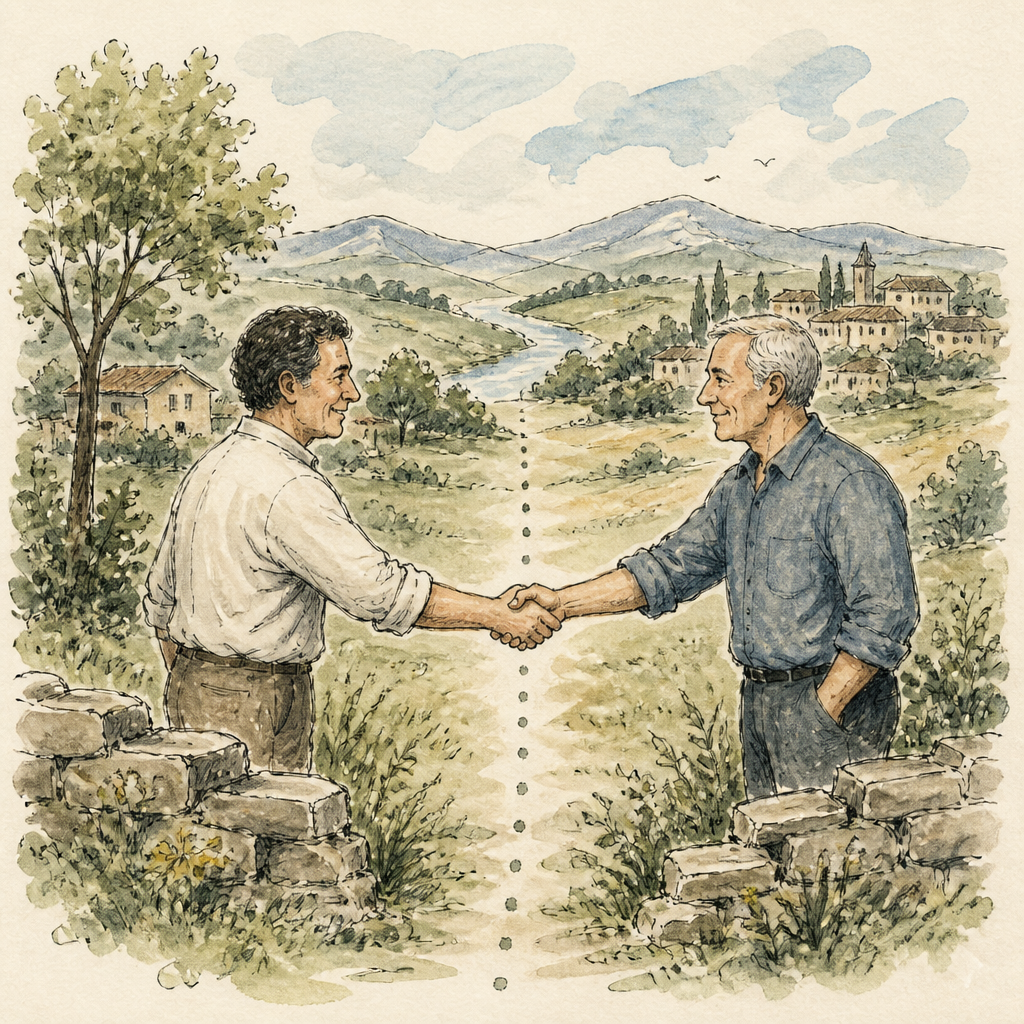
Two doors, one summer
This week, Europe rehearsed two versions of itself.
In France, wildfires forced evacuations, and thousands of people were bused out, sheltered, and — as the heat broke — sent home again, with neighbouring countries' fire crews and coordination quietly doing their unglamorous work. Nobody held a press conference to announce that French villagers deserved rescue. It was simply done, because that is what a shared civil-protection system is for.
At almost the same hour, tens of thousands of people crossed from Morocco into Ceuta, the Spanish enclave on African soil. Dozens died in the crush at the fence. Spain's prime minister called it the work of traffickers.
He may be right that organised smugglers profited from the chaos. Traffickers usually do. But notice the shape of the sentence: it moves the story away from questions a democracy might otherwise be asked — about reception capacity, about what pushed 60,000 people toward a fence in the first place, about why a wall this news-worthy still surprises anyone in August 2026. Blaming the middleman is not false. It is simply the easiest true thing to say.
What "neighbour" is doing in that sentence
A neighbour, in the old sense, is someone whose fire you help put out even if you don't like their fence, their politics, or their accent. The word does not come with a citizenship test attached. It comes with proximity and need.
Europe is comfortable extending that word inward — French villager to Spanish firefighter to German engineer, all trading resources through institutions built for exactly this. It is far less comfortable extending the same word across the Strait of Gibraltar, where proximity is even shorter and need, self-evidently, greater.
This is not an argument for open borders as slogan. A democracy that cannot say how many people it can house, register, and process is not being generous; it is being disorganised, and disorganisation at a border produces exactly the deaths Ceuta saw this week. Orderly arrival, fair asylum procedure, and enforceable law are not the opposite of neighbourliness — they are its practical form. A country with no functioning door is not a hospitable country. It is a country waiting for a wall to fail.
The test, then, is not whether Spain controls its border — of course it must. The test is whether the language used to explain the deaths at that border is honest about all four causes at once: traffickers, yes, but also drought and conflict pushing people north, and a European asylum system that has spent a decade being reformed on paper and rebuilt too slowly in practice.
The revenge logic, and its opposite
Compare this, for contrast, to a settler in the West Bank telling a reporter this week that attacks on Palestinians are justified as revenge. That sentence, too, is a shortcut — from grievance straight to entitlement, skipping the part where a shared future has to be negotiated between people who are not going anywhere. It is the exact inversion of neighbourliness: proximity used as licence for harm rather than reason for restraint.
Democracies do not get to claim the moral high ground over such logic by pointing at it from a distance. They earn that ground, slowly, by demonstrating — at their own fences, in their own headlines — that proximity produces responsibility, not revenge and not evasion either.
A small, telling footnote
And since the week also gave us a diplomatic map of Africa with every country mislabelled at a US-hosted conference, perhaps the smallest test of all is this: you cannot be a good neighbour to a continent whose shape you have not bothered to learn. Names matter. Borders drawn correctly on a map are a modest but real form of respect.
So here is the standpoint, weighed rather than shouted: control your borders, yes — democracies that cannot are not being kind, they are being careless. But do not let "traffickers did it" become the whole sentence. The fire truck that crosses a border without asking whose flag flies there is the better rehearsal of what these institutions were built for. Ceuta deserves the same instinct, not a different vocabulary.