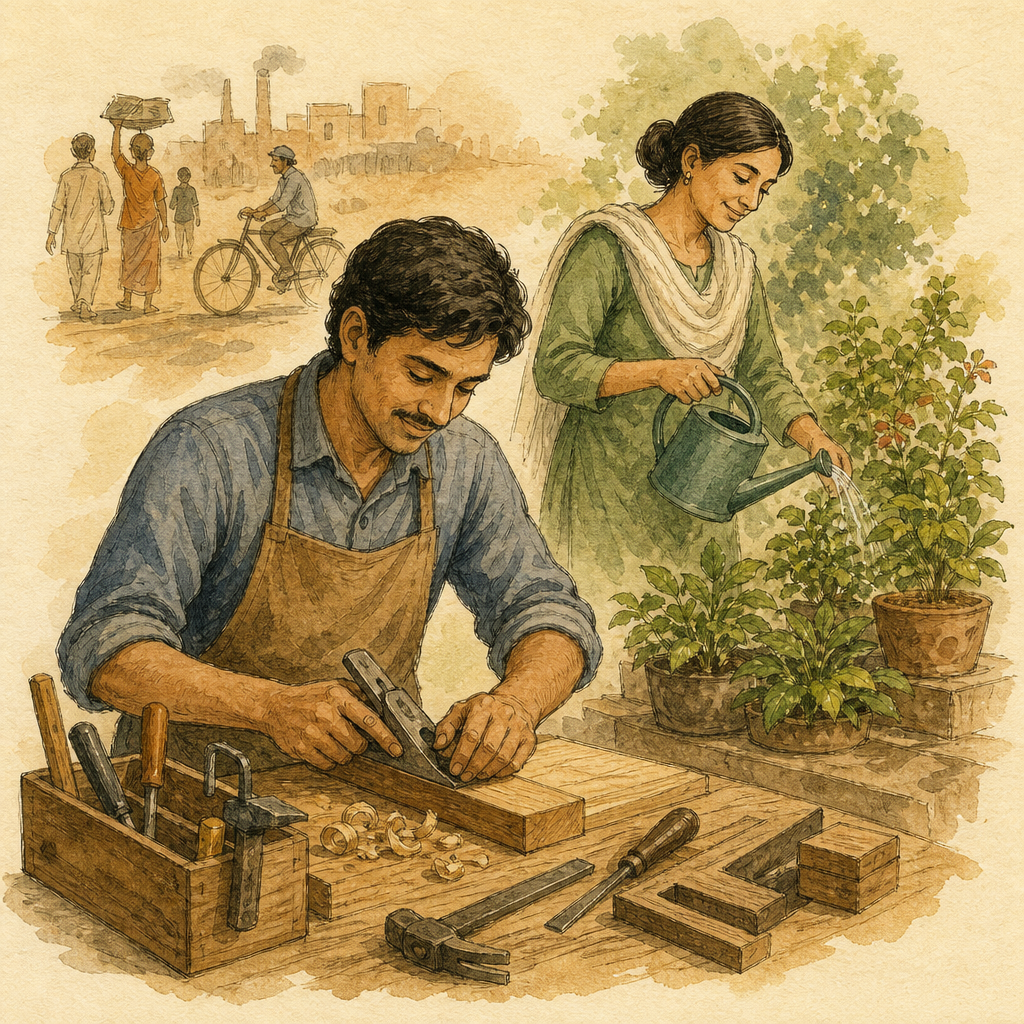
Two failures of the same idea
Somewhere near Ceuta, young men who crossed a fence are now waiting on the street, uncertain of their papers, uncertain of tomorrow. Somewhere in earthquake-damaged Japan, two workers went back into a mall on their boss's order and did not come out. Different continents, different headlines. But look closer and both stories are about the same fragile deal: the deal between a person willing to work and a system that decides whether that willingness counts for anything.
We like to say work gives dignity. It is one of the oldest agreements in any decent society — you contribute, and in return you are treated as someone who matters. But an agreement only holds if both sides keep their end. This week, on two continents, one side clearly did not.
The one who wants to work and cannot
The men who reached Ceuta did not cross a border for tourism. Whatever the exact mix of hope, desperation, and rumor that pushed them there, most came looking for the most ordinary thing: a job, a wage, a way to send something home. That is not a threat to European civilization. It is, if anything, a request to join it on its own terms — contribute, earn, belong.
Instead they wait in limbo, and Ceuta's own leader calls what happened at the border an atrocity, while Rabat says it bears no responsibility. Deaths near a hundred are now a statistic to be argued over rather than a tragedy to be answered for. The EU's interior ministers meet on Tuesday. One hopes they discuss not only fences, but visas — because a continent that needs workers and a generation that wants work should not have to meet each other through barbed wire and blame.
Dignity of work is not just a phrase for people already employed. It includes the harder question: does a society make room for people who are asking, quite reasonably, to earn their place in it? Turning that question into a purely security matter is cheaper than answering it, but it is not wiser.
The one who worked and was sent back in
The mirror image sits in Japan. Here the workers were not asking for a chance — they already had jobs, already belonged, already contributed. And when a boss ordered them back into a quake-damaged mall, that trust was spent for them without their consent. They followed instructions. The blast that followed was not their failure of judgment; it was someone else's failure of care.
Dignity of work cuts both ways. It asks the willing to show up and contribute rather than treat idleness as a virtue. But it equally asks employers and institutions not to treat that willingness as something to be spent recklessly. A worker who does as told should not have to gamble his life on a supervisor's confidence. Reciprocity is not a slogan for migrants alone — it belongs on the factory floor too.
What a decent contract looks like
So here is where both stories meet. A healthy idea of work requires two honest promises. Societies must open real, legal paths for those who can and want to contribute — not because compassion is limitless, but because turning away willing hands wastes exactly the labor an aging Europe claims to need. And employers, and the states that license them, must never treat a worker's obedience as an excuse to skip the harder, costlier duty of keeping them safe.
None of this requires romance about borders or employers. It requires arithmetic and memory: remembering that every migrant at a fence and every worker on a factory floor is answering the same call a decent economy is supposed to send — come, contribute, and in return, be treated as someone whose life is worth more than the shift.
That is not charity. It is neighbourliness with a ledger. And it is cheaper, in the long run, than fences that fail and floors that collapse.