Three Small Tests, One Large Question
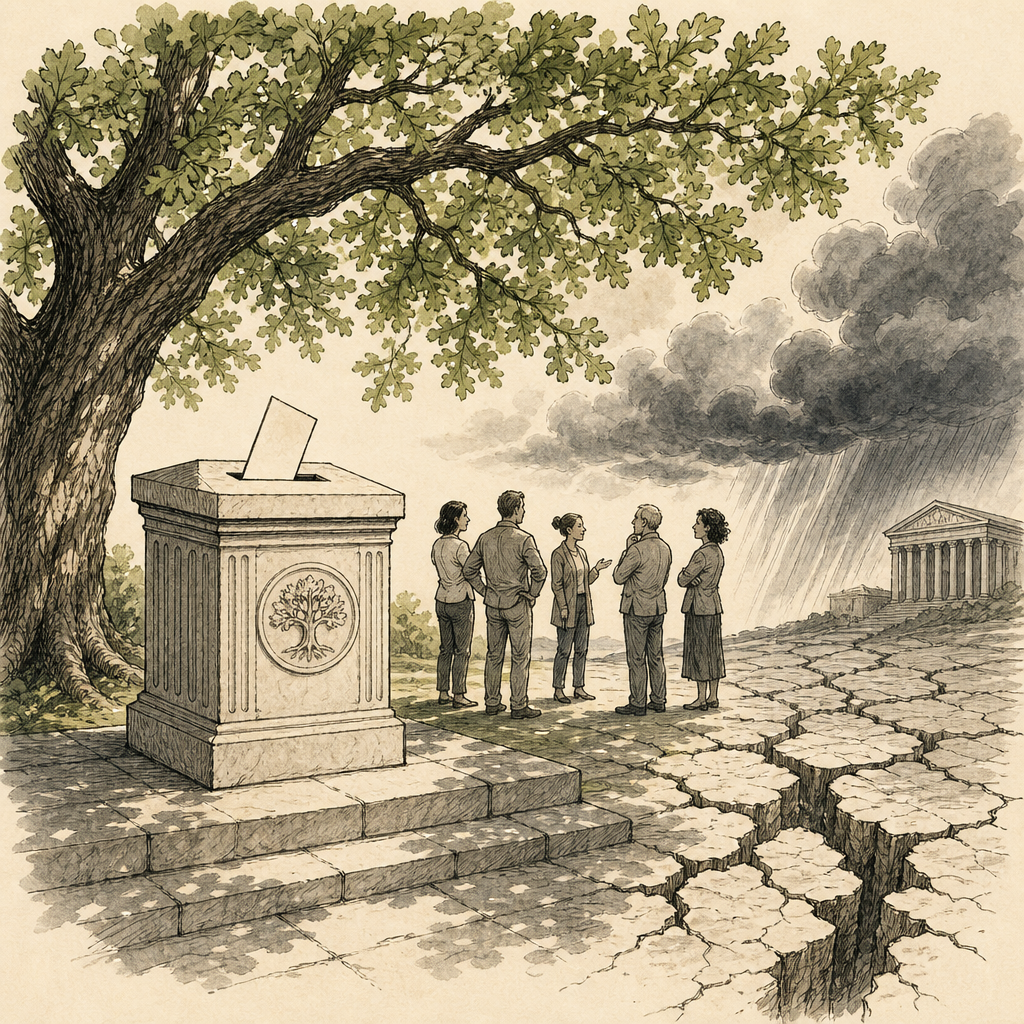
Democracies rarely fall in a single afternoon. They erode in weeks like this one, when several small tests arrive together and nobody notices they are the same exam.
This week: tens of thousands crossed into the Spanish enclave of Ceuta from Morocco, dozens died in the attempt, and Madrid's government called the response of some fellow EU states "selfish." A former Peruvian president walked free after a court overturned his fifteen-year corruption sentence. And in the West Bank, a settler told a reporter that attacks on Palestinians were simply justified revenge.
Different continents, different headlines. Same quiet question: what happens to a shared rule when honoring it becomes costly?
The Fence: Solidarity as a Democratic Muscle
A border crisis is, among other things, a stress test for whether neighboring democracies still believe they are in something together. The European Union is not a charity; it is a bet that member states will share burdens they did not individually create, because the alternative — each nation quietly building its own wall of indifference — is how unions dissolve into a collection of frightened islands.
Calling another government's response "selfish" is easy. Harder is asking whether one's own instinct, faced with sixty-seven deaths and a sudden crowd at the fence, is to reach for shared procedure or to reach for a wall. Every time a democracy answers a crisis by closing ranks instead of opening a meeting, it rehearses a habit that authoritarian politics is built on: the idea that borders exist to keep responsibility out, not just people.
The wise position is unglamorous: hold the emergency summit, share the burden by formula rather than by outrage, and treat the people on the fence as a humanitarian fact before they become a political football. Nothing about that is thrilling. It is also the only version of the story where nobody drowns for a headline.
The Judge: Does the Court Bend for Everyone, or Only for Some?
A reversed fifteen-year sentence should make any citizen ask a fair question, not a cynical one: was the original verdict flawed, or did power simply find a later court more sympathetic? Democracies need appellate courts that can correct real errors — that is a feature, not a scandal. But the same mechanism, in the hands of a captured judiciary, becomes the exit door through which the powerful walk free while ordinary defendants do not.
The test is not whether a conviction is overturned. The test is whether the same court, applying the same reasoning, would free a poor man too. Readers who cannot answer that question about their own country's courts have found, without meaning to, the exact seam where democracy is thinnest.
The Settler: When Revenge Wears the Robes of Law
The most telling sentence in this week's news may be the quietest one: a settler explaining that attacks on Palestinians are simply justified revenge. Not law. Not a court. Not even a claim of self-defense in the moment — revenge, stated plainly, as its own justification.
This is what it looks like when a state's monopoly on legitimate force quietly changes hands to whoever feels wronged enough. No dictatorship announces itself by decree first; it announces itself when citizens stop asking a judge and start asking themselves whether they feel entitled to punish. A free society survives only as long as "I felt justified" remains a private feeling and not a public defense.
Why Defend the Boring Machinery
None of these three stories is thrilling. Summits, appellate rulings, and the slow grinding insistence that revenge is not law — none of it trends. But this is precisely the muscle that keeps a society from sliding, headline by headline, into rule by whoever is strongest or angriest that week.
Defending democracy is rarely a barricade moment. Usually it is choosing, again, the tedious meeting over the wall, the appeal that applies equally over the appeal that applies selectively, and the courtroom over the alibi of revenge. Notice when a society stops choosing those things. That is the moment to protest — while protest still works.