A shop window and a newsroom door
In Germany this week, cost-of-living protests turned violent and shops were looted. In Egypt, a government fined the editor Lina Attalah and shut Mada Masr, one of the country's last independent outlets. Two very different events, half a continent apart. But put them side by side and a useful question appears: which of these is actually dangerous to a democracy, and which merely looks dramatic on camera?
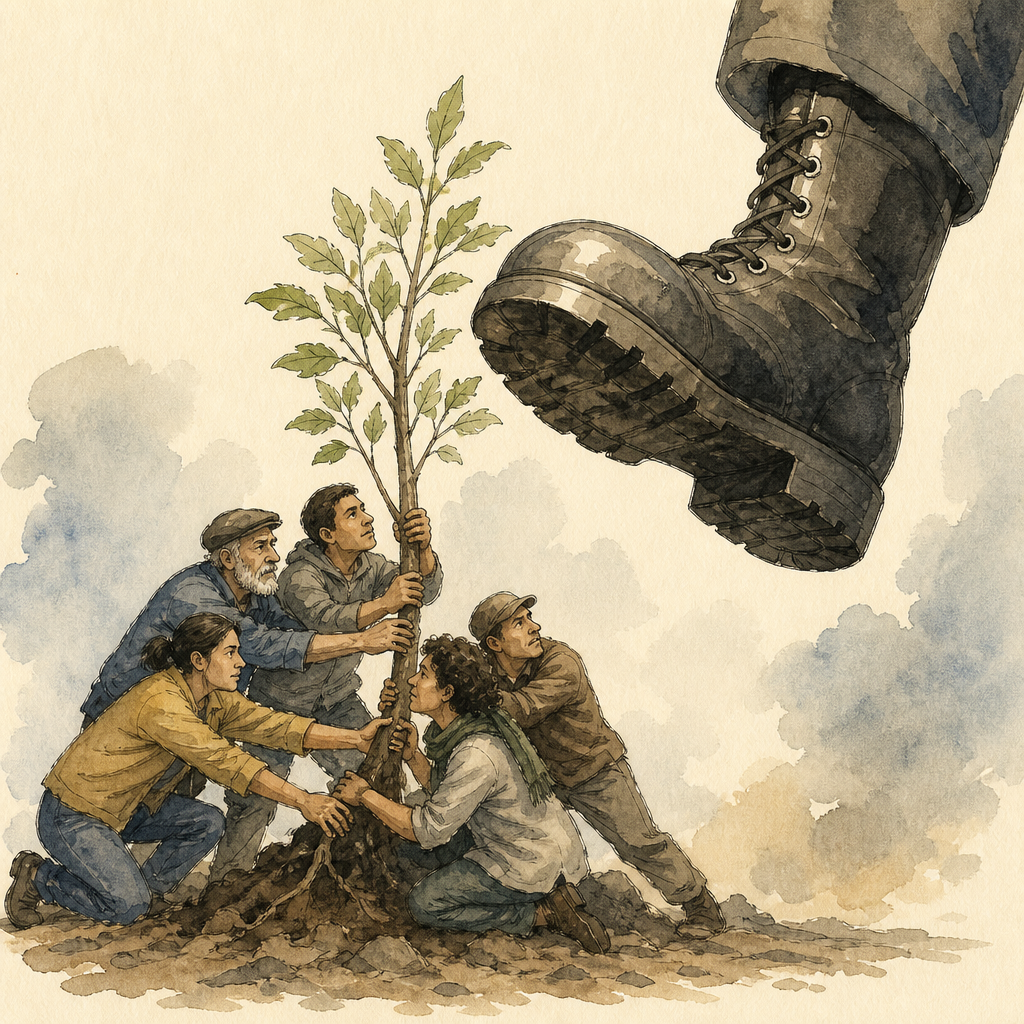
A broken shop window is ugly, costly, and instantly photogenic. A fine against one editor, and the quiet closing of one newsroom, barely makes the evening bulletin outside the country concerned. Yet the second is the one that should worry a careful reader more. Looting burns itself out in a night. A silenced press stays silenced for years, and nobody rings a bell when it happens.
Habits, not headlines
This week's commentary on Serbia and Hungary made the point in a different register: Vučić's unraveling is said to mirror Orbán's. Read that not as gossip about two men but as a pattern. Power does not usually announce itself as authoritarian. It arrives as a habit — a friendly regulator, a media license delayed, an editor fined for an administrative technicality, a court appointment that happens to be convenient. Each habit, alone, is defensible. Together, over a decade, they are a different country.
That is precisely why the moment to object is the boring moment — the first fine, not the tenth crackdown. By the time a habit has calcified into a system, protest becomes expensive, sometimes impossible, and the people who warned early are the ones already in exile or in court.
What hell actually looks like
For a vivid reminder of where unopposed habits eventually lead, read the accounts this week of Ukrainians reuniting with family after years trapped in a Russia-occupied front-line city. "We came back from hell," one said. Nobody in that city woke up one morning to full occupation. It arrived in stages, each one survivable, each one slightly worse than the last, until survival itself became the whole of life. The instinct to say "it's not that bad yet" is exactly the instinct that lets a habit become a hell.
This is not an argument for panic over every new regulation. Most fines are just fines. Most new rules are just rules. The point is attention, not alarm: a free society should notice its own habits the way a careful driver notices drift, correcting gently, long before correction requires a crash.
In defence of the boring protest
Which brings us back to the streets of France and Germany, where youth-led protests have been sweeping Europe over the cost of living. Protest, in its ordinary form — marching, chanting, inconveniencing traffic, embarrassing a minister — is one of the healthiest habits a democracy has. It should be frequent, unglamorous, and entirely unremarkable, the civic equivalent of brushing teeth. A society where protest is normal and bloodless is a society whose immune system still works.
Looting is not that. It is parasitic on protest, borrowing its energy while handing its opponents the only argument they actually need: look what "protest" does. Every government that would rather not be criticised loves a looted shop window, because it lets them change the subject from wages to vandals.
So the stance here is not complicated, even if it asks for some discipline. Protest early. Protest often. Protest loudly, peacefully, and specifically — about rent, about wages, about an editor fined for doing her job. Defend the boring institutions — a free press, an independent election commission, a court that still says no to power — because they are the ones that let habits be noticed before they become hell. And leave the shop windows alone; the people inside them did not design the housing market, and broken glass has never yet lowered a single price.