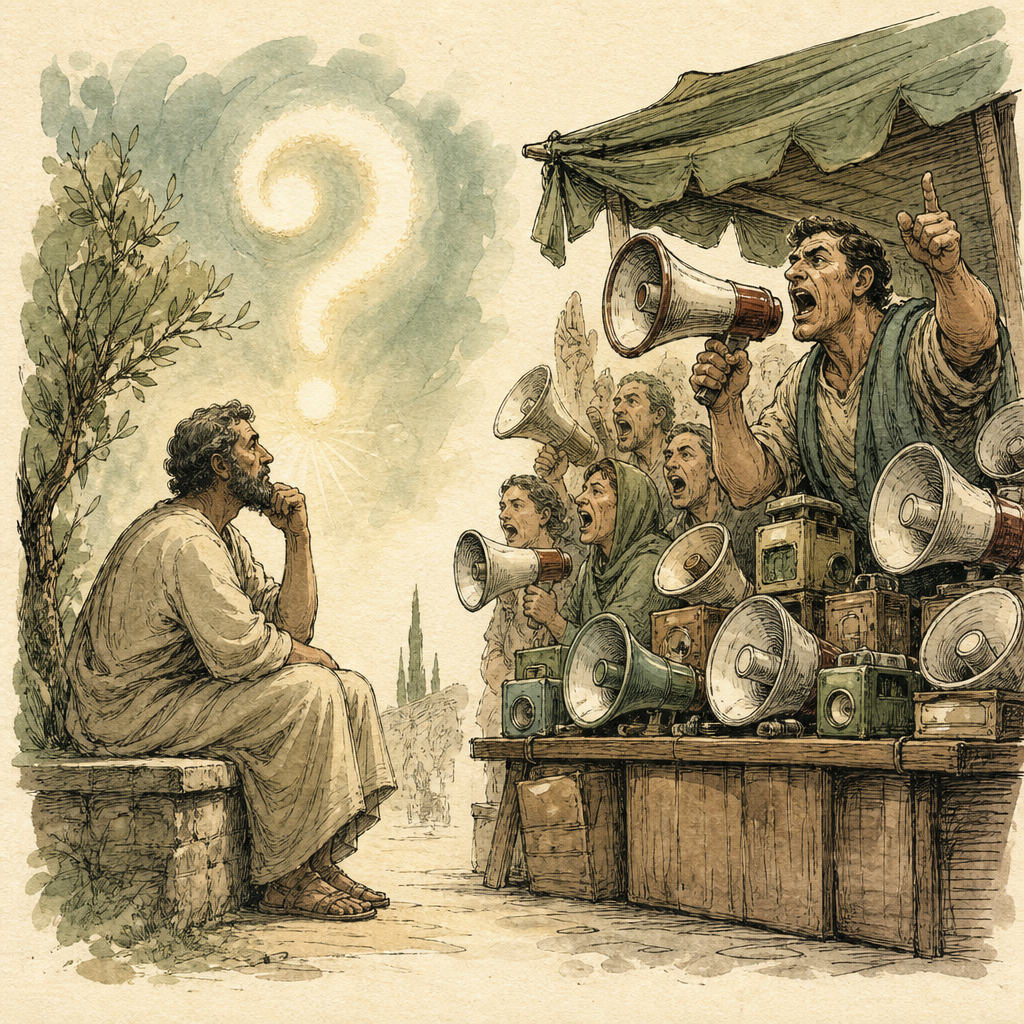
The Price of a Promise
Suppose someone told you that if your team wins in November, every adult in the country gets five thousand dollars. Wouldn't you want to know where the money comes from before you cheered?
This week the promise came from Donald Trump, tied explicitly to a Republican victory in the midterms. Lawyers are already asking whether such a payout is even legal. But legality is only the second question. The first is simpler: why does a democratic election need a cash prize at all? Voters are citizens, not customers being offered a loyalty bonus. A ballot that comes wrapped in a check stops being a ballot and starts being a receipt.
None of this requires outrage. It requires one more question than the headline invites: what does the promise ask of you in return for the certainty it offers?
A War With a Calendar
Also this week, Trump suggested the war with Iran won't end until after the crucial November elections. That is a striking sentence to say out loud. Wars, in the telling of those who fight them, are supposed to end when the enemy is defeated or a settlement is reached — not when a domestic political calendar turns a convenient page.
Maybe there is a strategic logic buried in the remark. Maybe there isn't, and the sentence simply slipped out because campaigns and conflicts have started to share a single clock in the speaker's mind. Either way, a citizen of a democracy is entitled to ask: whose timeline is this war really running on — the battlefield's, or the ballot's? A leader confident enough to say the quiet part about elections and airstrikes in one breath is not hiding uncertainty. He is selling you certainty about something that should never be certain in advance.
An Enemy Inside the House
The same week brought a third certainty: an overhaul of the intelligence community, framed around the phrase "Deep State." It is a phrase built for comfort, not for accuracy. It tells you the problem is not complexity, disagreement, or the ordinary friction of institutions checking one another — it is a hidden enemy, already identified, already guilty.
Every mature democracy needs intelligence agencies that can be reformed, criticized, even overhauled. That is healthy. What is less healthy is skipping the boring democratic question — what exactly failed, and how do we fix it without breaking independent oversight? — in favor of a name that already supplies the verdict. "Deep State" is not an argument. It is a costume certainty wears when it doesn't want to explain itself.
The Discipline of One More Question
Three unrelated headlines, one shared habit: an easy, total answer offered instead of a harder, partial one. A check instead of a functioning fiscal debate. A war's end date instead of a negotiated peace. A villain's name instead of an institutional diagnosis.
Certainty is seductive because it asks nothing further of you. Common sense is less comfortable, because it always asks one more question. Where does the five thousand dollars come from, and who doesn't get it? If the war's end is timed to an election, whose interest does that serve, and does it serve the people actually fighting it? If the state has an enemy within, name it precisely enough that it can be checked by courts, journalists, and voters — not just by the person naming it.
This is not cynicism. Cynicism assumes the worst and stops asking. Common sense assumes nothing and keeps asking, because it trusts citizens to handle a harder truth better than they can handle an easy lie. A democracy's real defense isn't a bigger promise or a sharper accusation — it's a public that has kept the habit of asking one more question before it applauds.