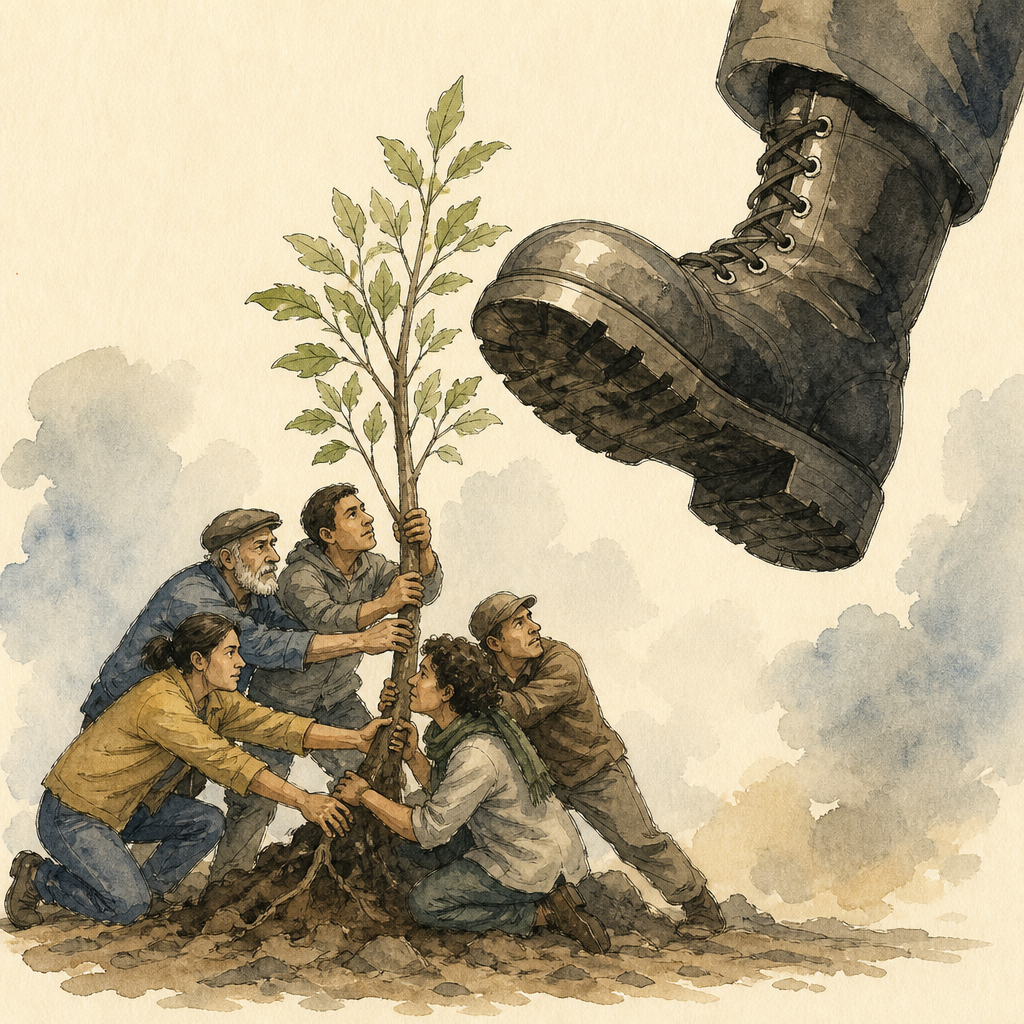
A flare is a small thing, until it isn't
This week a Russian warship reportedly fired flares at a Danish military helicopter. Nobody died. No treaty was broken in the strict legal sense. It was, by the standards of history, a nothing-event — the kind that will not make an anniversary. And that is exactly why it deserves attention.
Authoritarian habits rarely announce themselves with tanks on day one. They announce themselves with a flare that could be an accident, a joke, a test. The point of the flare is to see who blinks, who protests, who quietly decides it isn't worth the paperwork to complain. A habit is just a test that nobody objected to loudly enough, repeated until it becomes normal.
Meanwhile, the boring news is the important news
On the same day, the US Supreme Court declined to let a president's administration narrow how Americans can vote by mail. Also on the same day, a report concluded that the state of American democracy has reached a new low. Also on the same day, the Kennedy Center — an institution built to hold a nation's culture above its politics — is reported to be in financial crisis.
None of these three, alone, is a coup. That is the trick. A court ruling against an overreach is not a headline that trends for long; a cultural institution running out of money looks like an accounting story, not a civics story. But put them side by side and a pattern appears: pressure applied to the electoral machinery, pressure applied to the cultural machinery, and a public report noting, dryly, that the machinery overall is creaking.
The good news, and it is real good news, is that in this case the court held. Judges still said no. That is early courage doing its quiet job — not marching in the street, just three words: "request is denied." Democracies are not saved by heroism alone; they are saved, most days, by boring institutional refusal repeated on schedule.
The gold under the pillow
There is a gentler illustration of the same instinct, half a world away. Turkish households are reported to hold enormous amounts of gold at home rather than in banks — a hedge against inflation that the government now says is quietly starving the economy of investment capital.
It is easy to mock this as superstition. It is wiser to recognise it as a form of protest that stopped being loud. When people no longer trust an institution to hold their savings honestly, they do not always march on parliament. Often they simply withdraw, quietly, one household at a time, and the institution weakens by attrition rather than by confrontation. Multiply that instinct from currency to courts, from banks to ballots, and you have a rough sketch of how democracies fade — not with a bang, but with everyone privately deciding the system can't be trusted, and nobody saying so out loud.
Why loud, ordinary, boring protest is still the cheaper option
Here is the argument, plainly: it is far cheaper to object to a small habit while objecting is still an ordinary Tuesday activity — a letter, a lawsuit, a vote, a headline that gets read and shrugged off — than to wait until objecting requires courage of the dramatic, historical kind. Early courage is unglamorous by design. It looks like filing a brief, showing up to a hearing, asking an uncomfortable question in a press conference, keeping your savings in the system you want to fix rather than under a pillow.
The flare over the Danish helicopter, the mail-voting case, the democracy report, the strained cultural institution, the hoarded gold — none of these require outrage. They require noticing. The reader who notices a small habit and says something ordinary about it — in a vote, in a comment, in a refusal to look away — is doing exactly the unglamorous work that keeps flares from becoming shells. That is not naïve optimism. It is just cheaper, and wiser, than the alternative.