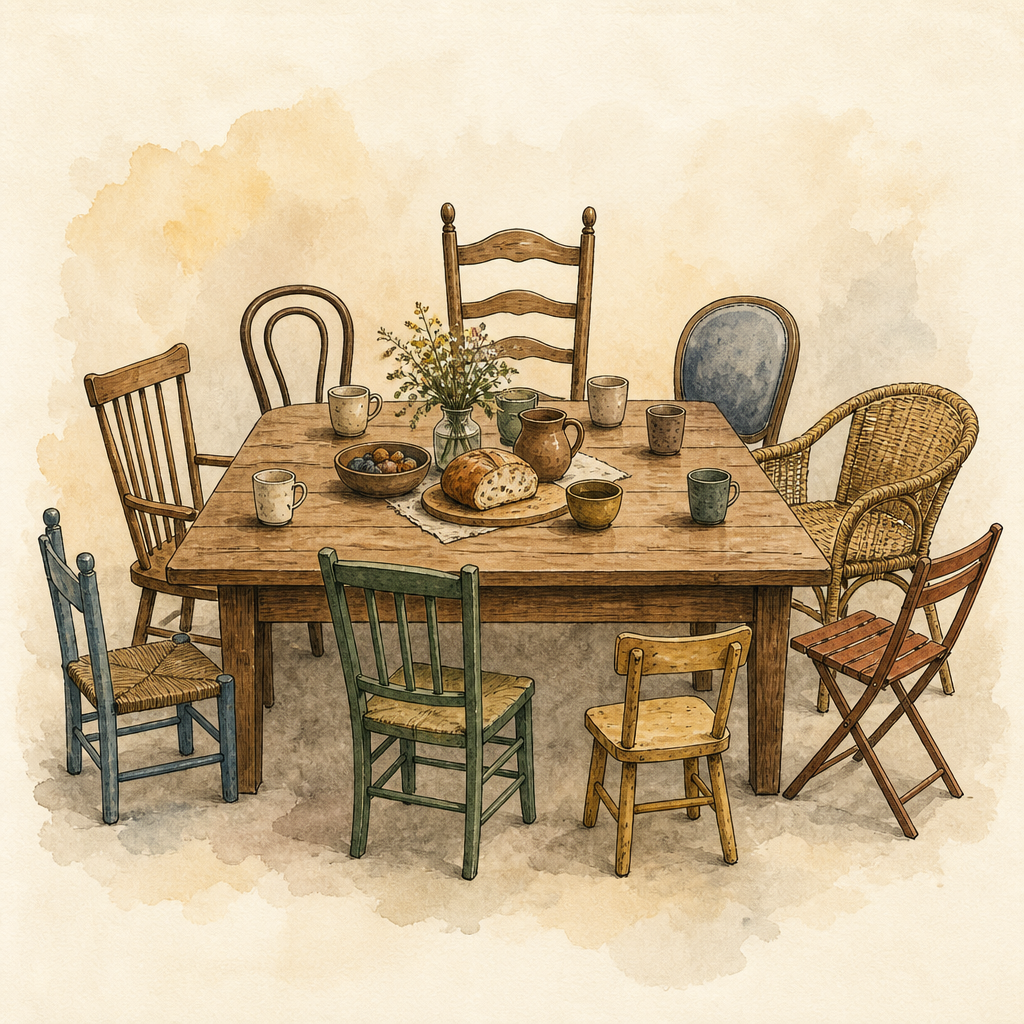
A table has rules before it has food
Every table, before anyone eats, has already made a decision. Who is invited. Who pulls up a chair without asking. Who waits by the door hoping someone notices them.
Today's headlines are, oddly, all about that door.
In Zambia, vote counting has been halted after alleged attacks on polling staff, in an election already shadowed by the memory of the incumbent president's fiercest rival. A count is, at bottom, a kind of table: every ballot a chair, every voter a guest who showed up to be heard. When counting stops because people were frightened away from the room, the table hasn't just lost a few chairs. It has lost the reason anyone set it in the first place.
Half the classroom, sent home
In Afghanistan, the Taliban's restrictions on girls' schooling — and, increasingly, on boys' education too — describe another table with half its seats permanently removed. A classroom is a shared table of a gentler kind: children pulling up chairs to the same lesson, the same alphabet, the same future. Deny that seat to a girl because she is a girl, and you have not merely closed a school. You have told half a country that its dinner is smaller than it should be, forever, by design.
The paid whisper at the border
And then Ceuta, where Instagram accounts now sell advice — for a fee — on how to cross into Europe. It is tempting to read this only as a smuggling story, and it is that. But look at what it reveals about appetite: young people paying strangers on a screen for the promise of a seat at a table that has told them, through visa forms and consulates, that they are not on the guest list. Desperation invented a black market in doors, because the front door looked bolted shut.
Three tables, one honest question
It would be too easy to lump these together as one grand story of exclusion and stop there, satisfied with the irony. That is not enough. Each table asks a different, harder question.
Zambia's question is about the ballot: does a vote still count if the room can be emptied by fear? The answer, plainly, is no — and every democracy watching should say so without hedging.
Afghanistan's question is about the golden rule in its bluntest form: would any of us accept, for our own daughters, what is being decided for someone else's? No parent anywhere would call that fair if it were done to their own child. That symmetry is the whole of the argument; it needs no decoration.
Ceuta's question is the least comfortable, because it has no clean villain and no clean answer. Compassion for people risking everything for a chair is right. But a chair invented by a smuggler's Instagram ad is not a seat — it is a debt, often paid in danger, sometimes in death. The honest reply to desperation is not a bolted door, and it is not a lawless side-entrance either. It is a legal door, wide enough to match what a society can actually carry, and clear enough that no one needs to buy false directions to find it. Solidarity that pretends capacity is unlimited helps no one; a door that stays shut on principle helps no one either. The wise table is the one built in daylight, with rules everyone can read.
Setting the table on purpose
There is a pattern worth noticing here, one some democracies have already tried, however imperfectly: build one shared table with one set of rules — one law, one language of public life, doors open to anyone willing to sit at it — rather than a scatter of separate tables where no one quite knows who is welcome or why. Denmark's attempt to dissolve its most isolated enclaves back into common civic life was controversial, and reasonable people still argue over its methods. But the instinct behind it was sound: dignity is not achieved by pretending everyone already has a seat. It is achieved by building enough chairs, and insisting — gently, firmly — that everyone sits at the same table under the same rules.
A reader with nothing more than an evening and a newspaper cannot fix Zambia's count, reopen Kabul's classrooms, or police an Instagram feed in Ceuta. But a reader can notice the pattern, and stop mistaking a closed door for a law of nature. Tables are set by choice. So are the empty chairs beside them.