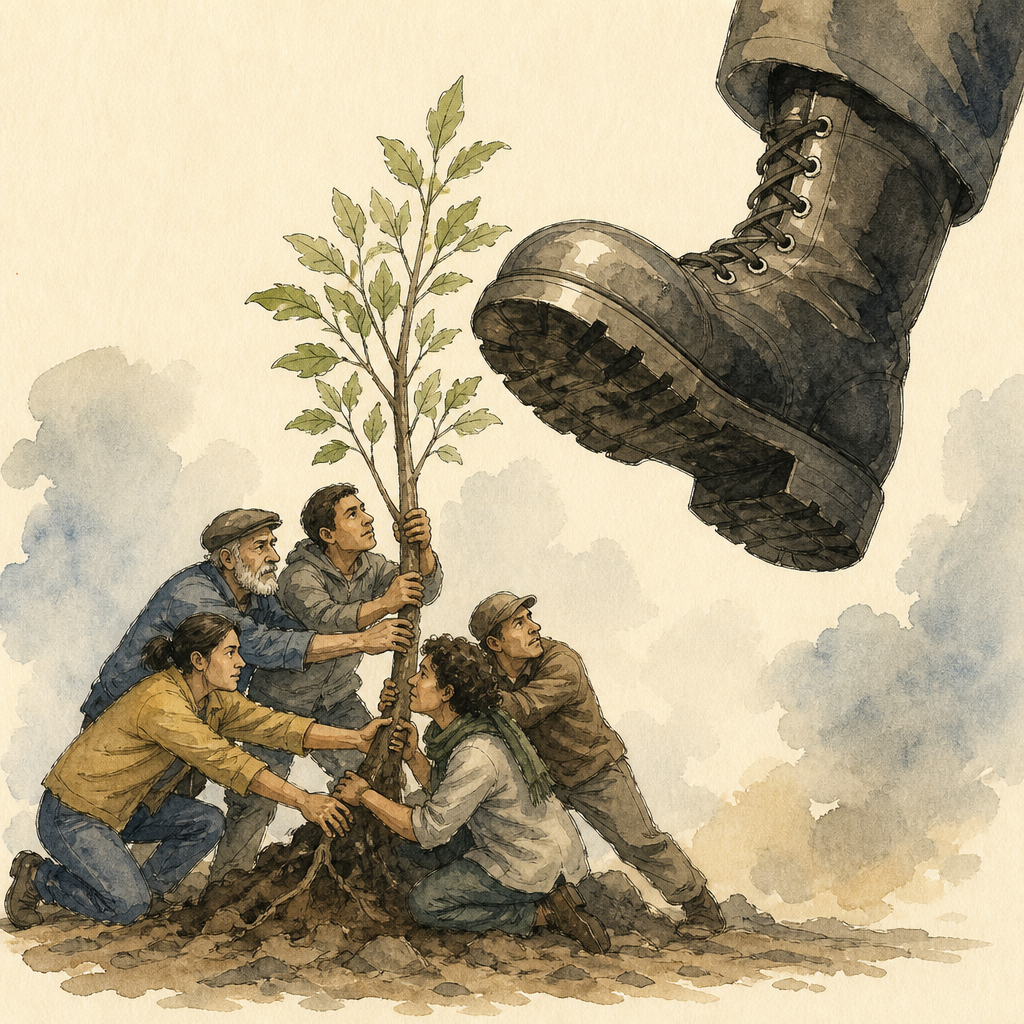
A state election, not yet a crisis
Today, a German state election is expected to hand real power to the far-right AfD — not a majority in Berlin, not tanks in the street, just a regional government, duly elected, duly counted. Nothing illegal has happened. That is precisely the point worth sitting with.
Authoritarian habits rarely announce themselves as authoritarianism. They announce themselves as normal politics having a strong week. A party once treated as unspeakable becomes merely controversial, then merely popular, then merely governing. Each step is small enough to defend and large enough to matter. Ask yourself: at which of those steps would you have protested? If your honest answer is "the last one, obviously," you have already answered the wrong question. The last one is rarely available for protest. By then it is called an election result.
Borders, ships, and constitutions doing the same trick
The same pattern is visible elsewhere this week, in smaller print. In Guinea-Bissau, a new constitution is being written that critics say will hollow out the very democracy it claims to modernise — always "modernise," never "weaken," that is the house style of every such document. In the Philippines, a sitting vice president has been ordered arrested over threats against the president, a dispute now settled by courts rather than by dialogue, which is either healthy accountability or a warning shot, and the honest answer is probably both, depending on who holds power next. Argentina, sensing a friendlier ear in Washington, restates its claim on the Falklands not through new argument but through new timing — testing whether an old boundary softens if you simply ask again, louder, when the room feels different.
None of these is yet the thing itself. Each is a rehearsal. Rehearsals are cheap, forgettable, and easy to wave off — which is exactly why they are the moment protest is still ordinary, still legal, still cheap, still likely to work.
Why the sabotage campaign matters here too
Europe, meanwhile, is reportedly living through a spreading campaign of sabotage, with Russia the chief suspect — cut cables, disrupted infrastructure, incidents too numerous to be coincidence and too deniable to be war. This is not a side story to the theme of early courage; it is the theme's weather system. Grey-zone pressure works precisely by staying beneath the threshold that would justify a loud, unified response. It bets that democracies will each individually decide the provocation was "not quite enough" to act on — and that the next one won't be either.
The strategic logic is identical to the domestic one: never present one unmistakable moment. Present a thousand ambiguous ones, and let fatigue do the rest.
The wisdom of protesting too early
Here is the uncomfortable argument, made plainly: it is wiser to object while an objection still looks slightly excessive than to wait until it looks obviously justified. Waiting for certainty is not caution — it is a subsidy paid to whoever benefits from delay. Ridicule is a small price. A hollowed constitution, a captured court, a border quietly redrawn by repetition — those are not small prices.
This is not a call to treat every election result as a fire alarm, nor every diplomatic needle as an invasion. Voters who choose AfD are not thereby monsters, and a government has every right to answer sabotage carefully rather than theatrically. The point is narrower and more useful: notice the habit while it is still a habit, in the boring, deniable, everyday stage, and say so — in parliaments, in newspapers, in the next vote — before the habit has finished becoming a fact.
Common sense does not require certainty about the future. It only requires the courage to speak while speaking still costs almost nothing at all.