A warning, delivered in advance
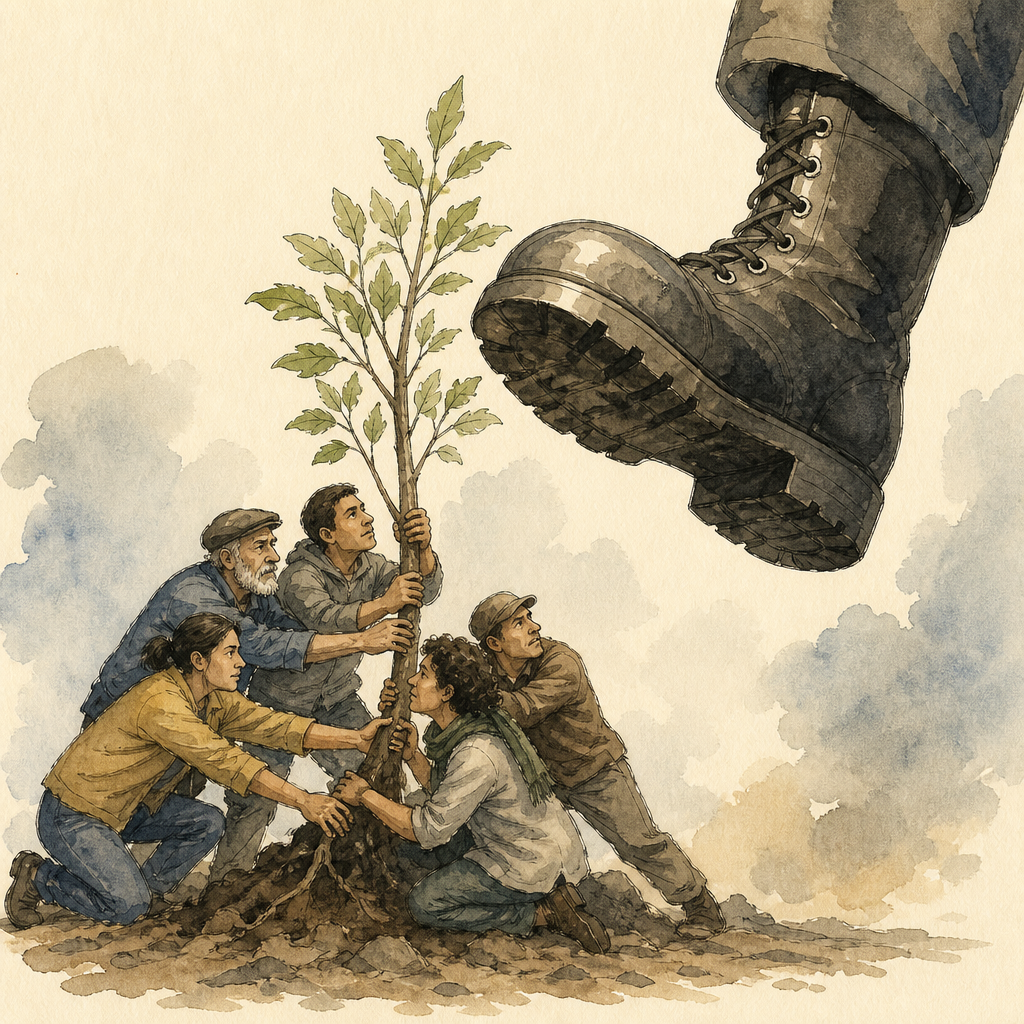
This week the White House told Democrats, in effect: be careful what you investigate once you have the votes to investigate it. Notice the timing. The probes do not exist yet. The warning arrived first.
That ordering is worth sitting with. Oversight is not being punished here — it is being pre-discouraged, the way a parent might say "don't even think about it" before the thought has fully formed. Is that normal politics, sharp elbows in a rough season? Or is it the opening move of a habit — the habit of making scrutiny feel dangerous before it has even happened?
Authoritarian habits rarely arrive announced. They arrive as reasonable-sounding caution. Wait for a better moment. Don't rock the boat. Save your courage for something that matters. The trouble is that courage, like any muscle, atrophies if it waits for the perfect moment to flex. It is cheapest early, and most expensive late.
Compare the cost
In Mississippi, Scott Colom made history as the state's first Black senator since the 19th century — not through a decree, not through a tribunal, but through an ordinary ballot counted on an ordinary Tuesday. Expensive in the long arc of history, yes. But on the day itself, it cost voters nothing more than showing up. That is democracy doing what it is supposed to do: making justice available through the unglamorous mechanism of counting.
Now look at Ukraine, where workers at a ruined power plant describe their job in four words — "we've got to run" — whenever the drones come close. Their courage is also ordinary, in the sense that it is daily and unremarkable to them. But it is no longer cheap. It is paid for in terror, in blackout, in the random mathematics of who happens to be standing where the strike lands.
That is the whole argument, really. Protest, scrutiny, and plain stubborn asking-of-questions are available at two prices: ordinary, or heroic. Societies get to choose which price they pay, mostly by how early they start asking.
Who is at the table, and why
This week also brought American envoys to Moscow, meeting Putin directly, after talks in Abu Dhabi, while Ukraine's military reports its Starlink links disrupted yet again. Perhaps this is simply diplomacy doing its unglamorous work — nobody serious thinks wars end without someone eventually talking to the people prosecuting them.
But it is fair to ask, out loud and without shouting: when the maps of someone else's country are discussed without that country fully in the room, whose habit is being accommodated — the habit of patience, or the habit of impunity? A reader does not need to answer that question with certainty to see that it deserves asking now, before the shape of any settlement hardens into a fact nobody can revisit.
A small, clean counter-example
Meanwhile in Indonesia, a vice president resigned this week after his academic credentials were questioned — not after years of cover-up, but promptly, while the question was still just a question. It is a small story next to Moscow and Gaza. But it is the kind of small story a healthy civic culture should want more of: accountability exercised while it is still inexpensive, before it calcifies into scandal, before it requires a crisis to force the same outcome.
The stance
So here is where this editorial lands, without pretending the world is simple: ask the awkward question before the vote, not after; back the ballot over the strongman, as Mississippi just did; insist that the people under the drones get a seat at any table drawn about their own country; and treat every small, cheap act of scrutiny — a journalist's question, a credential checked, a committee convened — as rehearsal for the moments when scrutiny will cost far more than it does today. Early courage is not dramatic. That is precisely its value.