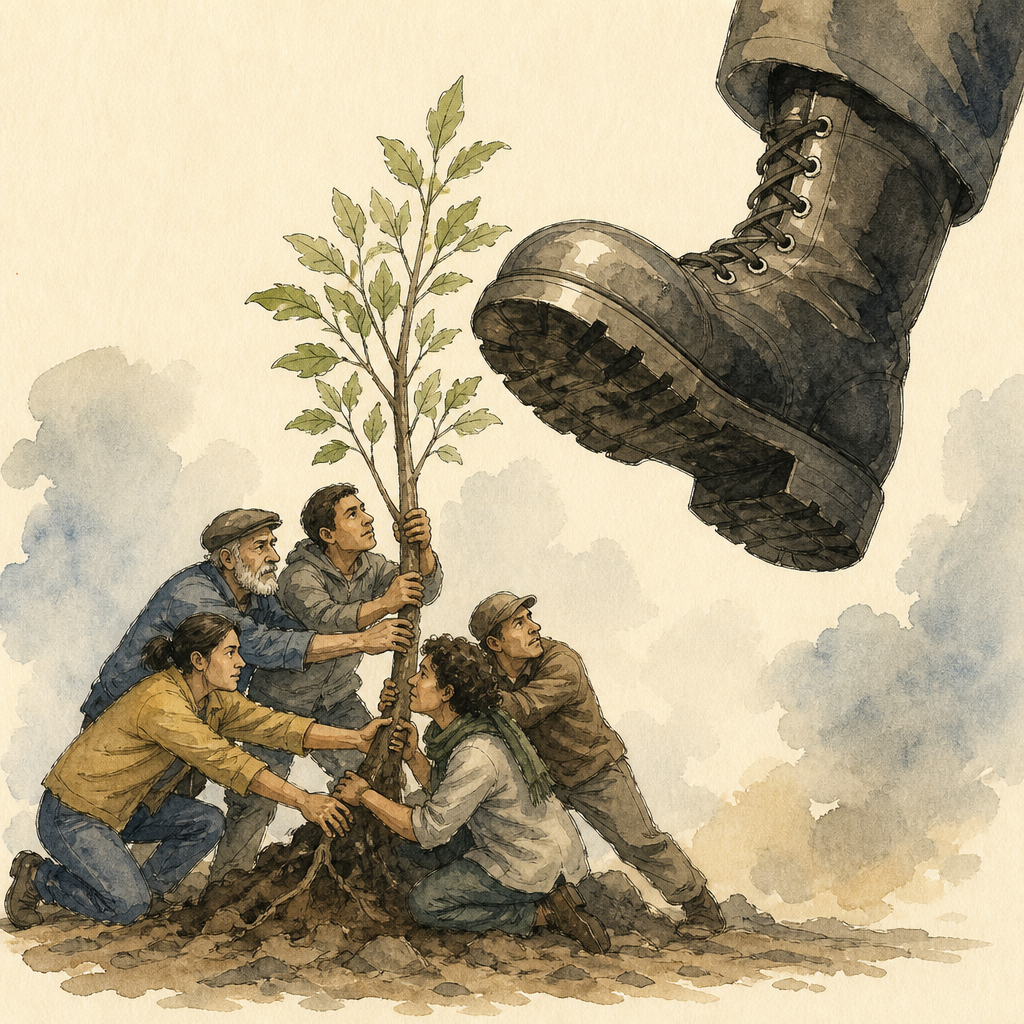
A warm room, a closed strait, a vacancy sign
Somewhere this week a handshake was warm. A deal was rejected. A country announced it was ready to lead. None of these things was a coup. None of them made a headline that screamed. That is exactly the point.
Trump gave Xi Jinping a warm welcome, the wires reported, and then the natural follow-up question arrived, almost embarrassed to ask it: what did the talks actually accomplish? Nobody seems entirely sure. The warmth was real. The outcomes are, so far, a rumor of outcomes. This is not scandal. It is something quieter and more interesting — a demonstration that in certain rooms, atmosphere has started to do the work that used to belong to institutions.
Meanwhile Iran's foreign minister said only negotiation can end the standoff over the Strait of Hormuz, after Trump rejected a deal on the table. Read that sentence twice. A strait through which a fifth of the world's oil moves is being managed, for now, through the preferences of two men rather than the patience of diplomats. Perhaps the rejection was wise. Perhaps it was posture. The trouble is that citizens of neither country, nor of the countries whose fuel prices ride on that water, get much say in which it was.
And Turkey, we're told, is positioning itself to "emerge as a leader" amid shifting Middle East dynamics. Leadership is not a crime. Regional influence is not automatically sinister. But notice the shape of the sentence: a vacancy has appeared, and someone is moving to fill it — not through a treaty ratified by parliaments, but through the accumulation of personal and national leverage while the cameras are elsewhere.
The habit before the regime
None of this is dictatorship. That's the uncomfortable part. Dictatorship rarely announces itself with dictatorship. It announces itself with efficiency. A leader who can simply decide, without the friction of negotiation, looks decisive. A summit built on personal chemistry looks warmer than one built on treaty language nobody reads anyway. A power vacuum filled quickly looks like stability compared to the alternative, which is nobody filling it at all.
The habit is convenience. The habit is applause for speed. The habit is the quiet relief when one strong figure says "I decided" instead of the slower, messier sentence: "we negotiated, and here is what we agreed, and here is who can be blamed if it fails."
Ask yourself, gently, which sentence appeared more often in this week's news.
Why courage is cheap now and expensive later
Here is the wager worth making: the moment to ask "what did this actually accomplish?" is now, while the answer is merely embarrassing rather than dangerous. The moment to say "a strait affecting global oil deserves a negotiated table, not a rejected one" is now, while saying so costs nothing but an editorial. The moment to ask whether a rising regional leader is building alliances or building a cult of personal indispensability is now, while the question is still ordinary enough to ask over coffee.
Protest, in its most useful form, is rarely a crowd in a square. It is a habit of noticing — a columnist, a parliament member, a citizen at a town hall — asking the plain question before the plain question becomes unaskable. Democracies do not usually fall to men on horses. They drift, first, toward men who are simply more convenient to agree with than to question.
So: welcome the handshake, if it produces something. Doubt the deal that was rejected without a visible alternative. Watch the vacancy sign, and ask who is filling it and by what authority. None of this requires bravery yet. That is exactly why it is the moment to do it. Early courage is cheap. Wait long enough, and the bill comes due for everyone.