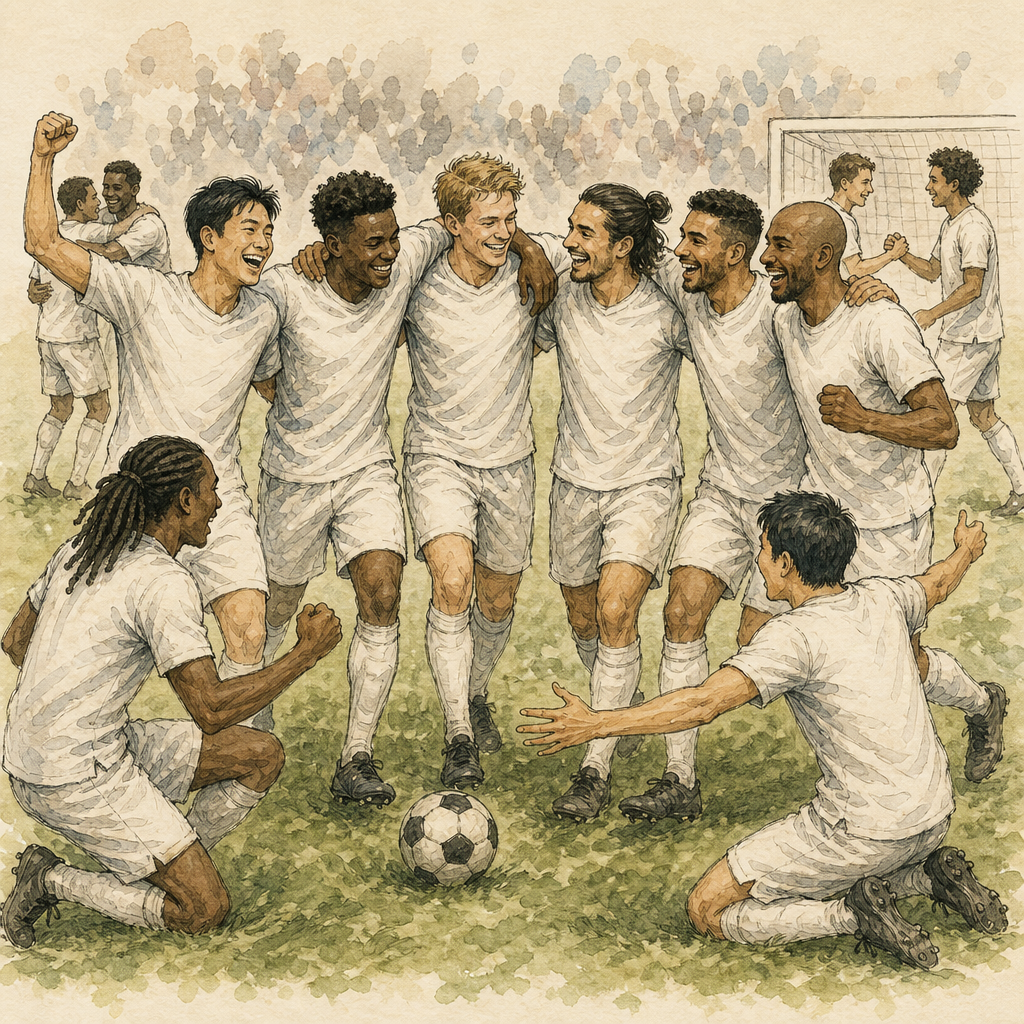
A pitch is a small democracy
Eleven players, one rulebook, a referee nobody elected but everybody obeys — for ninety minutes, football stages a version of the social contract that most nations spend centuries arguing over. You do not have to like your opponent to shake his hand. You do not have to agree with the offside call to accept it. The kit is shared; the rules are shared; the outcome is not fixed in advance. That is the whole rehearsal, and it is not a small one.
Which is why this week's mess inside FIFA is worth more attention than a mere scheduling squabble. UEFA says a boycott may still go ahead. England's FA has withdrawn its support for Gianni Infantino. And yet Infantino, at an internal crisis meeting, reportedly received enough backing to stay exactly where he is. Read that sequence twice. A significant confederation and a founding federation both signal no confidence — and the man in question survives the room anyway.
Ask the question football is supposed to teach
Here is the Socratic bit: if a federation cannot apply its own accountability rules to its own president, what exactly is it teaching the eleven-year-olds who watch the World Cup and dream of fair play? A referee who ignores a clear foul because he likes one team is not neutral; he is simply a different kind of player. The same logic applies one level up. An organisation that treats governance as a popularity contest inside a closed room, rather than a rule applied evenly, is not modelling the sport it claims to protect.
Compare that with Meta's $567 million fine this week over child safety failures — a sharp number, delivered by an actual regulator with actual teeth, imposed on an actual giant. Whatever one thinks of the sum, the mechanism worked: a rule existed, evidence was gathered, a penalty landed. That is unglamorous, bureaucratic, and exactly the muscle that a boycott threat inside football is trying, clumsily, to build where none yet exists. UEFA and the FA are not throwing a tantrum. They are attempting — with blunt tools, because sport has few sharp ones — to do what a good regulator does quietly: say that titles do not exempt anyone from rules.
The rehearsal only works if it is honest
None of this is really about one Swiss federation. It is about whether "shared kit, shared rules" is a real principle or a marketing slogan that dissolves the moment someone powerful is inconvenienced by it. The same week brought a grimmer reminder of what happens when rules and safety fail entirely off the pitch: a leading Ugandan footballer killed by robbers wielding paving stones — a death with no relation to sport except that it stole a career the game had built. Football's peace rehearsal, remember, is only a rehearsal. The real conditions — safe streets, functioning courts, accountable institutions — still have to be built by everyone else, all year round, off camera.
And yet there is good news too, worth setting beside the bad: Nigerian security forces freed more than 300 hostages in what is being called the largest single-day recovery of its kind. That is what accountable power, used well, actually looks like — force applied under rules, in service of people, not personalities. It is a useful yardstick. Ask of any institution, sporting or governmental: does its power serve the people bound by it, or does it simply protect itself?
The stance
So: is a boycott threat over a federation president an overreaction to a game? No. It is a small, useful insistence that shared rules must bind the powerful too, or the whole rehearsal is theatre. Supporters who push UEFA and the FA to keep the pressure on are not spoiling football — they are trying to keep it worth watching. A sport that lets its rulebook bend for the man at the top is not preparing children for peace. It is quietly teaching them the opposite lesson, in shin pads.