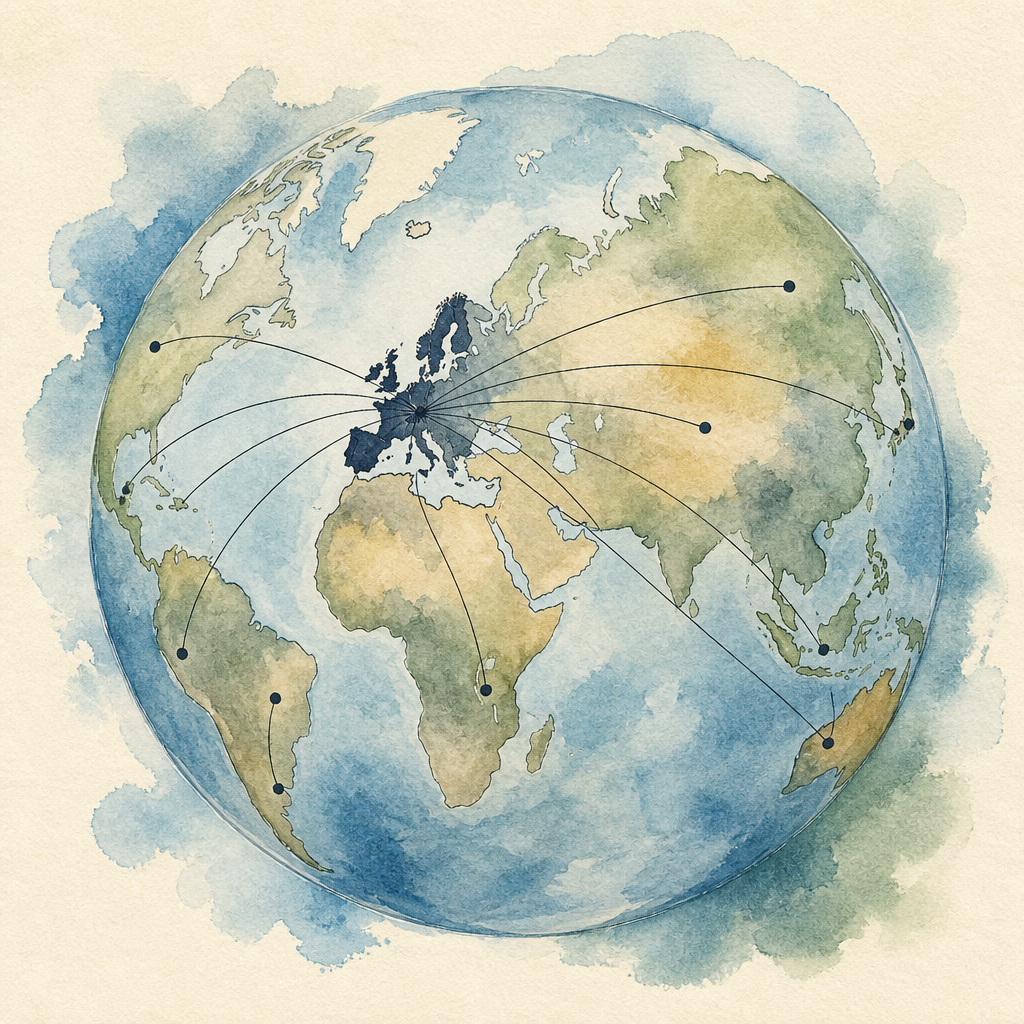
A Correction, Finally, in Ink
For centuries the standard world map has shrunk Africa to roughly the size of Greenland, when in fact the continent could swallow Greenland, China, the United States, and most of Europe and still have room for India. The distortion was not an accident of geometry. It was drawn by European cartographers serving European empires, and it stayed on classroom walls long after the empires left.
This week the United Nations is expected to vote on adopting a map that shows Africa at its true scale. It sounds like a small housekeeping matter. It is not. A map is an argument about importance, made in silence, repeated a billion times before anyone thinks to question it. Fixing it costs nothing and admits everything.
So here is a fair question for European readers, asked without a raised finger: if we can correct three centuries of cartographic vanity in a single vote, what else might deserve the same plain honesty?
Two Ways to Show Up in the World
Consider who else is visiting the neighbourhood this week. China's leader is touring Egypt, his first visit there in a decade, offering infrastructure, financing, photographs. It is a familiar script: attention without conditions, partnership without a mirror.
Meanwhile in Guinea-Bissau, a new constitution is moving forward that opponents say quietly guts the checks that made the country's democracy worth having. That is the harder, less photogenic story. No one arrives with a delegation to celebrate a constitution getting narrower.
This is where Europe's actual usefulness in the world gets tested — not in grand summits, but in whether anyone from the union of twenty-seven still bothers to ask the boring question: does this constitution still let citizens throw the government out? A patron who never asks that question is not neutral. He is simply a patron who prefers governments that never have to answer to anyone, including him.
Europe's model is slower, more annoying, full of clauses and reports and conditionality. It is also the only model on offer that treats the answer to that question as the actual point.
The Old Ledger Still Open
And then there is Sharpeville — the 1960 massacre in apartheid South Africa, whose survivors are still, decades later, asking for compensation that has never fully arrived. It is tempting for Europeans to file this under someone else's history. But the architecture of apartheid, like the shrunken map, did not design itself. Outside powers looked away for a long time because looking away was profitable.
A union that wants to speak credibly about Guinea-Bissau's constitution, or about anyone else's democratic backsliding, cannot do so with its own unpaid ledgers left open indefinitely. Consistency is not an act of guilt. It is the entry fee for being taken seriously when you ask others to keep their promises.
What the Union Is Actually For
None of this argues for European self-flagellation as a substitute for a foreign policy. Nobody is served by a union that spends its energy apologizing instead of acting. The useful version of Europe is the boring one: courts that function, elections that get monitored, aid that comes with a scoreboard attached, and yes, maps that get redrawn when the old ones were simply wrong.
That is a smaller, less romantic role than empire or patron. It is also the only one compatible with treating other peoples as equals rather than clients. A union of democracies earns its voice in the world not by the size of its cheque or the length of its state visit, but by whether it still insists — quietly, at the UN, in a vote about a map nobody will notice — that the truth should look like the truth.
Africa was always this size. It is worth asking what else on the map, and in the ledger, has been waiting the same length of time to be drawn correctly.