The Stall Nobody Audits
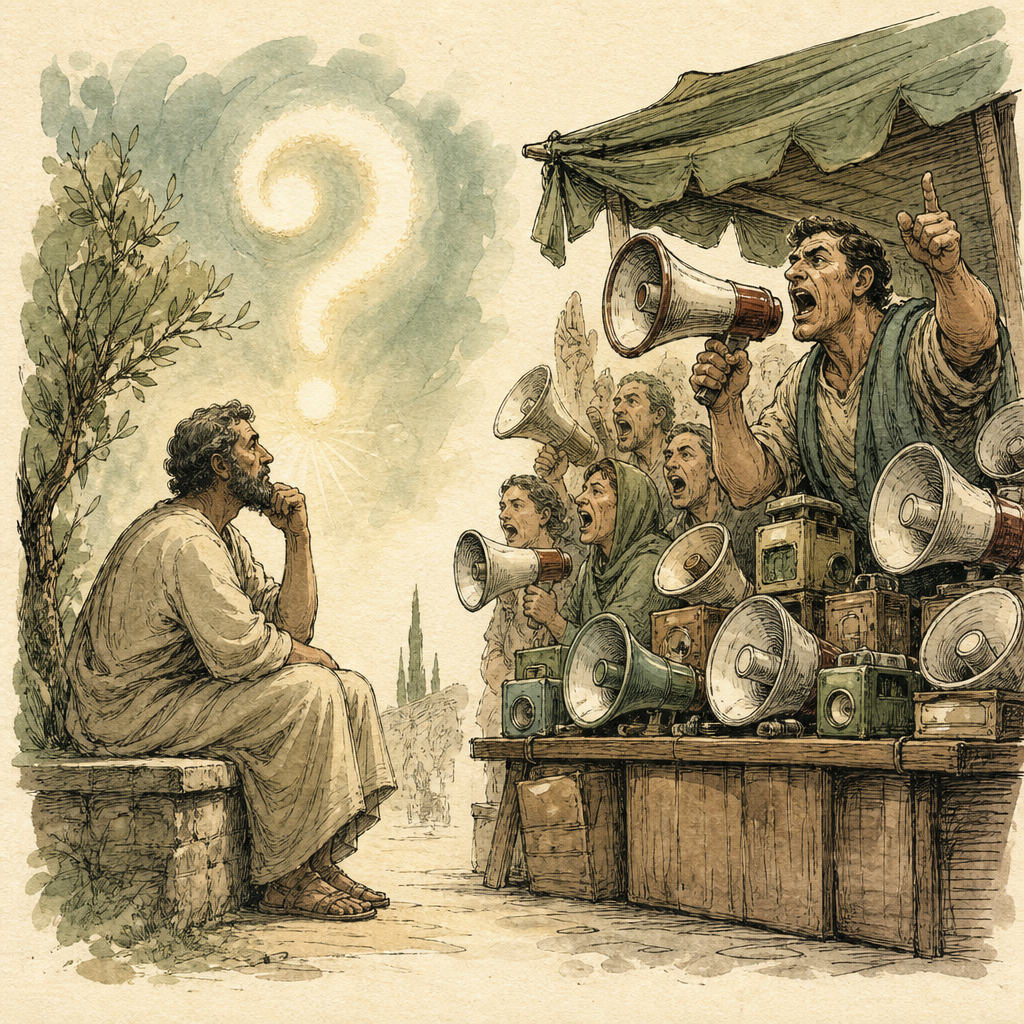
Walk through any public square — real or digital — and you will find one stall doing brisker business than the rest. It sells certainty. Not bread, not tools, not even ideas exactly, but the feeling of already knowing.
The vendor rarely shouts. Shouting would invite scrutiny. Instead the voice is calm, almost bored, the tone of someone explaining gravity to a child. This is simply how things are. Anyone reasonable already agrees. Why are you still asking?
Common sense, by contrast, keeps terrible sales figures. It hedges. It says "probably" and "depends" and "let's check." It has never once filled a stadium.
Two Kinds of Confidence
There is the confidence of a bridge engineer, built on measurements that can be wrong and were checked anyway. And there is the confidence of a man who has never measured anything but is very sure the bridge will hold, because doubting it would be unpatriotic.
Dictatorship rarely arrives announcing itself as dictatorship. It arrives as relief — the relief of no longer having to weigh evidence, because someone has kindly weighed it for you. Certainty is sold as a public service. Only later does the invoice mention that the price was your own judgment.
So here is one more question, offered without malice to the loudest stall in the square: if you are so certain, why does disagreement frighten you? A fact does not flinch when questioned twice. Only a slogan does that.
What Football Knows That Slogans Don't
A football match is ninety minutes of unresolved argument conducted by mutual agreement of the rules. Nobody at kickoff knows who wins. That uncertainty is not a flaw in the sport — it is the entire sport. Remove it, fix the score in advance, and you no longer have a game; you have a ceremony.
Mixed squads full of players who grew up on opposite sides of old borders still manage to lose to each other gracefully on a Tuesday and share a locker room that same evening. Nobody there is asking them to stop being rivals. Only to stop pretending the other side doesn't exist, or doesn't deserve the same rulebook.
Certainty finds this arrangement intolerable, because certainty needs a final whistle that never blows in its favour by accident.
The Socratic Tax
Asking one more question costs almost nothing and is rarely popular. Socrates, for his trouble, was handed a cup and a verdict — the oldest reminder that certainty, cornered, prefers silence to conversation.
Modern versions of the cup are gentler: a labelled "troublemaker," a quietly cancelled invitation, a follower count that dips. The mechanism is the same — make the question more expensive than the answer, and most people, being reasonable, will stop asking.
This is precisely why the habit is worth keeping. Not out of contrarian pride, but because a society that has forgotten how to ask its own leaders "how do you know that?" has already handed over more than an argument.
A Question for the Reader, Not an Answer
This essay will not tell you which stall in your particular square is selling false confidence this month. That would be, ironically, exactly the kind of certainty it warns against.
Instead: next time an answer arrives fully assembled, needing no assembly, admitting no exceptions — ask what it would cost the speaker if you asked one more question. If the honest answer is "nothing," you are probably near common sense. If the honest answer is "everything," you have found the stall.
Either way, the asking is the point. Democracies do not run on certainty. They run on citizens willing to keep asking, out loud, in public, long after the loud stall has told them to move along.