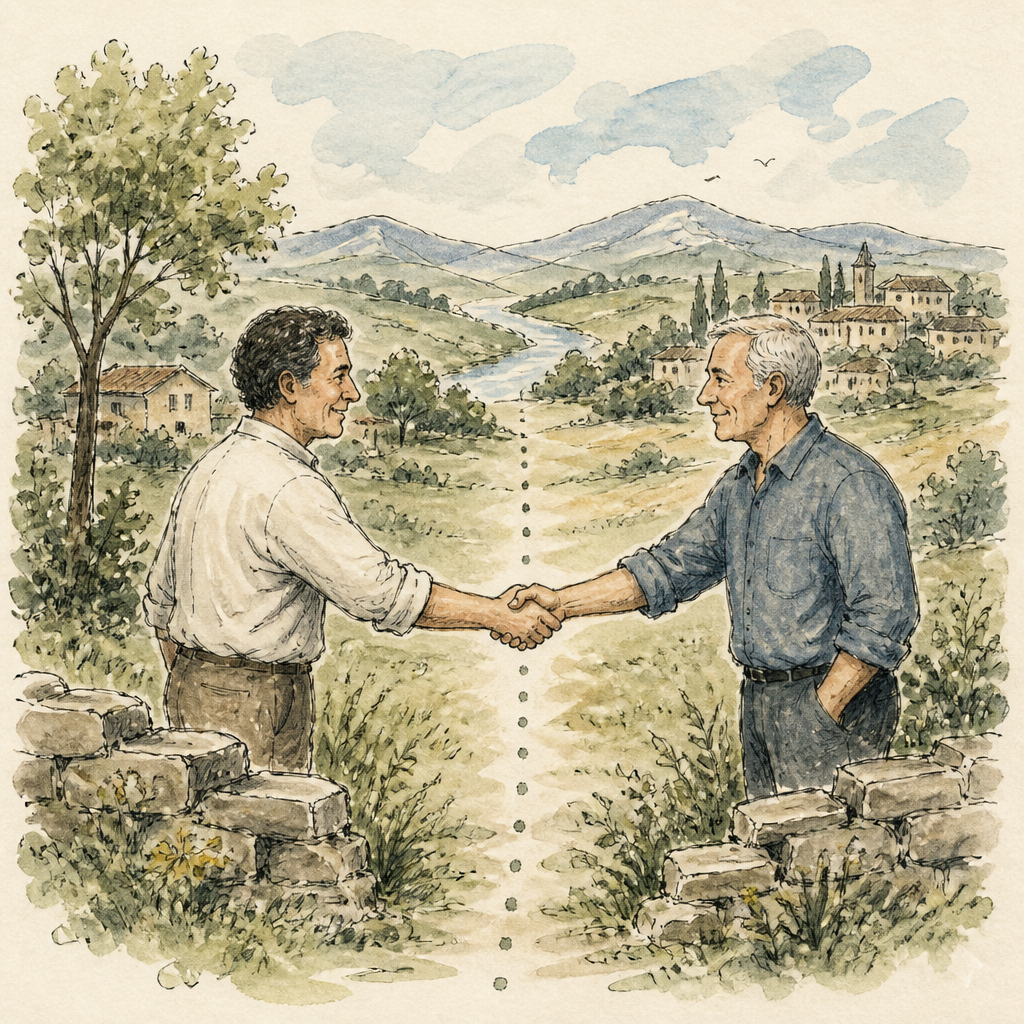
Two kinds of news about getting along
Somewhere in Brussels and London this week, officials have reportedly been finishing the paperwork for a youth mobility scheme between the UK and the EU. It is not thrilling news. No flags were waved. Nobody signed it on a gilded table in front of cameras.
Elsewhere, three men posed for exactly that kind of camera. Donald Trump, Vladimir Putin and Xi Jinping released what they called a "peace declaration" after a historic meeting — while the leaders who actually live next to the war, the Europeans, say they are merely "ready for talks" on ending the fighting in Ukraine. Ready, note, after the fact. Invited to the talks about their own neighbourhood, but not to the photograph.
Here is a modest proposal: judge cooperation not by its drama, but by who had to say yes.
What makes someone a neighbour
A youth mobility scheme is unglamorous because it is reciprocal. A young Pole can study in Manchester; a young Briton can wait tables in Lisbon. Both governments answer to parliaments that can throw them out if the deal turns sour. It is small, it is slow, and it is the kind of cooperation that survives a change of government, because it was never about one leader's ego in the first place.
Compare that to a declaration issued by a room of three men, at least two of whom do not face a ballot box that can meaningfully remove them. A top House Democrat is already asking, reasonably, what exactly the summit accomplished for anyone outside that room. It is a fair question to ask of any peace plan written without the people whose cities are actually being shelled at the table.
Is that unfair to the idea of great-power diplomacy? Perhaps declarations between powerful states have their place — wars have ended before at tables where the smaller nations were consulted late, if at all. But there is a difference between a first conversation and a finished declaration. One invites scrutiny; the other announces itself as already settled. Readers inside besieged Yemeni cities, telling their children the explosions outside are "just fireworks," know better than anyone how little comfort a faraway declaration offers until it changes something on the ground.
Honesty is the hinge
Neighbourliness between democracies only works if the institutions doing the cooperating stay honest — including with their own citizens. Which is why it is worth noticing, in the same week, the accusation that the European Commission sugarcoated figures to justify releasing funds to Egypt. If true, that is not a small embarrassment. It is the termite in the floorboards of the whole European project: a Union that asks its members to trust shared rules cannot quietly bend its own numbers when a client relationship becomes inconvenient. Cooperation built on flattered statistics is not cooperation; it is public relations with a flag on it.
The stance
So here is where this paper lands, without much irony left to spare: prefer the visa form to the photograph. Prefer the slow, auditable, reversible kind of cooperation — a mobility scheme, a trade protocol, a court ruling like the one the UN's top court just delivered on Myanmar and the Rohingya, unpopular with the powerful and issued anyway — over any declaration stamped by men who do not need to win an election to stay in the room.
It is not that boring cooperation is morally superior simply for being boring. It is that boring cooperation can be checked, amended, and voted away if it fails, by the very people it affects. A declaration between unaccountable leaders cannot be checked by anyone except history, and history is a slow editor.
Europe does not need another summit photograph to prove it has neighbours. It needs forms filled in honestly, funds released honestly, and courts that rule honestly even when the ruling embarrasses a government that might, in response, consider sanctioning the judge. Good neighbours, as it turns out, are made the same way good fences are: not with declarations, but with paperwork both sides actually read.