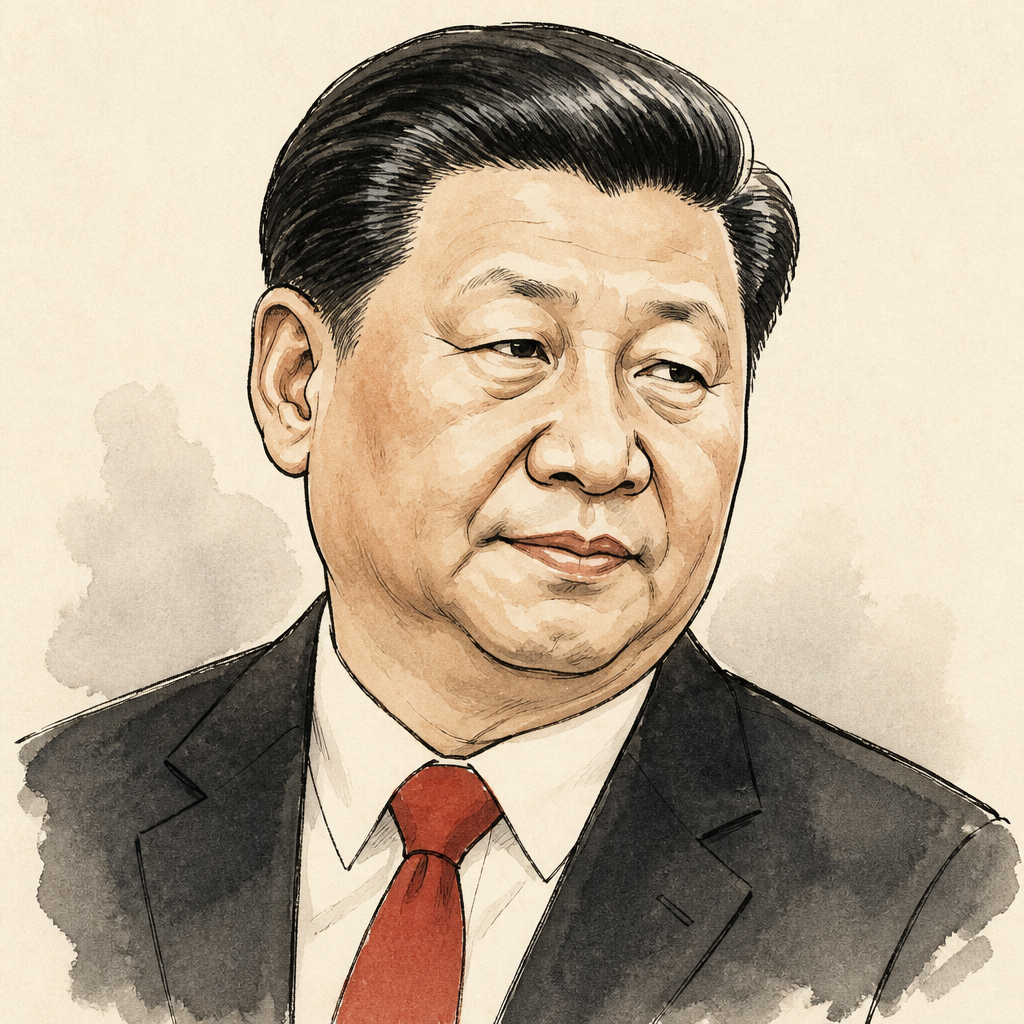
A General, a Committee, a Pattern
Somewhere in Beijing this week, a general was elevated to the Politburo. Elsewhere, the Party announced it would strengthen discipline. Neither sentence contains a threat. Neither contains a lie. And yet, read together, they say something that no press release will say for them: the circle around Xi Jinping is getting smaller, and the loyalty required to stay inside it is getting larger.
This is not breaking news. It is the slow weather of a system, the kind you only notice if you keep checking the sky.
The Question Worth Asking
Here is the fear, stated plainly, because clarity is a form of respect for the reader: is Xi Jinping actually engaging with the world — trading with it, meeting it at summits, signing its communiqués — or is he simply waiting until he no longer has to?
It is a fair question to ask of any leader who concentrates power while the cameras are pointed at trade figures and GDP. Patience, after all, is not automatically a virtue. A chess player who studies the board for an hour is not meditating on beauty; he is deciding when to move.
A World Full of Smaller Mirrors
You do not need China to see the shape of this instinct. In Brazil, a politician who lost an election simply declared himself "leader of Brazil" anyway, as though the ballot were a suggestion rather than a verdict. In Egypt, an independent newsroom was fined into silence, because an editor who asks questions is more dangerous to a government than one who does not. These are smaller mirrors, cruder and easier to mock. But they reflect the same habit: power that treats accountability as an inconvenience to be managed rather than a condition to be honored.
Xi's version is simply more patient, more institutional, and therefore harder to laugh at.
Why the Fear Is Reasonable, Not Paranoid
Einstein's razor asks us to make an explanation as simple as possible, but not simpler. So here is the simple version: a system is authoritarian not because it is rude, but because it removes the mechanisms that would let citizens correct it. Elections you cannot lose. Courts that cannot rule against you. A press that cannot embarrass you. Watch for the removal of mechanisms, not the tone of the voice.
By that measure, the quiet tightening inside the Politburo is more informative than any speech Xi has given at a G20 podium. Diplomacy can be sincere and still be temporary — a bridge used only until the far bank is strong enough to stand alone.
What Not to Do About It
The wrong response is panic, and the wrong response is also naivety. Trade with China, cultural exchange, climate cooperation, even the football pitches where mixed squads briefly make nationalism look silly — none of this should stop simply because a government is patient. Isolation does not make authoritarian habits gentler; it usually makes them lonelier and less observed.
But cooperation without illusion is not the same as cooperation without limits. Democracies can keep the door open while still reinforcing their own frame: a free press that outlets like Mada Masr remind us is never guaranteed, a military capable of deterring adventurism for as long as the world keeps mistaking strength for provocation, and institutions sturdy enough that no single leader — in Brasília, Cairo, Moscow, or Beijing — mistakes a lost election, a free newsroom, or an internal rival for an inconvenience to be filed away.
The Honest Answer
Is Xi playing a long game until he can ignore the rest of us? Possibly. Probably, in the narrow sense that every concentration of power eventually tests how far it can go unchecked. The wise response is not to assume the worst motive, but to stop being surprised by the predictable pattern — and to keep building the kind of open societies that do not need anyone's permission to notice, to ask, and to say so out loud.
That noticing, done early and often, is the cheapest insurance democracies have.