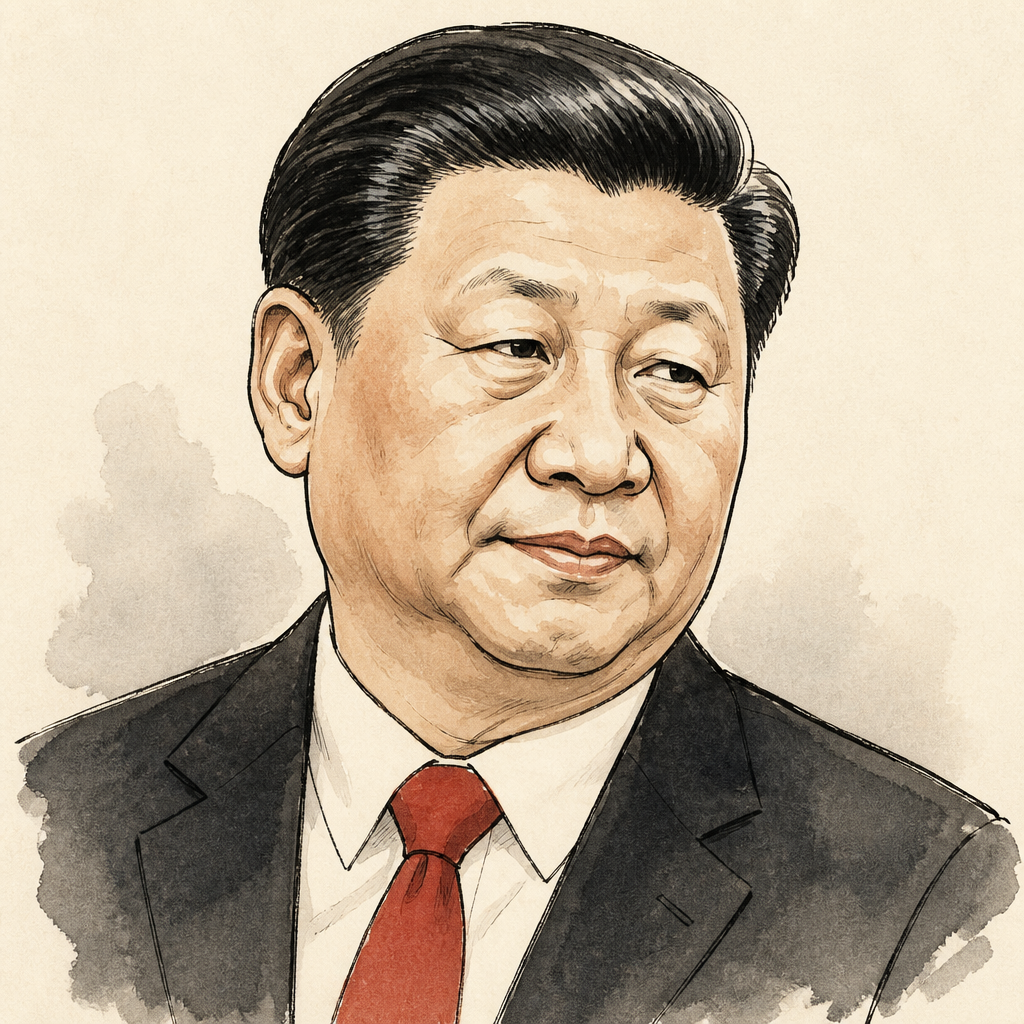
A verdict without headlines
Somewhere between the closed settlement in the West Bank, the queues for petrol in Russia, and the price Pyongyang now demands for a smile from Washington, a Hong Kong court delivered a quieter verdict today. Activists who once lit candles for Tiananmen were found guilty under a national security law. No tanks rolled. No shots were fired. A judge simply read a ruling, and a memory became a crime.
Compare that to 1989. The method has changed entirely — the destination has not.
The strongman who never raises his voice
Vladimir Putin shouts through artillery. Kim Jong Un shouts through missile tests and now, apparently, through pricing Washington's attention like a landlord who knows his tenant has nowhere else to go. Even Washington shouts back — economic warfare declared on Iran, a debt clock ticking past $40 trillion, a Supreme Court asked to rule on a ballroom.
Xi Jinping does none of this today. He does not need to. His instrument is the courtroom, the five-year plan, the slow tightening of a screw that nobody outside Hong Kong feels turning until it is finished.
This is my honest fear, and I would rather say it plainly than dress it in false calm: is he simply waiting — indulging our summits, our trade talks, our polite communiqués — until the balance tips so far that our objections become theatre he no longer has to watch?
A world too busy to notice
NPR's own framing today calls it correctly: the wars happening across the world are connected. Not necessarily by treaty, but by rhythm. Every crisis that pulls a democracy's attention toward Gaza, toward Kyiv's gas shortages, toward Tehran's sanctions, toward a helicopter crash in Kenya or a mine collapse in Bangui, is also, by simple arithmetic, attention that is not on Hong Kong, not on Taiwan, not on the South China Sea.
I do not accuse anyone of orchestrating this diffusion. Chaos does not need a conductor to be useful to the patient. But ask yourself: if you were building the largest, most disciplined authoritarian apparatus in human history, would you want the world's cameras trained on you — or trained everywhere else?
Weighing the other side
Fairness requires the counter-question. Perhaps this is not a trap but simply governance — a state managing its own citizens by its own laws, however illiberal those laws look from Copenhagen or Washington. Interdependence, the argument goes, restrains ambition: an economy this woven into ours has every incentive to keep the peace it profits from.
That argument deserves respect, not dismissal. But it asks us to treat a one-way ratchet — more security law, fewer freedoms, no verdict that ever loosens — as evidence of restraint. A ratchet that only tightens is not patience toward us. It is preparation.
What a democracy should actually do
Not panic. Panic is what a patient adversary hopes distracts us next. The wiser response is memory — the unglamorous discipline of tracking the slow cases the way we track the loud ones. A trial in Hong Kong deserves the same durable attention as a missile test in Pyongyang, because both are votes cast in the same referendum: does the rules-based world still count, or has it become background music for those clever enough to wait it out?
I do not know if Xi is merely governing or quietly finishing a countdown. Neither, I suspect, does he need us to know. That uncertainty is the whole strategy. The least we owe ourselves is to keep watching anyway — not with alarm, but with the plain refusal to let patience go unnoticed simply because it never shouts.