A week of weather, not climate
Every day brings a fresh front. Today it is Emmanuel Macron warning that Russian hybrid attacks on Europe are intensifying, and Poland's prime minister cautioning that some of those attacks on Ukraine's allies may one day be dressed up as "accidents." Drones over airports, cut cables under the sea, disinformation seeded like weeds — hybrid war is designed to feel like weather: sudden, deniable, exhausting. You cannot arrest a gust of wind.
But nations are not weathervanes. The whole point of hybrid tactics is to make citizens react like one — spinning toward the latest gust, forgetting which way is north. So it is worth asking a plain question: what, in all this turbulence, is actually built to last?
What an oak is for
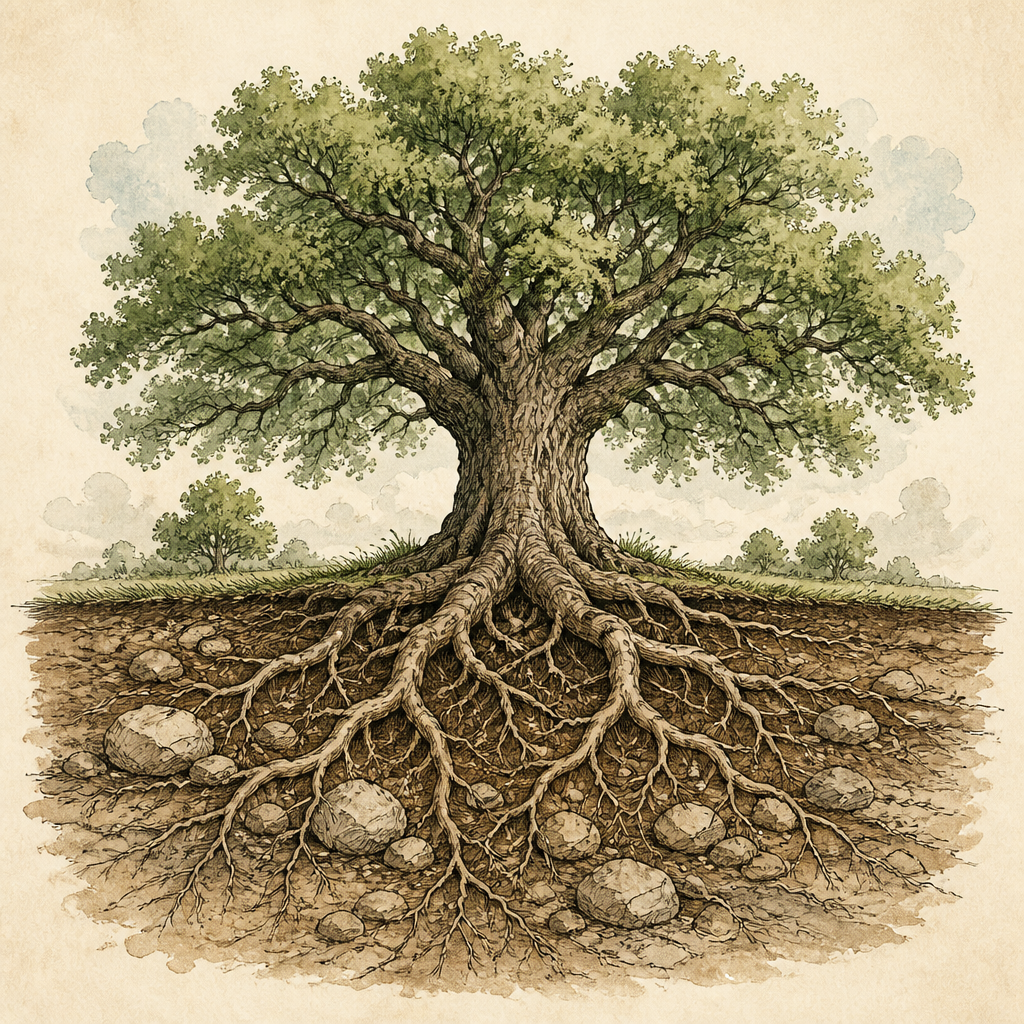
An oak does not win every storm by being loud. It wins by being deep. Its roots reach further than its branches sway. Institutions work the same way — courts, alliances, treaties, habits of trust between neighbours. They are boring by design. Boring is not a flaw; boring is what survives the news cycle.
Consider, from today's file, a small but telling item: a judge ruling that a sitting American president cannot simply demolish the Kennedy Center on his own say-so. Nobody will remember the specific building in five years. What matters is the shape of the ruling — that a court, not a mood, decides what a president may unilaterally tear down. That is an oak root doing its quiet, unglamorous job: reminding power that it has a fence.
Is that inconvenient for someone in a hurry? Certainly. Is it wise? History suggests yes. The strongman's complaint about courts, parliaments, and treaties is always the same complaint: they are slow. But slowness is often the price democracies pay for not waking up one morning under a different regime entirely.
Roots take longer to plant than to burn
The European Union's quiet overture to Canada this week points the same direction. It is not a headline that trends for long — no explosions, no ultimatums. It is two mature democracies, already bruised by an unreliable partner across the Atlantic, choosing to grow closer roots rather than louder branches. That is not nostalgia for old alliances; it is common sense dressed as diplomacy. Alliances built during calm weather are what hold when the storm actually arrives.
Contrast that with hybrid war's whole strategy: it thrives on the short attention span, on outrage that peaks and drains before institutions can even convene. Poland's warning about "accidental" attacks is really a warning about tempo — that adversaries count on democracies debating procedure while damage is already done. The answer is not to abandon procedure. The answer is to make procedure fast enough to matter and durable enough to survive being tested.
And where roots have rotted
Not every institution deserves the oak's patience. When Olga Tokarczuk, J.M. Coetzee and others demand proof of life for Eritrean writers disappeared years ago, they are pointing at the opposite failure: a state that has no independent courts, no free press, no root system at all to hold power accountable — only silence, which is what authoritarianism plants where an oak should be. Patience is a virtue for citizens waiting on courts that still function. It is not a virtue for a government that has simply stopped answering.
The reasoned stance
So: invest in the boring things. Defend the court that says no to a president's whim. Build the alliance before the crisis, not during it. Treat each day's hybrid gust as weather to be weathered, not proof that the whole forest is dying. And reserve real urgency — the kind that should keep readers awake — for regimes where no root system exists to ask a government where its writers have gone.
An oak does not need to win the news cycle. It only needs to still be standing when the cycle has moved on to something else entirely.