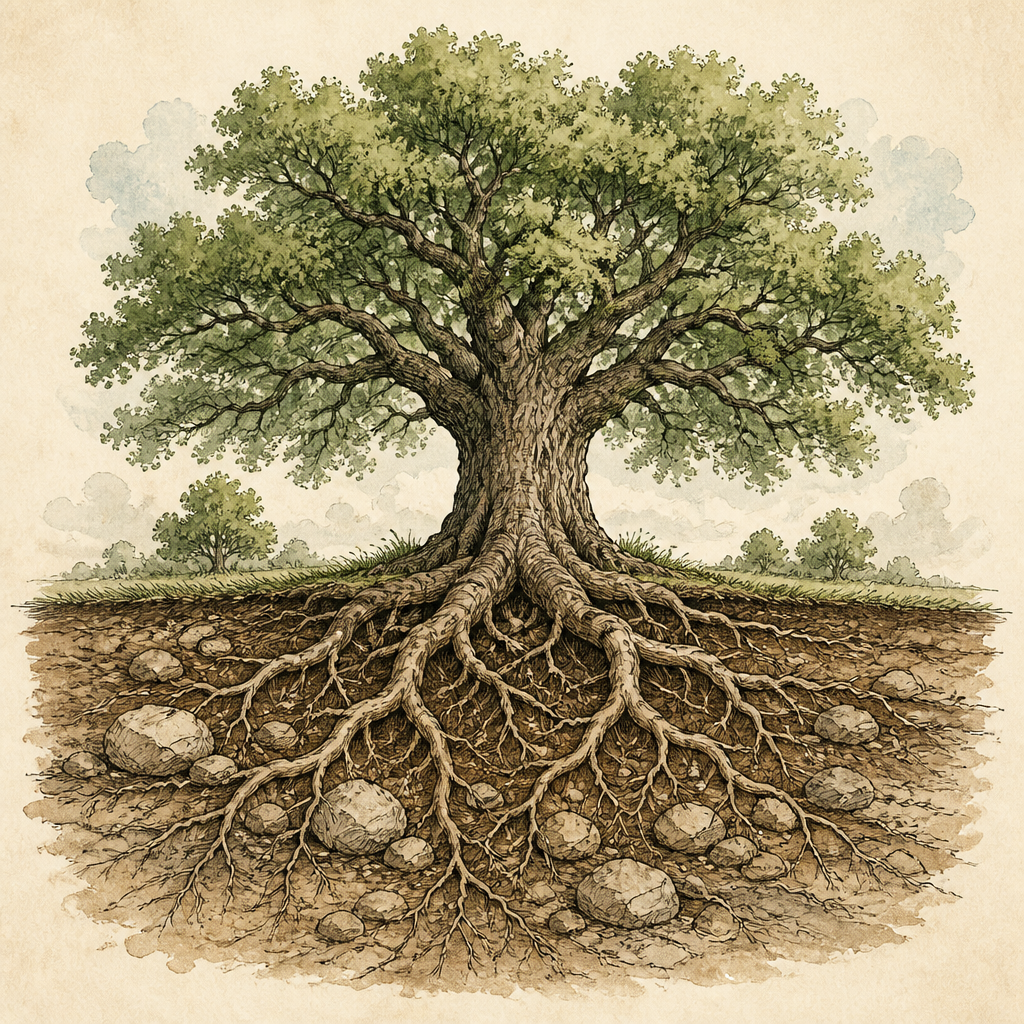
A tree falls fast. A forest takes decades.
This week the BBC gathered Afghan women to describe what five years of Taliban rule has done to their lives. "Unrecognisable" was the word used. NPR added the companion fact: it is not only girls' education that has been gutted, but boys' too, since an education system starved of teachers, funding, and purpose cannot selectively rot.
Five years. That is how long it took to cut down what generations had planted — schools, courts, newsrooms, the quiet civic habits that let a plumber trust a judge and a mother trust a midwife. An oak takes fifty years to become itself and an afternoon with a chainsaw to become firewood. Authoritarian rule is always, at its core, a chainsaw pretending to be a gardener.
The news cycle wants a different tree
Here is the trap: the news cycle rewards the chainsaw and forgets the oak. A dramatic seizure of power is a headline. The slow, unglamorous work of an election commission counting ballots correctly, or a parliament holding a hearing about a mismanaged aircraft carrier, is not. And yet the second kind of story is the one that actually protects people, year after unremarked year.
Consider, from this same week's list, the American senators asking pointed questions about conditions aboard the USS Lincoln. Nobody will make a documentary about a Senate oversight hearing. But that is precisely the mechanism — boring, procedural, replicable — that keeps a democracy's military accountable to its citizens rather than to a single office. It is a root system doing its unglamorous job underground.
Zambia's ghost, and what haunting actually means
Zambia's election, reportedly haunted by the shadow of the incumbent's old rival, offers a different lesson. Ghosts only haunt houses that are still standing. A country whose institutions can be haunted by history is a country whose institutions have enough continuity to carry memory at all. Compare that to Afghanistan, where five years was long enough to erase not just a rival but the very idea that political memory might matter, because there is no longer an open forum in which memory can be argued over.
Haunting is, paradoxically, a sign of institutional health. The alternative — total forgetting, imposed from above — is what dictatorship actually offers, and it should never be mistaken for peace.
So what should the reader carry past the headline?
Here is the case for patience, argued plainly: rebuilding what the Taliban destroyed will not happen through outrage cycles, however justified the outrage. It will happen, if it happens, through decades of quiet accumulation — teacher training programs re-started twice after being shut down, court systems rebuilt by people willing to work in obscurity, diaspora networks that keep sending resources long after the story has left the front page. None of that photographs well. All of it is what actually regrows an oak.
The same logic applies closer to home. When a democracy's oversight committee spends a tedious afternoon on procurement failures or ship conditions, that tedium is the price of not needing a revolution later. Bureaucracy that catches problems early is cheaper, in every sense, than the crisis it prevents — provided it stays proportionate and does not become an oak so thick with red tape it can no longer bend in the wind.
A modest, unfashionable conclusion
Readers of daily news are trained to expect resolution within the news cycle: a verdict, a ceasefire, a result. Institutions do not work that way, and pretending they do is how impatient societies talk themselves into shortcuts — a strongman here, a suspended parliament there — that promise fast growth and deliver, at best, fast-growing weeds.
The wiser stance is unglamorous: fund the hearing, fund the schoolteacher, fund the election monitor, and measure success in years the way an arborist does, not in headlines the way a newsroom must. An oak does not ask to be watched. It asks to be left standing long enough to grow.