A Handshake Is Not a Treaty
Somewhere today, cameras caught Donald Trump shaking hands with Vladimir Putin and Xi Jinping ahead of what is being called a historic meeting in China. The word "historic" arrived before the meeting did. That is worth noticing.
A photograph of three men gripping hands is a fact. What it means is not yet a fact — it is a claim, offered with great confidence, asking to be believed on sight. Common sense's only job here is modest: ask one more question before applauding.
What, specifically, was agreed? In what document? Enforced by whom? A handshake can precede a ceasefire or precede nothing at all except better lighting for three men who each have reasons to look indispensable at once.
The Gap Between the Stage and the Street
While the summit stage was being built, Kuwait says it repelled an Iranian attack — the first in two months, arriving only after US strikes on an island. Grand tableaux of world leaders do not automatically reach the places where small wars still simmer. The photograph promises order; the headline next to it shows the order hasn't landed yet.
This is not cynicism. It is arithmetic. Three handshakes do not divide evenly among the world's unresolved quarrels. If the summit produces a verifiable step — a named mechanism, a date, an inspector — common sense will say so plainly. Until then, the wise reader holds the applause and keeps the question.
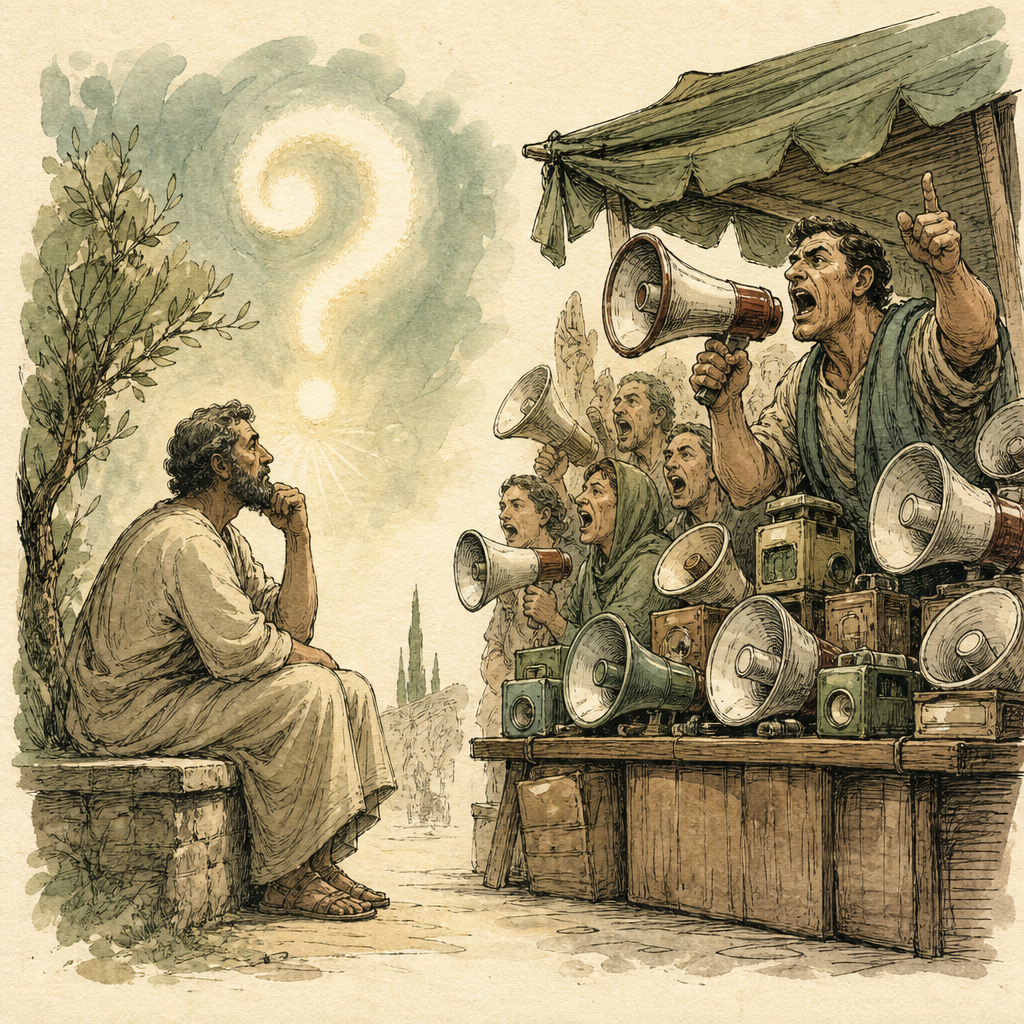
Certainty Sold at Other Counters
The same instinct belongs at smaller stalls. Ghana's government bought a $60 million presidential jet and is discovering, loudly, that citizens are not required to accept the sales pitch of necessary grandeur. Good. A public that asks "necessary for what?" is a public still awake.
Five EU states now propose migration "return hubs" in Rwanda, offered with the confident tone of a solved problem. Maybe it is workable; maybe it merely exports the hard questions somewhere less visible. Either way, the proposal deserves the same one more question every confident plan deserves: who checks on the people once they arrive, and who checks on the checkers?
And then there is the quieter, more troubling item: fears that sanctions may fall on judges of the International Court of Justice ahead of a genocide ruling on Myanmar. This is certainty's ugliest trick — not answering the question, but removing the body whose entire function is to ask it. A democracy that respects itself protects the referees even when it dislikes the score.
The Discipline of Not Being Impressed Too Quickly
None of this means doubting everything equally, as if scepticism itself were a virtue. A court doing its slow, unglamorous work of asking evidence-based questions deserves more trust than a stage-managed handshake photographed for maximum effect. Common sense is not neutral between the two — it simply insists both be tested the same way: show your work.
That discipline is unglamorous. It will never trend as fast as a photograph of three powerful men agreeing to agree. But it is the only habit that has ever reliably told the difference between a peace and a pause, between a policy and a postcard.
A Small Correction, Far From the Cameras
In a Berlin square, children play near a statue an artist built decades ago to simply watch over them — no summit, no press pool, no claim to have solved anything. It has outlasted several men who were certain they had.
That is the quiet standard worth keeping this week: not the loudest stall with the shiniest answer, but the patient figure that asks nothing, promises nothing, and is still standing when the ink on the grander claims has long since faded.