A plane, a threat, a story
Somewhere between Brussels and Washington this week, a president changed planes. He said it was because of a possible threat tied to the Iran conflict. He confirmed it himself, which is its own kind of announcement — not a leak, not a whisper, but a headline volunteered.
There is nothing wrong with taking a threat seriously. Heads of state have security details for exactly this reason. But notice the shape of the story: danger is named, personal stakes are implied, the public is invited to feel the weight of it — and no evidence is offered beyond the telling. It is theatre with a real backdrop. That does not make the threat false. It makes the telling worth watching.
Why does this matter for a Wednesday in August, and not just for security briefings? Because the habit of turning danger into a personal narrative — I was the target, I outwitted it — is one of the oldest tools in the authoritarian toolbox. It does not require a coup. It only requires a public that has learned to measure politics by the leader's peril rather than by the citizen's institutions.
Small habits, not yet a system
On the same news day, a court approved ending temporary protected status for people from South Sudan living in the United States — a country still recovering from war. And an extradition fight over a man once known mainly for online misogyny is now, reportedly, a test of influence inside the same administration.
None of these three things — the plane, the ruling, the extradition leverage — is a dictatorship. Say that plainly, because exaggeration is its own kind of dishonesty. But look at what they share. Each moves power a little further from scrutiny and a little closer to personal discretion. A dramatic security story that centers the leader. A legal protection withdrawn through procedure rather than public debate. A question of whether closeness to power can soften consequences.
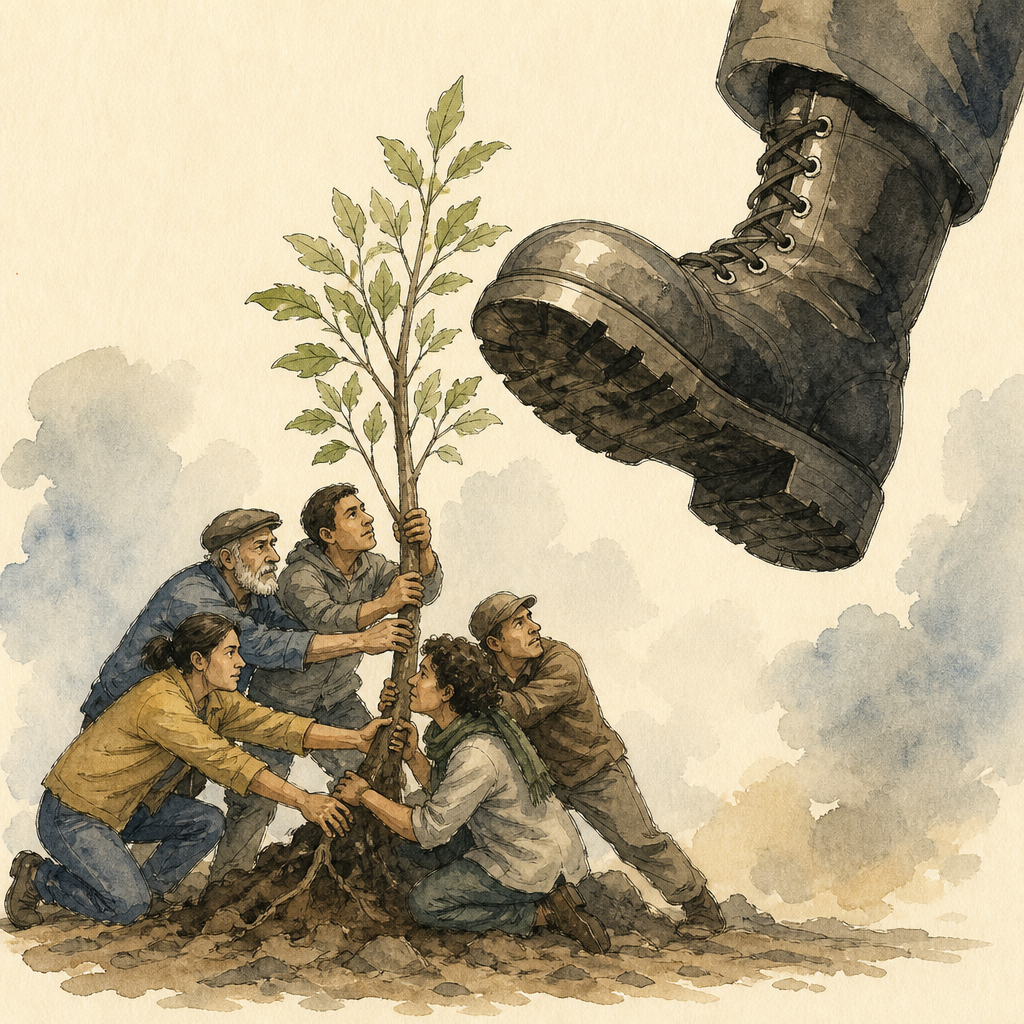
These are habits. Habits are dangerous precisely because they do not announce themselves as danger. Nobody in a healthy democracy wakes up one morning to find tanks in the square. They wake up, year after year, to slightly more discretion for the top and slightly less accountability underneath — until one day the discretion is the system.
The courage to protest while it is still ordinary
Here is the uncomfortable but useful idea: the best time to object to a habit is while objecting is still an ordinary, unremarkable act — a letter to a representative, a question at a town hall, a court challenge, a journalist asking for the flight manifest instead of the anecdote. Not later, when objecting itself becomes the risky part.
This is why early courage looks so unglamorous. It rarely gets a headline. It is a judge asking for evidence rather than accepting a story. It is a newsroom asking who verified the threat, not just who told it. It is citizens who treat the withdrawal of protection for South Sudanese families as a policy to be argued over in public, not a technicality to be nodded through.
Skeptics will say: surely a plane swap and a court ruling are unrelated matters of routine governance, and connecting them is alarmist. Fair challenge. But the reply is simple — routine governance is exactly the terrain where habits are built or broken. If we only object to the dramatic, we train ourselves to overlook the procedural. Dictatorship rarely announces itself; it accumulates.
The stance
So: notice the story of the swapped plane, and ask for more than the telling. Notice the quiet ruling, and ask who argued the other side in public before it was decided. Notice who gets leverage because of who they know, and ask whether that leverage would survive daylight.
This is not paranoia. It is maintenance — the small, dull, necessary work of keeping power accountable while accountability is still cheap. Protest while protest is ordinary. That is the whole art of staying free.