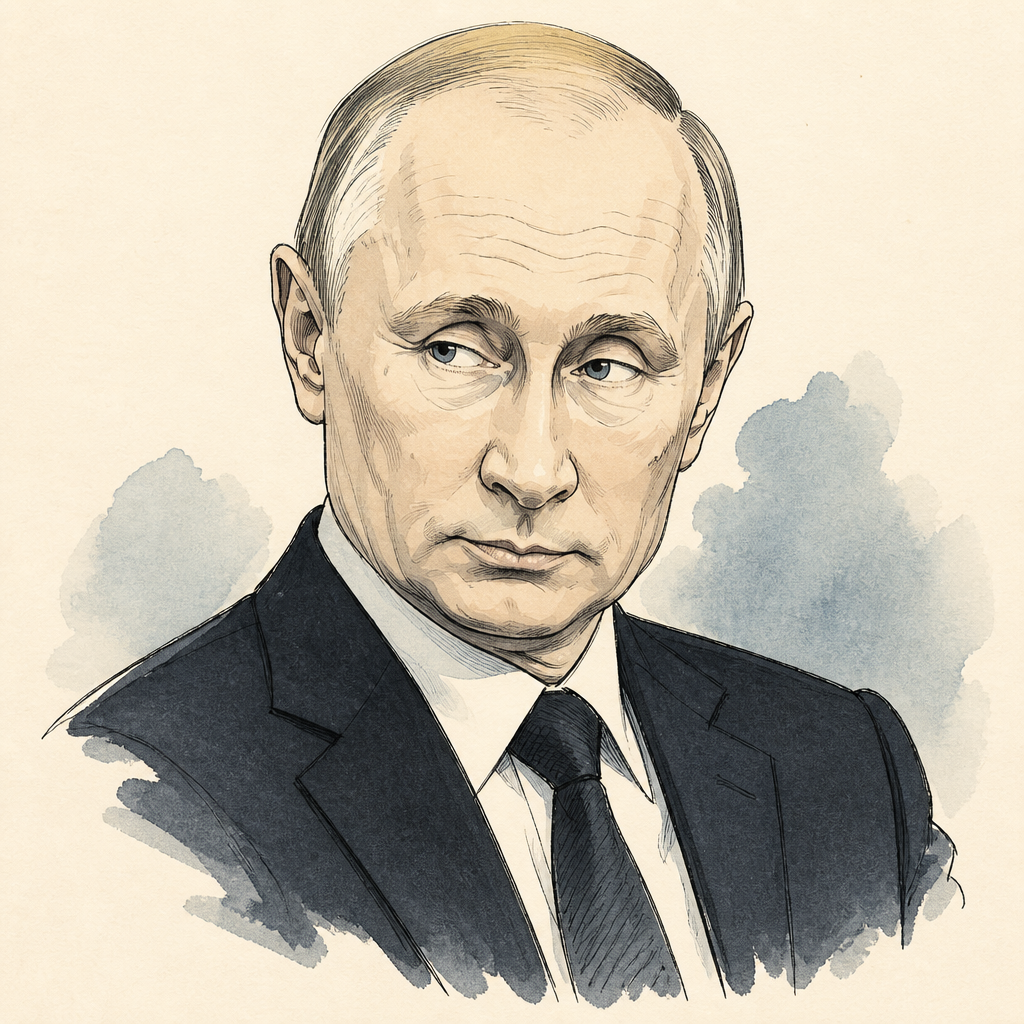
A ranking nobody wants to make
There is a lazy parlor game the free world plays with its authoritarians: who is worse, who is scarier, who should we worry about first. Xi Jinping's courts hand down a life sentence to a fallen property tycoon and a national-security verdict to Tiananmen-era activists in Hong Kong. Pyongyang fires another missile toward the sea, as it does. Washington threatens Tehran with what headline writers call an "economic D-Day." The game invites us to treat these as interchangeable villains on a scoreboard.
They are not interchangeable. And the honest answer to who I fear most is not a difficult one, even if it is an uncomfortable one to say plainly: Vladimir Putin.
Not because of who he is — because of what he has already done
This is not a character judgment, the kind irony usually prefers to needling questions rather than declarations. It is a capability judgment. Xi rules through bureaucracy, courts, and patient control — a system built to preserve stability at home, however harshly. North Korea rattles a missile toward the sea as ritual, a small state performing relevance. Iran manages, under pressure, a regional strategy of proxies and patience.
Putin is different in one specific way worth naming without flinching: he has already shown, over years now, that he will trade his own soldiers' lives for territory at a scale and duration most planners thought impossible in this century. That is not a threat. It is a demonstrated fact, already priced into how the world plans.
And the wars of this moment, as this week's commentary on interconnected conflicts reminds us, are not separate stories filed under separate countries. North Korea's missiles, Iran's drones, Moscow's war — these threads have been visibly braided together for years now, each regime lending the others capability, cover, or customers. A ledger of shared risk, not four unrelated headlines.
Why this fear is useful, not paralyzing
A reader could reasonably object: naming one man as the chief danger flatters him, feeds the personality cult the strongman craves. Fair. But there is a difference between flattery and clear-eyed assessment. Doctors do not flatter a tumor by naming it the largest one on the scan.
The useful fear is specific, not diffuse. Diffuse fear produces paralysis or, worse, cynicism — the shrug that says all systems are corrupt, so why bother defending any of them. Specific fear produces policy: sustained defence spending among democracies (not glorification of war, but insurance against the one actor who has shown he will use it), continued condemnation of land grabs and settlement projects wherever they occur, and — crucially — refusing to let connected authoritarian wars be treated as isolated news items competing for attention against debt figures and helicopter crashes and El Niño forecasts.
The comfort of watching courts instead of tanks
There is something almost reassuring, in a grim way, about authoritarianism that still bothers to use a courtroom — Hong Kong's national-security trial, Evergrande's life sentence. A regime that still performs legal process, however hollow, is telling you something about the limits it still fears crossing. A regime that has already crossed the largest limit — invasion, years of grinding attrition, casual talk of the nuclear threshold — has told you something scarier: that it has run out of limits to perform.
What wisdom asks of us
Democracies are good at debating debt ceilings, census numbers, and which ally should host which detainees. These arguments matter, and free societies should keep having them loudly, because the alternative — silence — is the first habit of the very authoritarianism this newspaper asks readers to notice early.
But clarity means admitting there is one actor on today's board who has already answered, by action rather than rhetoric, the question every commentator keeps politely re-asking: what would you actually do? Wisdom is not equal fear for equal despots. It is naming the one who has already shown his hand, and building policy — and solidarity among free peoples — around that plain fact rather than around comfortable equivalence.