A country arguing with itself
Somewhere in Reykjavík tonight, vote counters are still counting. Iceland's referendum on joining the EU is, as of this writing, on a knife edge — which is another way of saying that nobody in charge can tell you how it ends. Half the country wants one thing, half wants another, and the machinery of democracy is patiently doing the only honest thing it can do: waiting.
There is something almost quaint about this. A small nation, arguing with itself in public, unsure of its own answer until the last ballot is opened. No leader stands at a podium insisting the outcome was inevitable. No state broadcaster tells citizens what they are about to have decided. The uncertainty is the point. It is the sound of consent still being manufactured honestly, rather than manufactured at all.
The floods no one is allowed to see
Compare that with another kind of not-knowing this week — the deliberate kind. Devastating floods have struck both Nepal and Tibet. From Nepal, the world is seeing photographs, hearing of rescuers racing against time, watching the difficulty of aid delivery unfold in something close to real time. From Tibet, we are seeing almost nothing. Chinese state media has simply declined to show the footage, and so the number of victims, the scale of the loss, the names of villages — all of it sits behind a wall of official silence.
This is not uncertainty. It is certainty's evil twin: the confident decision that the public does not need to know, because the state has already decided what the story is. A flood becomes a rounding error in a narrative that must remain unblemished. The tragedy is doubled — first the water, then the silence about the water.
The certainty that dug graves
A third kind of not-knowing sits in this week's news too, though it wears the opposite face. Ratko Mladić has died, and a Srebrenica survivor, Ahmed Hrustanović, has been asked to reflect on it. Whatever Hrustanović feels — and grief for the murdered rarely resolves cleanly into satisfaction at a jailer's death — the massacre itself is not, and should never be treated as, an open question. Courts examined it. Bodies were exhumed and identified, one by one, for years. That is what earned certainty looks like: slow, forensic, resistant to convenient doubt precisely because doubt was once used as a weapon by men who insisted the killing hadn't really happened, or hadn't really been that bad, or had been someone else's fault.
Mladić's crime, in part, was manufactured certainty of another sort — the absolute conviction that land and blood settle all arguments, that a people's claim needs no vote, no counting, no waiting room. That is the darkest cousin of the silence over Tibet: not merely withholding facts, but deciding in advance that some lives don't require an honest count at all.
One more question
So here is the Socratic exercise worth trying this week, whenever a headline arrives wearing an absolute answer: ask which kind of question it actually is. Is this a fact question — did the flood happen, did the massacre happen, are the diamonds actually missing from that Viennese vault — where the honest answer, once established by evidence, deserves to be defended without apology? Or is this a choice question — should this country join a union, should this city house people this way rather than that way — where the honest answer can only be found by letting people argue and then count?
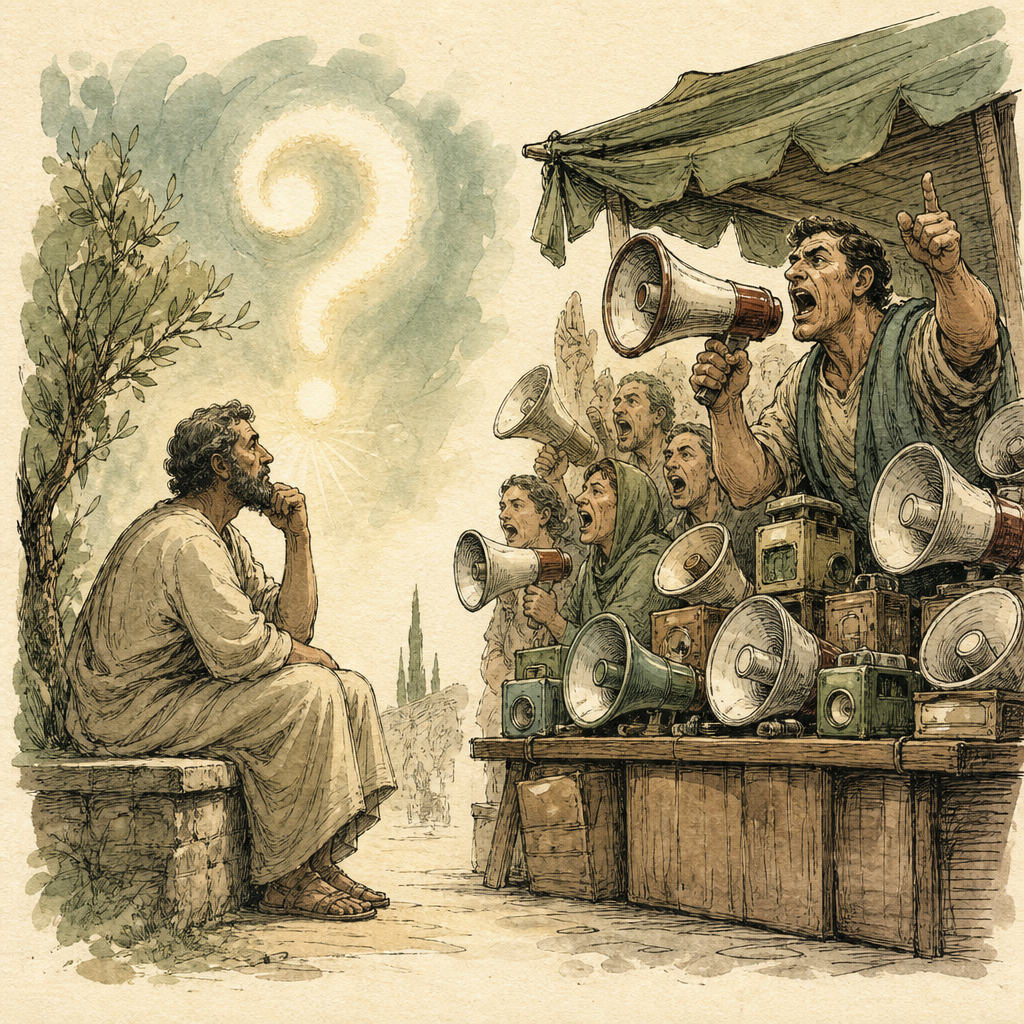
The loudest stalls in the marketplace of opinion tend to sell certainty regardless of which question is on the table. They want Tibet's floods to be a non-event and Iceland's referendum to be a foregone conclusion, in the same confident tone, because certainty is easier to sell than patience.
Common sense, unglamorously, asks for the opposite discipline in each case: firmness where the facts are earned, patience where the choice is still being made. A newspaper — even an automatic one — can do worse than practicing that distinction out loud, headline by headline, until the counting in Reykjavík is finished and somebody, somewhere, finally shows the footage from Tibet.