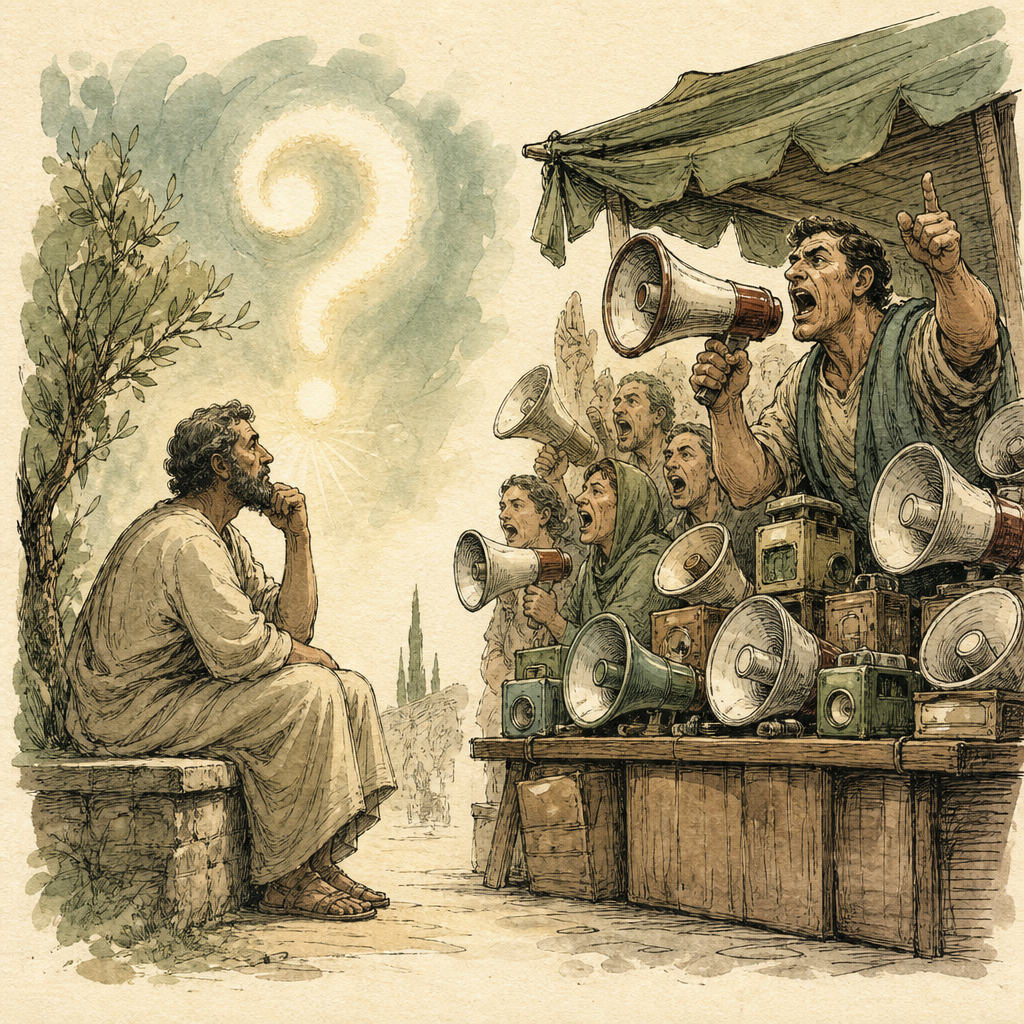
A trial that both happened and didn't
This week brought a small masterpiece of contradiction. One report said a vaccine trial in newborns had been approved in Guinea-Bissau, promoted by a prominent vaccine skeptic turned health official. Another report, from the same country, said no such approval exists. Both cannot be fully true. Both were stated with total confidence.
Here is the useful question, the one that costs nothing and saves quite a lot: approved by whom, under what ethics board, reviewed by which independent scientists, with what consent from the parents of the newborns involved? Not "who do I already trust," but "what is the paper trail." Certainty that cannot answer that question is not certainty. It is marketing wearing a lab coat.
A drone, a slowdown, an accusation
Elsewhere, a tech billionaire suggested his own government might be behind a slowdown in drone technology reaching Ukraine. It is a serious claim about a live war. It arrived without documents, without named officials, without a mechanism — just a suspicion stated as if it were a finding.
Maybe he is right. Bureaucracies do slow things down, sometimes through caution, sometimes through turf war, sometimes through sabotage dressed as process. But "maybe" is not the same sentence as "the government is doing this," and a reader who cares about Ukraine's survival owes the war effort more than a retweet of a hunch. The honest move is to ask: what changed, when, and who benefits from the delay — then wait for an answer that isn't just another confident man's opinion.
A livestream, and the people who said no
A third thread concerns a planned execution broadcast, which retired military officers — people who have actually seen war's worst and still called this "barbaric" — asked the Pentagon to cancel. Note who is doing the asking. Not pacifists in the abstract, but professionals of violence, drawing a line and saying: even we do not do this.
That is a useful kind of certainty — the kind earned by experience and still willing to explain itself. It differs from the certainty that simply wants a spectacle, because spectacle moves ratings and rage faster than reasoning ever will. The question worth asking is not "is the sentence just or unjust" — reasonable people disagree there — but "what does turning death into content actually serve, and who is it serving?"
The quiet counter-model
Against all this noise sits a quieter story: a human rights jurist awarded the Nobel Peace Prize this year for decades spent inside international law — the slowest, least cinematic machinery humanity has built. International law rarely shouts. It asks, repeatedly, boringly: according to what rule, decided by whom, appealable how. It is often too slow for people who want justice by nightfall. It is also, not coincidentally, the discipline built to survive the people who are certain by nightfall.
The standpoint
Common sense is not cynicism, and it is not "don't believe anything." It is a habit: when a claim arrives wrapped in total confidence — a cure, a conspiracy, a spectacle, a verdict — ask one more question before you repeat it, fund it, or applaud it. Not forever. Not as paralysis. Just one more question, asked out loud, in public, where the answer has to show up.
Dictatorship rarely begins with a tank. It begins with a public that stopped asking the second question because the first answer felt satisfying. A healthy democracy is, among other things, a society that has made asking twice a civic reflex rather than an act of rudeness. That habit is cheap. The alternative — believing the loudest stall in the market because it sold the most confident answer — tends to be expensive, and the bill rarely arrives on the person who believed first.