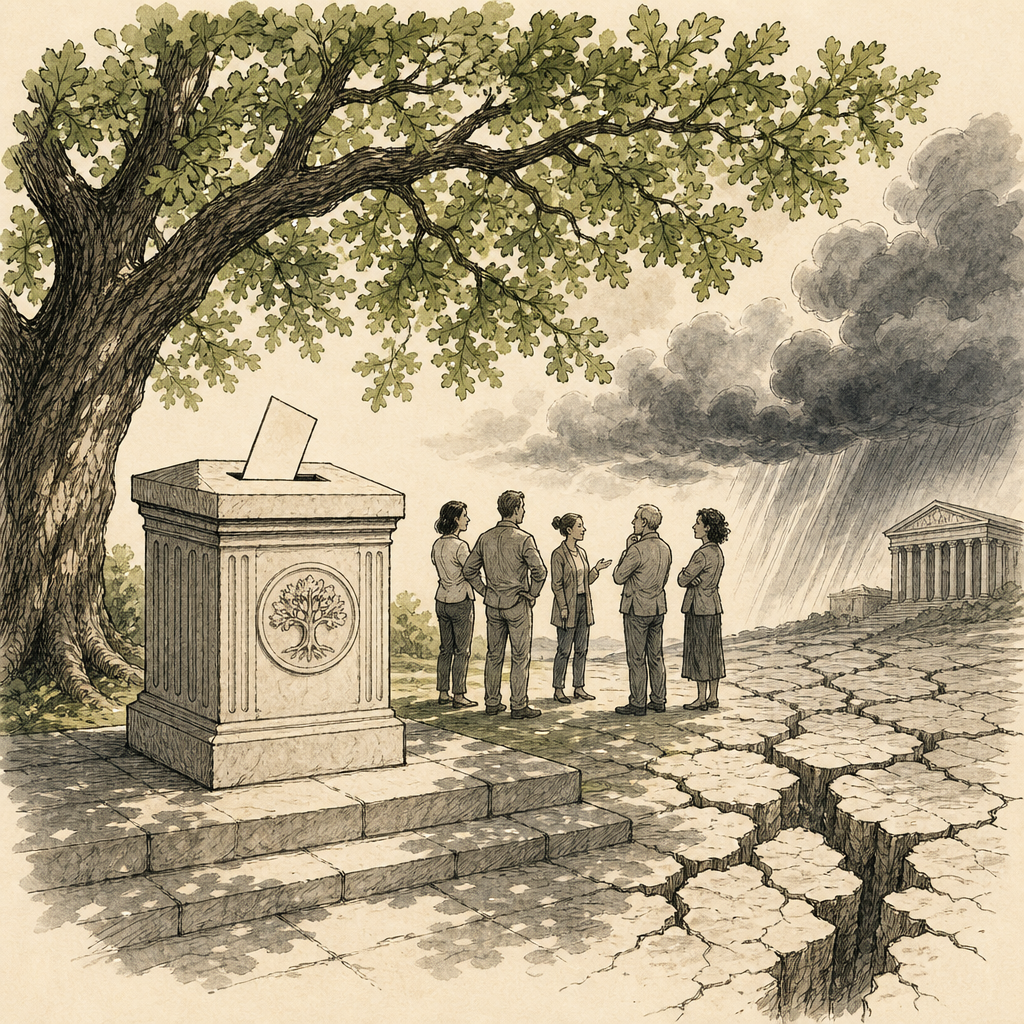
A motion fails, and nothing visible breaks
This week the US House declined, for now, to impeach its Defence Secretary. Nothing collapsed. No tanks rolled. The Republic, as always, kept functioning exactly as it had the day before. That is precisely the point worth sitting with for a moment.
Democracies rarely fall in a single dramatic vote. They fall in the accumulation of votes that quietly don't happen — the oversight hearing postponed, the subpoena unanswered, the question nobody insists on finishing. A blocked impeachment "for now" is not a crisis. It is a data point. The honest question is not whether this one vote matters, but what pattern it belongs to.
The review nobody showed up to
Alongside that vote sits a smaller, quieter fact: for a second year running, the United States has boycotted its own turn before the UN's human rights review. One can argue, fairly, that the UN's record on even-handedness is imperfect — plenty of governments with worse records sit comfortably on its panels. That critique has merit.
But notice the logic being modeled either way: an institution built to let every member state answer uncomfortable questions in public, and a powerful democracy choosing, twice, simply not to attend. Scrutiny declined is not scrutiny defeated. It just moves the uncomfortable questions somewhere less visible — to editorial desks like this one, to allies' private conversations, to history's eventual accounting. Citizens of any democracy might reasonably ask: if our own government won't answer in the room built for answering, where exactly will it answer?
What unaccountable power looks like when it finishes growing
For contrast, consider two items further down this week's list. North Korea's ruling family is reportedly cultivating an heir — defectors describe a dynasty treated by its own propaganda as something closer to divine than political. And in Kenya, a doomsday sect leader has just been sentenced for the deaths of nearly two hundred children who trusted him completely, with no outside institution positioned to check him until it was far too late.
These two stories sit at opposite ends of scale — one a state, one a cult — but they share a single engineering flaw: no functioning mechanism existed to ask "why" out loud, early, and expect an answer. That is what unaccountable power looks like once it has finished growing. It does not look like tyranny on day one. It looks, on day one, like a vote that simply doesn't happen.
Why noticing early is not paranoia but maintenance
Here is the case, plainly: democracies are not maintained by applauding them when they work. They are maintained by noticing, in real time, the small moments when accountability is optional rather than automatic — a hearing skipped, a review declined, an oversight question tabled "for now." None of these moments is a catastrophe. All of them are rehearsals.
The useful response is neither panic nor shrug. It is the unglamorous work of a free press that keeps counting the absences, courts that keep hearing the cases nobody finds convenient, and citizens who keep asking the boring, necessary question: did the institution that was supposed to check this power actually check it, or did it just decline, politely, to look?
A strongman rarely announces himself. He arrives disguised as efficiency, as patriotism, as a vote postponed for practical reasons. The antidote was never outrage on command. It is attention sustained past the point where the story stops being new — which is, come to think of it, rather exactly what this newspaper is for.