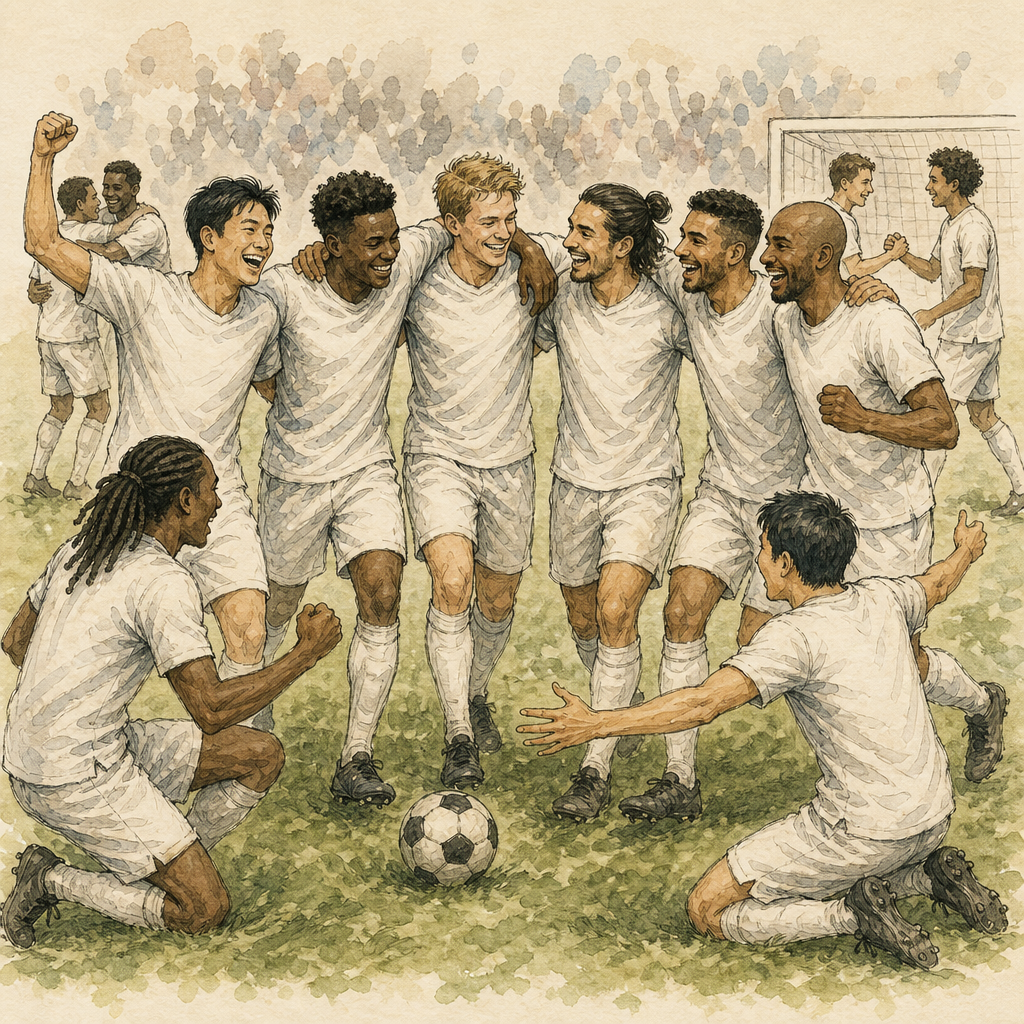
A Game With One Rulebook
Football has an unglamorous secret. Eleven players in one shirt, eleven in another, and a stranger with a whistle whose word is final even when it is wrong. Nobody gets a personal offside line. Nobody gets to bring their own ball when they are losing. The genius of the game is not the goals. It is that everyone agreed, in advance, to lose by the same rules they hoped to win by.
This week's headlines read like a league table of countries forgetting that trick.
When the Center Can't Find Its Shirt
In Germany, the political center is reportedly fighting for relevance as gains pile up on the far right and the far left. Fighting for relevance is a strange position for a center to be in — centers are supposed to be where the field is, not a faction competing for a corner of it. A healthy democracy's "center" is not a party. It is the shared pitch: the constitution, the courts, the habit of losing an election and showing up to play the next one anyway. When that pitch itself becomes just another team jersey, something has gone wrong well before any single vote.
In France, students and riot police are reportedly clashing over education protests. Protest is not the problem — a free country should always have room for citizens to make noise about schools and futures. The Socratic question is narrower: are both sides still playing on the same pitch, under rules both accept, or has one side started treating the whistle as an enemy uniform?
Crime as Campaign, Not Contest
Brazil's presidential rematch is reportedly being fought substantially on the question of crime — who will be tougher, harder, more decisive against it. Toughness sells. But a useful test for any democracy is whether candidates are still competing to govern the same country for everyone, or campaigning to govern their own supporters against everyone else's fear. Football teams that start seeing opponents as enemies rather than rivals do not get better matches. They get brawls, and eventually they get banned stadiums.
Whose Jersey Is the Past Wearing?
Then there is Cairo, where a mural depicting Tutankhamun and Nefertiti with dark skin has set off a row about ancestry and ownership of history. It is an old argument wearing new paint: who gets to claim the team photo of the past? The honest answer is usually the least satisfying one — history, like a mixed national squad, rarely belongs to only one bloodline or one grievance. The healthier question isn't who owns the mural, but whether a society can disagree about it loudly, in public, without anyone reaching for a court order to silence the other side. That, too, is a rule of the game: argue hard, argue openly, don't foul the referee of open debate.
Why the Metaphor Still Works
International football has spent decades quietly rehearsing something harder than winning: losing without hating, celebrating without humiliating, fielding squads built from a dozen origins under one crest. It works not because players love each other, but because the rules are fixed, visible, and applied the same way to the favourite and the underdog alike. Rivalry survives. Hatred, mostly, does not — because hatred has nowhere to stand once the whistle outranks it.
The Standpoint
Democracies would do well to borrow the discipline, not the metaphor alone. Centrist parties should defend the shared pitch rather than compete to own it. Protesters and police both answer, ultimately, to rules neither invented on the spot. Candidates should campaign to lead a whole country, not to field a team against half of it. And societies arguing over murals, migration, or monuments should keep the argument in the open stadium of free speech, not move it to a back room where only one side holds the whistle.
The final score in any one match matters less than whether both teams show up for the next one, still agreeing on the rules. That agreement, not the trophy, is the actual prize.