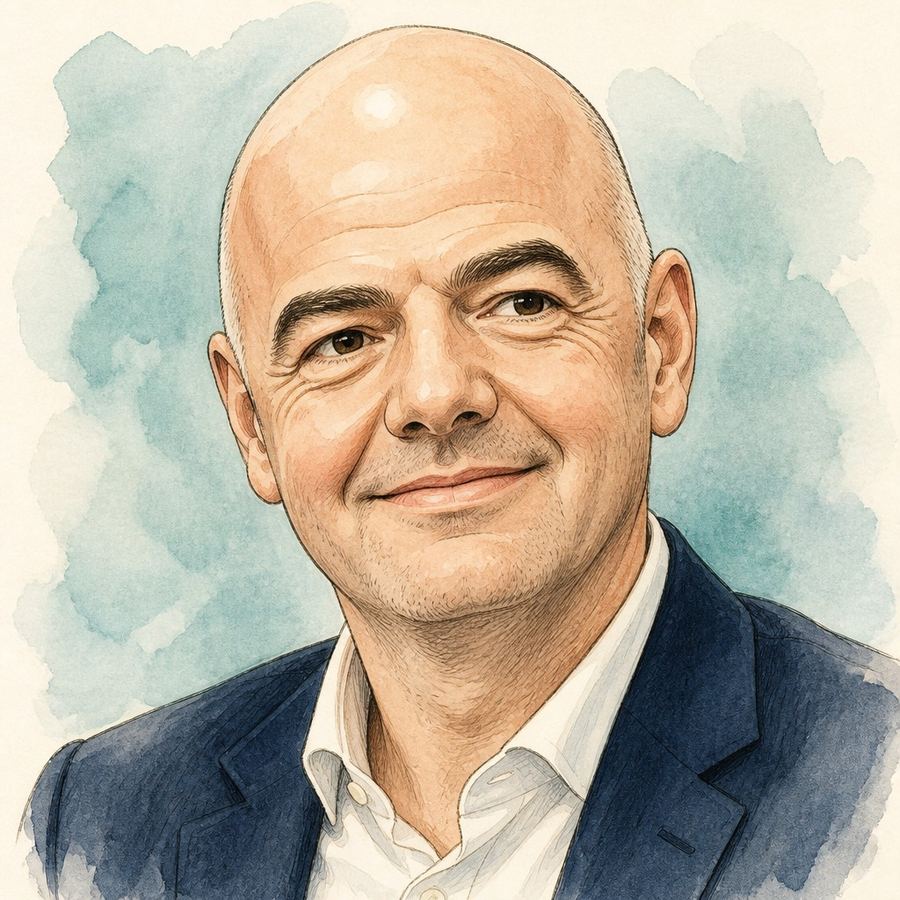
A Sunday of Ballots and Barrages
Today Germans go to the polls to decide whether Friedrich Merz keeps his job. The outcome is not fixed in advance. Coalitions may shift, tempers may fray, and by Monday morning someone in Berlin will owe someone else an apology. This is what a functioning democracy looks like: mildly chaotic, genuinely uncertain, occasionally boring — and all the better for it.
Elsewhere the news is louder. Hundreds of drones reportedly crossed toward Moscow overnight. Saudi Arabia says it intercepted missiles fired from Yemen toward its capital. France, Poland and other allies warn of Russian hybrid pressure creeping across Europe's edges. It is a day, in other words, when the difference between a country that counts votes and a country that counts casualties feels unusually vivid.
A Parliament With No Opposition
Against that backdrop, consider a much quieter institution that likes to describe itself in almost governmental language: FIFA, the world's football federation, with 211 member associations — more than belong to the United Nations. Each one gets a vote in the FIFA Congress. On paper, it is one of the largest and most inclusive democracies on Earth.
In practice, its congresses have a habit of producing results Germany's election night will not: landslides of near-total unanimity, presidents re-elected essentially unopposed, and term limits that get discovered to be flexible exactly when the sitting president would otherwise have to leave. Gianni Infantino has governed football's global body since 2016, and each renewal has looked less like a contest and more like a coronation with paperwork.
None of this required fraud. It required something quieter and more familiar: small federations who depend on FIFA's development funds learning that a dissenting vote rarely pays, while a loyal one sometimes does. The structure is democratic. The habit is not.
Monuments, Ammunition, and Whose Trophy This Is
This week's headlines offer an accidental illustration of the pattern football's leadership seems drawn to. Donald Trump has announced that his planned triumphal arch will double as a military storage complex — a monument and an armory in one gesture, which is either efficient or revealing, depending on your taste in symbolism. Infantino has spent recent years photographed comfortably beside precisely this kind of leader, and beside others like him, while FIFA's Congress in 2024 awarded the 2034 World Cup to Saudi Arabia, a kingdom currently on the receiving end of ballistic missiles aimed at its own capital.
None of this makes Saudi Arabia's football fans, players, or ordinary citizens the villains of the story — reciprocity applies to them too. But it does raise a plain question for the 210 other member federations: if the World Cup can be awarded to a single bidder in a process this smooth, in a country carrying this much geopolitical weight, what exactly was their vote for?
What a Real Vote Would Look Like
Here is the wager worth making. FIFA does not need a revolution. It needs its own members to start voting the way Germans are voting today — as though the outcome is genuinely open, as though a federation from a small country has as much standing to say no as a large one has to assume yes.
That means real term limits with no exceptions carved out for incumbents. It means hosting decisions weighed by independent human-rights review before the applause, not after. It means secret ballots that federations are not quietly discouraged from using freely.
Democracy is not proven by having a lot of voters. Communist congresses had plenty of those. It is proven by the plausible existence of a losing side — one that loses today and might plausibly win next time, the way Merz might lose tonight and gracefully hand over the keys.
Until FIFA's congress can produce a competitive election it did not orchestrate the outcome of in advance, it remains what it has been for some time: a democracy in its bylaws, and something considerably older in its habits.