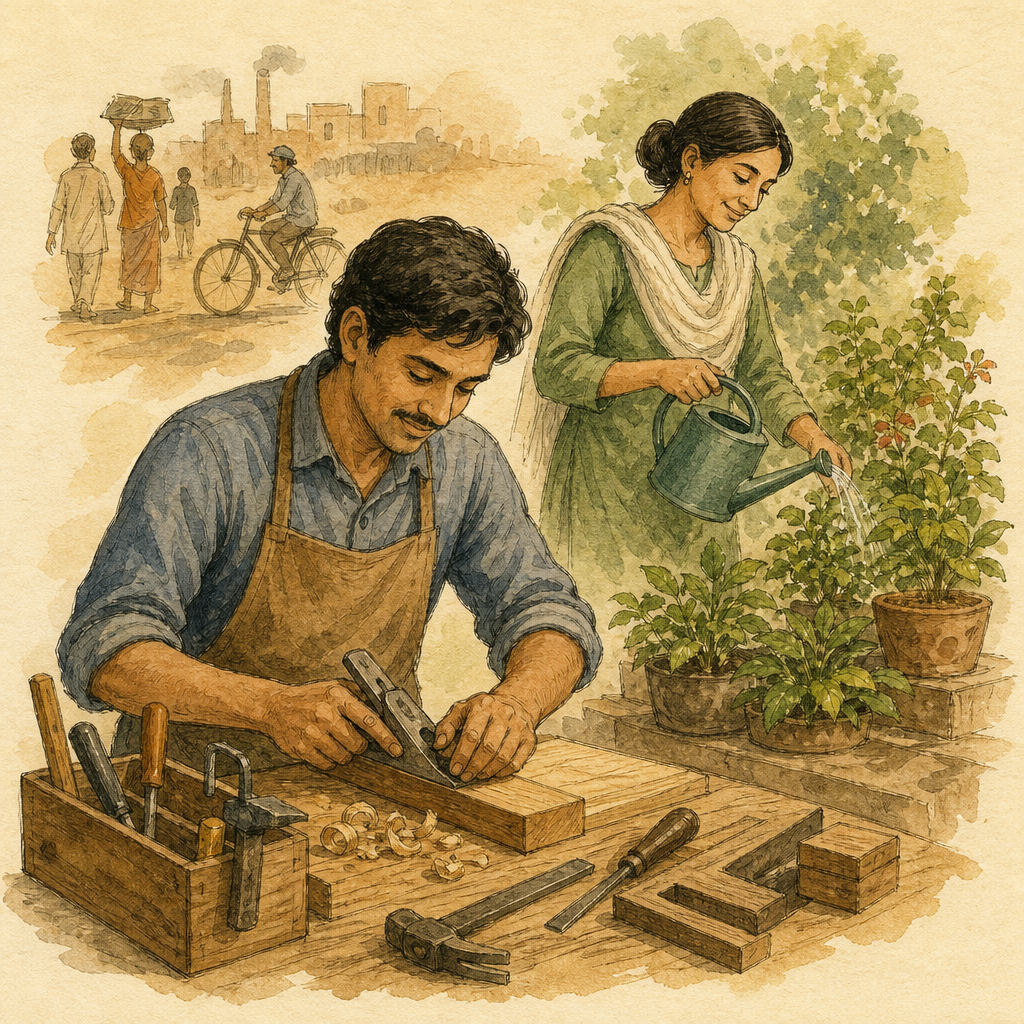
A Strange Kind of Ledger
Russia has, by its own figures, lost close to half a million people in the war on Ukraine. Read that number slowly. Half a million is not a battle; it is a town, a province, a generation of sons who will not come home to fix roofs, teach children, or argue about football at the kitchen table.
The state that sent them calls this duty. It calls it sacrifice for the motherland. It is worth asking, gently and without shouting: is this what contribution looks like? Or is it the opposite — the swallowing of contribution, the melting-down of a man's working life into a single, final, unrepeatable act?
Two Kinds of 'Doing Your Part'
There is a moral intuition, shared across cultures and creeds, that those who can work should work — that dignity comes partly from pulling your share of the common load. It is a good intuition. Idleness as an ideal corrodes a person as surely as it corrodes a society.
But that same intuition has a dark twin, and authoritarian systems love to borrow its clothing. They too speak of duty, of giving everything for the collective. The difference is simple, and it is everything: one system asks you to build, and lets you choose how; the other spends you, and does not ask.
A farmer, a nurse, a coder, a goalkeeper — each adds something that did not exist before and still exists after they stop. A soldier conscripted into a war of conquest adds nothing that the war required; he is consumed by it. That is not neighbourliness scaled up to the size of a nation. It is extraction wearing the mask of virtue.
The Same Pattern, Smaller Print
Leaked data this week describes something similar on a smaller stage: Russian mercenaries dying by the hundreds to keep a junta in power in Mali, far from any border Russia needs to defend. Different country, same arithmetic — young men spent, not employed; a regime propped up, not a people served.
And the Guardian's account of a Ukrainian family divided by grief, a mother blaming the wrong side for a death that turned out to be more complicated than anyone's first story — that too belongs here. War does not just end the contributions of the dead. It poisons the judgment of the living, turns neighbours into suspects, turns mourning into propaganda's raw material.
Contribution, Done Right
Set beside all this, smaller stories carry a quiet rebuke. A sports court restores Senegal's Africa Cup title after Morocco's appeal fails — a dispute settled by rules, not by force, which is what contribution inside a shared order is supposed to look like. Engineers prepare to release close-up images of an asteroid deliberately struck to test whether humanity can defend itself — not against each other, but against a rock with no politics at all. That is work worth admiring: patient, cooperative, aimed outward at a problem everyone shares.
And Those Who Cannot
The principle cuts the other way too. A Sri Lankan asylum seeker sent by Britain to Eswatini took his own life rather than live in the limbo that followed. Whatever the legal arguments, a man who wanted only the ordinary chance to work and build a life was instead shuffled between jurisdictions until he saw no door left open. Dignity of work means nothing if the door to work is the first thing a system removes. Compassion for those who cannot yet contribute — the displaced, the waiting, the broken — is not a soft addendum to this value. It is the value, applied honestly.
The Standpoint
So here is a stance, not just a wink: contribution is a virtue only when the contributor still owns the choice. A government that drafts men into a war of aggression and calls it duty is not teaching the dignity of labour; it is strip-mining it. A government that locks a willing worker out of the economy through bureaucratic exile is committing the same theft from the other direction.
The measure of a decent society is not how loudly it praises sacrifice, but how many of its people get to spend their working lives building something that outlasts them — a bridge, a classroom, a match well played, an asteroid safely nudged off course. Watch which governments offer that, and which only ask for bodies. The difference is not subtle. It only asks to be noticed.